Mexico Markets: The IPC Index and the Peso — August 18, 2026
Key Facts
- Mexico’s S&P/BMV IPC fell 0.38% to 64,152, its third straight decline as global caution weighed on local stocks.
- The peso was steady at 17.0386 per dollar, up just 0.09% as the dollar index eased.
- América Móvil (AMXB) rose 1.0%, leading the most-traded names with $20 million in turnover.
- Grupo México (GMEXICOB) gained 0.9%, while airport operators GAP and ASUR each lost 0.8%.
- The IPC stands 10.4% below its 52-week high, with the index trading near the middle of its annual range.
Today’s Focus
Mexico’s benchmark stock index, the S&P/BMV IPC, closed down 0.38% at 64,152 points on Monday, tracking a cautious Wall Street session where the S&P 500 lost 0.52%.
The peso — Mexico’s currency — finished nearly flat at 17.0386 per US dollar, a gain of 0.09% that reflected a slightly softer dollar rather than any domestic catalyst.
Trading was selective: miners and América Móvil drew buyers, while banks, airports and consumer staples lagged.
What matters today. The IPC remains stuck in a defensive range, with global risk appetite, not local news, setting the tone.

01 The session in one read
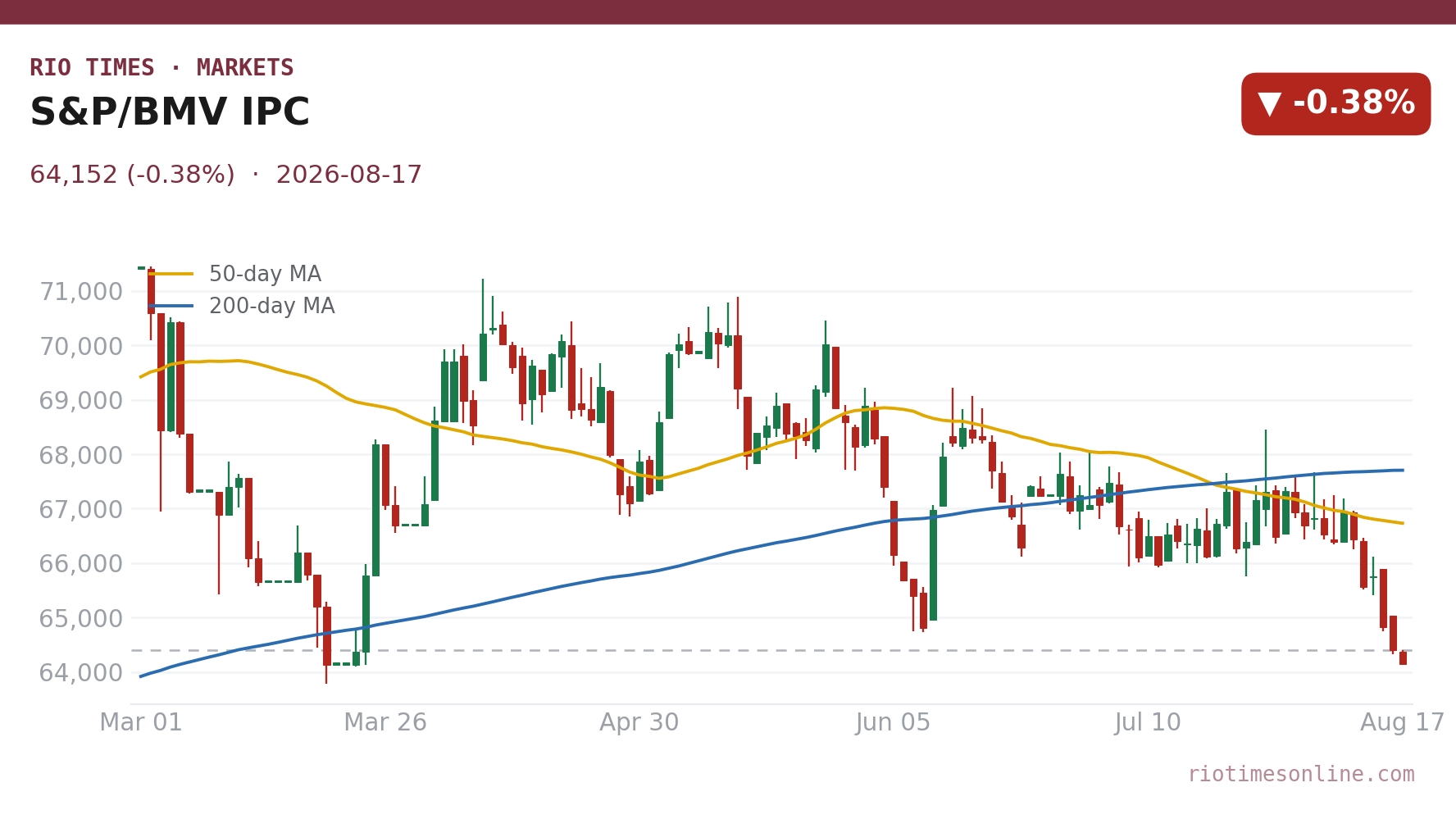
Mexico’s S&P/BMV IPC — the main stock index tracking the 35 largest and most liquid companies on the Bolsa Mexicana de Valores — closed Monday down 0.38% at 64,152 points.
The fall mirrored a modestly lower session in New York, where the S&P 500 lost 0.52% and the Dow Jones slipped 0.51%.
The peso, quoted as pesos per US dollar, finished at 17.0386, a marginal 0.09% strengthening on the day.
That tiny move kept the currency just off its 52-week high of 18.74, a level that now stands 9.1% away.
Trading felt defensive but not panicked: investors bought miners and América Móvil, while trimming banks, airport operators and consumer names like Walmex and Bimbo.
The session’s evidence points to a market without strong local conviction: turnover was thin, gains clustered in commodity-linked names, and losses spread across rate-sensitive and consumer-heavy sectors. The peso’s near-flat close against a weaker dollar suggests investors are comfortable with current levels but not chasing the currency. Watch whether the US 10-year yield — which rose to 4.726% — puts renewed pressure on Mexico’s rate-sensitive stocks in the next session.
02 The day’s numbers
| Measure | Level | Change | Read |
|---|---|---|---|
| S&P/BMV IPC | 64,152 | −0.38% | Mexico’s main stock index, down for the session |
| USD/MXN | 17.0386 | +0.09% | Peso steady, near its strongest since 2025 |
| S&P 500 | 7,745 | −0.52% | Wall Street fell, weighing on local tone |
| Dow Jones | 53,460 | −0.51% | US blue chips also lower |
| VIX | 15.19 | +6.60% | The ‘fear gauge’ rose, showing some caution |
| Gold | $4,398/oz | +0.51% | Safe-haven demand helped Mexican miners |
The IPC remains 10.4% below its 52-week high of 71,601, set when optimism about nearshoring and domestic consumption was stronger.
Its 52-week low of 58,633 is 9.4% below Monday’s close, meaning the index is trading near the middle of its annual range.
For foreign investors, the peso at 17.04 per dollar means the currency is 9.1% stronger than its weakest point of the past year. Rio Times · Live Market Intelligence
Live Market IntelligenceMexico — Live Market Board
Mexico — Live Market Board
Instrument Last Change YoY Prev. High Low Volume
IPC MEX
64,152.21
-0.38%
+12.17%
64,397.45
66,121
65,405
108,886,187
USD/MXN
17.06
-0.24%
-8.58%
17.10
17.08
17.01
—
WALMEX
48.07
-0.62%
-14.38%
48.37
48.65
48.02
10,781,446
GMEXICO
223.28
+0.35%
+73.59%
222.50
226.18
222.17
1,325,556
FEMSA
201.19
-0.24%
+25.67%
201.67
206.71
199.56
750,706
CEMEX
19.32
+0.89%
+19.10%
19.15
19.35
19.04
14,327,054
GFNORTE
193.98
+1.18%
+14.36%
191.71
195.79
191.83
1,579,115
BIMBO
60.98
-0.96%
+11.89%
61.57
61.46
60.29
1,048,115
TELEVISA
9.71
+0.21%
+12.78%
9.69
9.75
9.60
577,851
AMX
19.80
-0.95%
+12.53%
19.99
20.05
19.70
58,058,525
GAP
366.23
+0.43%
-21.21%
364.68
370.85
362.82
226,946
ASUR
275.04
+1.25%
-15.28%
271.64
275.08
271.31
15,451
OMA
233.50
+0.62%
-6.48%
232.06
235.00
230.62
555,693
KOF
188.04
+0.86%
+18.94%
186.44
188.56
185.52
425,273
GRUMA
252.90
+0.11%
-21.85%
252.61
254.74
250.36
90,048
KIMBER
39.74
+0.43%
+8.85%
39.57
40.09
39.33
490,551
AMX ADR
23.38
-0.23%
+22.25%
23.43
23.49
23.06
1,347,445
03 Why it moved — global caution, local selection
Monday’s decline in Mexico was not driven by any single domestic shock.
Instead, the IPC followed Wall Street lower after US stocks slipped, with the VIX volatility index jumping 6.6% to 15.19 — a signal that some investors were hedging against short-term risk.
The dollar index, or DXY — a measure of the US currency against a basket of major peers — fell 0.11%, which helped the peso stay firm even as stocks drifted.
Local media reported that the Bolsa had opened down 0.31% early in the session, with the close extending that soft tone.
Within the index, the divergence was telling: commodity exporters like Grupo México and Peñoles rose with gold and silver prices, while interest-rate-sensitive and consumer-facing names gave back ground.
This suggests investors were rotating into companies that benefit from higher metal prices and a weaker dollar, rather than making a broad bet on Mexican growth.
The performance fits the wider theme local outlets covered: a sluggish domestic economy, weak investment and productivity, plus fresh doubts about consumption momentum.
04 The day’s movers
| Driver | Level / Move | Change | Note |
|---|---|---|---|
| América Móvil (AMXB) | +1.0% | +1.0% | Most-traded gainer, $20m turnover |
| Grupo México (GMEXICOB) | +0.9% | +0.9% | Miner lifted by gold and copper |
| Peñoles (PE&OLES) | +1.0% | +1.0% | Silver miner, best large gainer |
| Cemex (CEMEXCPO) | +0.5% | +0.5% | Cement maker edged higher |
| Bimbo (BIMBOA) | −3.6% | −3.6% | Bread maker, biggest domestic loser |
| GAP (GAPB) | −0.8% | −0.8% | Airport operator slipped, $31m traded |
| ASUR (ASURB) | −0.8% | −0.8% | Airport operator also lower |
| Walmex (WALMEX) | −0.8% | −0.8% | Retailer fell amid consumption worries |
| Femsa (FEMSAUBD) | −0.8% | −0.8% | Beverage and retail group down |
| Banorte (GFNORTEO) | 0.0% | 0.0% | Bank flat, $24m traded |
The most-traded names tell the story of a selective session. América Móvil — the telecoms giant controlled by Carlos Slim — rose 1.0% on $20 million of turnover, making it one of the day’s brightest spots.
Miners were the clearest winners: Grupo México added 0.9% and Peñoles climbed 1.0% as gold rose 0.51% and silver jumped 1.24%.
On the losing side, Bimbo — the world’s largest bread maker — dropped 3.6%, the worst domestic fall, in a possible reflection of concerns about weak consumer spending.
Airport operators GAP and ASUR each lost 0.8%, suggesting investors were not keen on travel-linked names linked to consumer confidence.
Banks were mixed but heavy, with Banorte flat on $24 million in turnover, while Walmex — Mexico’s biggest retailer — slipped 0.8% as local media highlighted how few Mexican millennials can afford a home in the capital.
05 The regional scoreboard
| Index | Country | Change |
|---|---|---|
| S&P/BMV IPC | Mexico | −0.38% |
| Ibovespa | Brazil | −0.09% |
| S&P IPSA | Chile | +0.96% |
| S&P Merval | Argentina | −1.77% |
| MSCI COLCAP | Colombia | 0.00% |
| BVL Perú | Peru | +0.12% |
Latin America was a mixed bag on Monday. Chile’s IPSA — the Santiago stock benchmark — was the regional standout, up 0.96%, while Argentina’s Merval fell hard by 1.77%.
Brazil’s Ibovespa, the main São Paulo index, slipped a marginal 0.09%, and Colombia’s COLCAP finished flat.
The live market board above carries the latest closes for all regional indices, but the session picture suggests investors were differentiating by country risk rather than trading Latin America as a single bloc.
Mexico sat in the middle: not as weak as Argentina, but not enjoying Chile’s commodities-driven lift.
06 The technical picture
The S&P/BMV IPC at 64,152 sits 10.4% below its 52-week high of 71,601, a level reached during an earlier wave of nearshoring enthusiasm.
The index is trading above its 52-week low of 58,633, with the current level almost exactly mid-range for the year.
For chart-watchers, the immediate level to monitor is 64,000 — a round-number support that has held through recent sessions.
A break below that could open a path toward the 62,500 area, while a recovery above 65,000 would signal that buyers are willing to push the index back toward the upper half of its annual range.
The peso’s level of 17.0386 against the dollar is notable: it is just a whisker from the 17.02 area that marked the currency’s strongest point of the past 52 weeks.
If the dollar keeps softening — the DXY fell to 99.561 — the peso could test that high-water mark, which would matter for exporters and foreign investors converting earnings back into dollars.
07 What to watch
- US 10-year Treasury yield: It rose to 4.726%; further gains may pressure Mexican banks and consumer stocks that are sensitive to local rates.
- Peso’s 52-week high: At 17.02 per dollar, any move below this level could strengthen exporter earnings and alter investor positioning.
- Bimbo and consumer names: Monday’s 3.6% fall in Bimbo bears watching; it may signal deeper worries about Mexican household spending.
- Banxico intervention signals: With the peso near its strongest levels, any central bank comment on the exchange rate could shift the market quickly.
Background: Mexico’s Industrial Production Grew 1.7% in June, but the Half Was Flat.
Background: Mexico’s Foreign Direct Investment Climbs 10.4% as Nearshoring Holds Up.
Frequently Asked Questions
What is the S&P/BMV IPC?
It is Mexico’s main stock index, tracking the 35 largest and most liquid companies listed on the Bolsa Mexicana de Valores, the country’s stock exchange.
Why did Mexico’s stock market fall on August 17?
The IPC dropped 0.38% as investors took a cautious tone after Wall Street slipped, while local news highlighted a sluggish economy and weak consumer confidence.
How did the peso perform?
The peso was nearly flat at 17.0386 per US dollar, up 0.09%, as the dollar index eased. It stands about 0.1% stronger than its weakest level of the past year.
Which Mexican stocks moved the most?
América Móvil rose 1.0%, Grupo México gained 0.9%, and Peñoles added 1.0%, while Bimbo fell 3.6% and airport operators GAP and ASUR each lost 0.8%.
This article was produced by The Rio Times’ automated newsroom system. How we use AI · Report an error
In depth
LatAm Markets: Live Signals → — real-time movers, turnover leaders and FX across Latin America.
Read More from The Rio Times