
ECONOMY · URUGUAY
Key Facts
- —The country Uruguay, a small South American economy of about 3.4 million people between Brazil and Argentina, runs an inflation-targeting central bank with a 4.5% goal.
- —Why it matters Annual inflation is above the target centre for a second month, which raises the odds of a rate increase that would lift returns on peso assets.
- —Why now The central bank’s monetary policy committee meets on Thursday 8 October, with the policy rate at 5.75%.
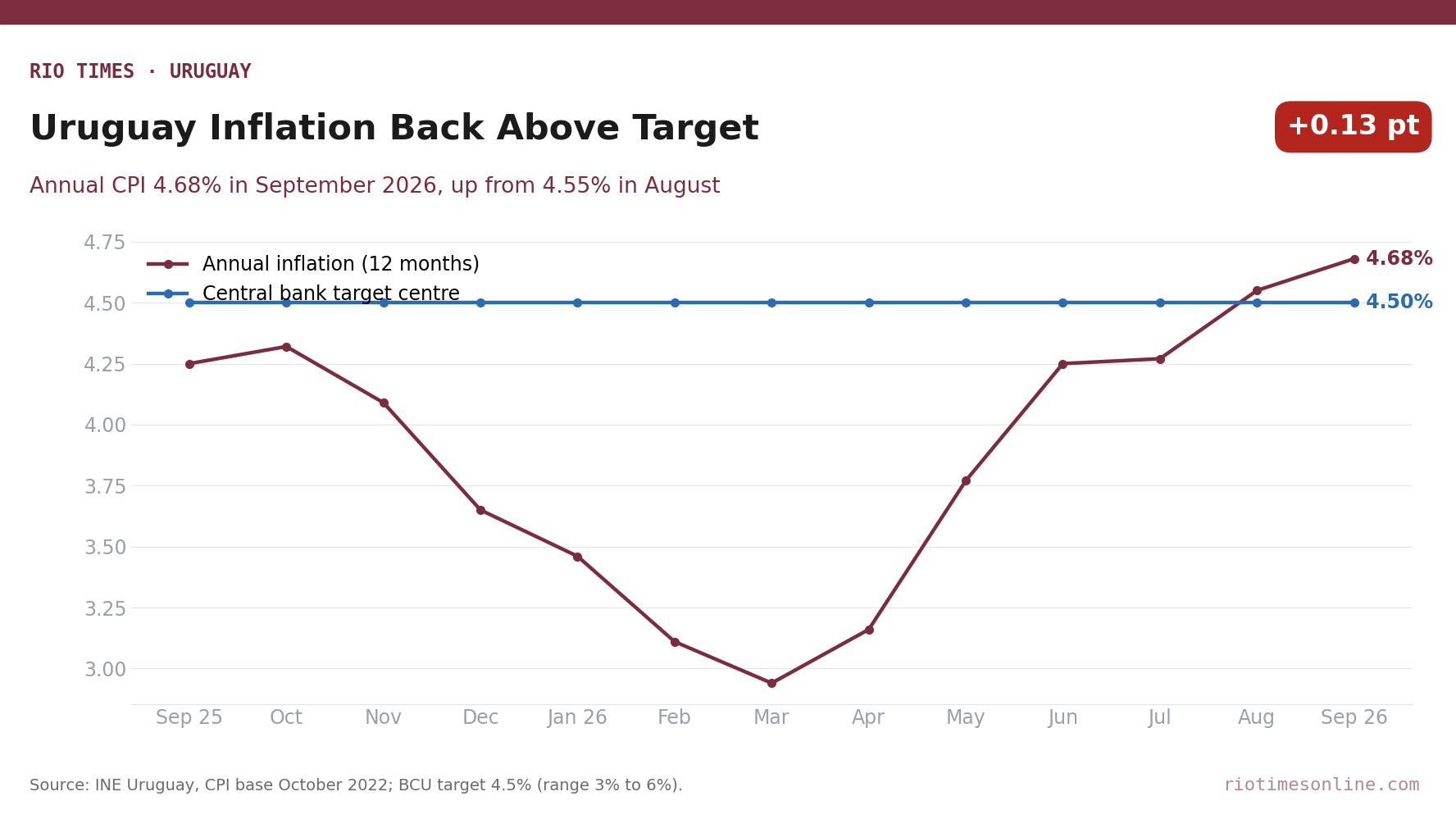
- —What happened On Monday 5 October the statistics office INE said consumer prices rose 0.54% in September, taking annual inflation to 4.68% from 4.55% in August.
- —The numbers Food and soft drinks rose 1.73% and supplied 0.45 of the 0.54 points. Vegetables jumped 5.27% and meat 2.43%. Analysts had expected 0.35% for the month.
- —What it means for you Groceries in Uruguay cost more than a year ago, while airfares fell. Peso savers and bond holders may soon earn a higher rate.
- —Still open Whether the central bank raises rates on Thursday, and how far October’s higher fuel prices push the next reading.
Uruguay inflation rose to 4.68% in the twelve months to September, the national statistics office INE reported on Monday 5 October. Prices climbed 0.54% in the month alone, driven by meat, fruit and vegetables. For US investors and Americans who live in or visit Uruguay, it matters because it could tip the central bank into a rate rise this week.
The Uruguay inflation reading is the second in a row above the 4.5% centre of the official target. It remains comfortably inside the tolerance range of 3% to 6%, so this is a drift rather than a breakout.
INE is the Instituto Nacional de Estadística, the government agency that compiles the consumer price index. Its September report shows prices up 4.21% since January, against 3.19% at the same point last year.
Food Drove Almost All of the Rise
Food and non-alcoholic drinks rose 1.73% in September. That one group supplied 0.45 percentage points of the 0.54-point monthly increase, according to INE.
Vegetables were the sharpest mover, up 5.27%. Tomatoes rose 48.86% and onions 25.45%, while courgettes fell 21.52% and potatoes 3.78%. Meat rose 2.43%, with increases across beef cuts, lamb and whole chickens. Pears rose 8.70%.
Transport pulled the other way, falling 0.54%. INE linked that to a 6.82% drop in ride services with a driver and a 5.29% fall in airfares. Fuel prices did not change during September, the Uruguayan outlet Nación reported.
Private health insurance fees rose 1.80% and car insurance 0.58%. University and tertiary tuition rose 1.67%.
The surprise was in the size of the monthly jump. Analysts surveyed by the central bank had expected 0.35% on average, Nación reported. The private research centre Cinve had forecast 0.33%.
Underlying Prices Are Also Firming
Volatile food items can swing back quickly, so economists tracking Uruguay inflation watch the core measures INE publishes alongside the headline. These also moved higher.
Inflation excluding fruit, vegetables and fuel reached 4.47% over twelve months. A narrower gauge that also strips out regulated and administered prices stood at 4.51%. Non-tradable goods and services, mostly local services, rose 5.80%. Tradable goods, which compete with imports, rose only 3.31%.
The trend is the real story. Annual Uruguay inflation fell to 2.94% in March, below the 3% floor of the target range, according to INE’s series. It has climbed every month since.
There is a stabiliser in that picture. The cheaper tradable basket shows that imported goods are not the main problem. Pressure is concentrated in food and local services, which the central bank can influence through rates and expectations.
A Rate Decision on Thursday
The Banco Central del Uruguay (BCU), the country’s central bank, sets policy through its Monetary Policy Committee, known as Copom. The committee is made up of the bank’s three board members and three senior officials.
Copom meets on Thursday 8 October at 10:00 local time, according to the BCU’s published calendar. The policy rate has stood at 5.75% since a cut in March, according to the BCU’s own statements.
Short-term central bank bills already price a 25 basis-point increase, Nación reported. The consultancy CPA Ferrere expects a hike this week and a gradual move towards at least 6.5% in 2027, El País reported.
CPA Ferrere partner Alfonso Capurro also said inflation could briefly pass 5% in early 2027. He expects it back at 4.5% by the end of that year. That is a forecast, not an official figure.
The BCU’s own survey of analysts sees Uruguay inflation at 4.71% by December, according to Nación. Business owners surveyed by INE expect 5.1%. Two-year expectations among analysts sit near the target, at 4.55%.
What It Means for You
Investors: a rate increase would lift yields on peso-denominated debt and deposits. That can support the peso, but it also slows an economy the IMF already expects to grow only modestly. See Uruguay Growth Forecast Cut to 1.3% by the IMF, Below the Government’s 1.6%.
Residents and retirees: the weekly shop is the pressure point, especially fresh produce and meat. Local services, the non-tradable basket, are up 5.80% on the year, faster than the headline.
Travellers: flights and ride services got cheaper in September. Fuel will not stay flat, because pump prices rose in October. See Uruguay Fuel Prices Rise 2% for Petrol, 7% for Diesel.
What Is Not Known
The BCU has not announced its decision, and a hold remains possible while inflation stays inside the range. How much of the vegetable spike reverses in October is unclear, since fresh produce often swings with weather and supply. The size of the fuel effect on October’s index will only be known when INE publishes it in early November.
What is Uruguay’s inflation rate now?
Annual inflation was 4.68% in September 2026, up from 4.55% in August, according to the statistics office INE. Prices rose 0.54% in the month.
What is the central bank’s inflation target?
The Banco Central del Uruguay targets 4.5% inflation, with a tolerance range of 3% to 6%. September’s reading is above the centre but inside the range.
Will Uruguay raise interest rates?
The central bank decides on Thursday 8 October. Its policy rate is 5.75%. Local reports say markets price a 25 basis-point increase, but no decision has been announced.
Sources: INE Uruguay, IPC Setiembre 2026 · INE CPI series · BCU Copom statements · BCU meeting calendar · Nación · El País · Búsqueda · Montevideo Portal
This article was produced by The Rio Times’ automated newsroom system. How we use AI · Report an error · Editorial responsibility: Matthias Camenzind, Editor-in-Chief
LatAm Markets: Live Signals → — real-time movers, turnover leaders and FX across Latin America.