The constant interference in the internal affairs of Peru by the former Bolivian president, the cocalero Evo Morales, and his friend Luis Arce -today head of state of the Andean country-, has generated the rejection of the Foreign Ministry and the Peruvian Legislature, evaluating actions before these acts.
Although the tensions between the two countries began in 2021, when Morales shamelessly supported the bases of the then presidential candidate, Pedro Castillo -today under preventive detention for the alleged crimes of rebellion and conspiracy-, visiting Lima and other Peruvian regions to promote projects in favor of a constituent assembly and other indigenous nonsense, since it was a private citizen, they did not raise major suspicions and rejections.
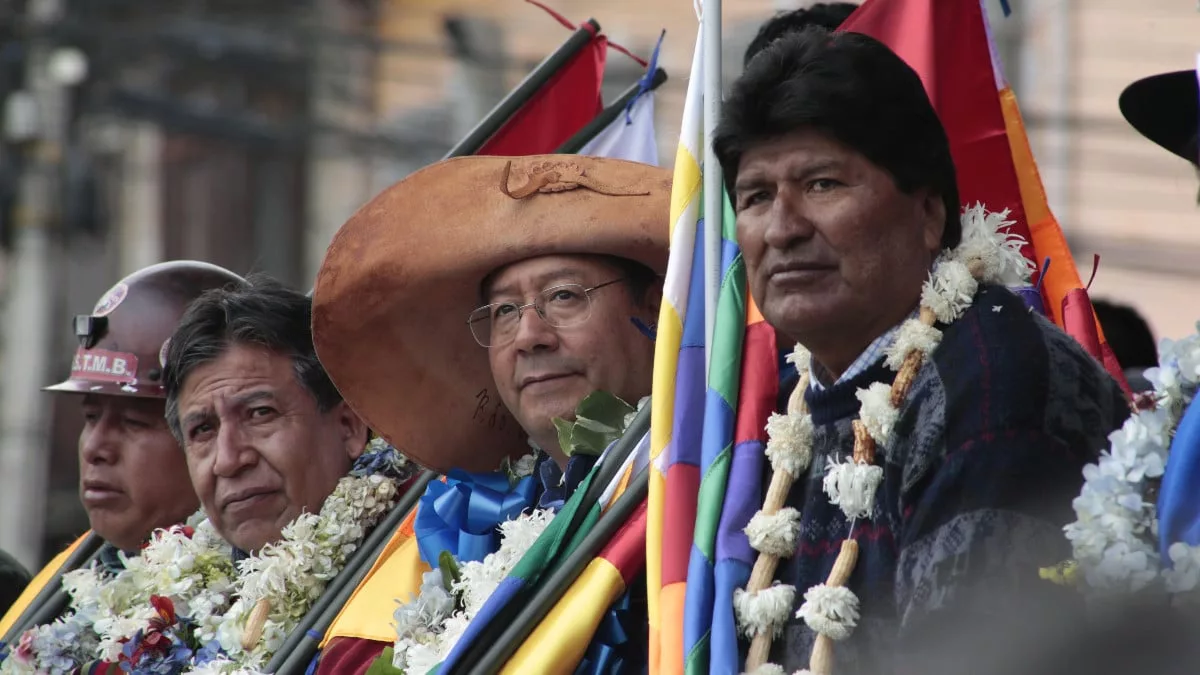
However, now the Bolivian president is the one who challenges his neighbor in South America.
At a party event, Arce expressed his support for the violent social mobilizations that have been taking place in the country against the government of President Dina Boluarte, and whose objective is her resignation to install a new government in accordance with the interests of the left and call general elections.
“In Peru, where we have the Peruvian people in a fight to recover their democracy and also to recover the right to elect a government that represents them,” said the Bolivian president on January 22.
“We have an enemy that is the right, that will always want to destabilize, that does not like that the organized Bolivian people (…) is making a government, is doing the things that the people need, is transforming the economy, society, the right-wing doesn’t like that,” added Arce.
Weeks ago, on January 9, Morales was prevented by the Superintendence of Migrations of Peru from entering the country, together with other leaders of his Movement for Socialism (MAS) party, also for issuing opinions against the Peruvian government and for carrying out activities proselytizing political nature, especially in Puno, a border region with Bolivia and one of the epicenters of the protest.
Through a statement, the Ministry of the Interior reported that Migrations took this measure on January 6 of this year, in strict compliance with its powers and article 48 of the Migration Law – Legislative Decree 1350.
Migrations ordered the registration of the impediment to entry into the country, through all immigration checkpoints, of nine citizens of Bolivian nationality, including Morales.
“Peru is a sovereign and democratic country, whose immigration regulations establish that all foreign citizens in the national territory have the duty to conduct themselves in compliance with the legal system, especially with regard to national security and internal order,” said the statement issued at that time.
BOLIVIA REJECTS INTERFERENCE
The Bolivian Foreign Ministry rejected on Tuesday the insinuation of a “supposed interference” by Luis Arce in the internal affairs of Peru, after the Peruvian Foreign Ministry issued a strong protest against statements by the Bolivian head of state.
“Bolivia respects international law and the principle of non-intervention. We do not accept the insinuation of an alleged interference in the internal affairs of the Republic of Peru, with whom we maintain a historic relationship between brother nations,” he said in a message.
THEY ASK THAT THE ARMY INTERVENE
Bolivian interference has caused, from the Peruvian Congress, parliamentarians such as Ernesto Bustamante (Popular Force) to call on the Executive to give Bolivia an “ultimatum” so that it does not continue -allegedly- financing the protests against the Boluarte government in the south of the country.
Bustamante’s suggestion includes the possibility of the Peruvian Army even intervening in the highland country and occupying natural resources.
“Peru must give the Bolivian government an ultimatum to stop material and financial support to terrorists in Peru. Once the deadline has expired without a solution, the Peruvian Army must enter Bolivia and cautiously occupy natural resources that guarantee a subsequent repair,” he wrote on his personal Twitter account this Sunday.
PERU, THE OBJECT OF “INTERNATIONAL AGGRESSION”
For the constitutional lawyer Enrique Ghersi, it is necessary to break diplomatic relations with the Government of Bolivia after Arce’s expressions, because with them he ignores the democratic legitimacy of the current Peruvian government.
“The open interference of the president (Luis Arce) cannot be tolerated for another minute. Peru must, based on its national dignity and respect for sovereignty, immediately break diplomatic relations with Bolivia,” he said.
For Ghersi, Peru is being subjected to “international aggression” and the Bolivian government is intervening in the acts of insurrection that have been taking place in Puno, a region with a high percentage of aimaras, Evo Morales’ ethnic group.
“It is very clear that Peru is being the object of international aggression, this is not only subversive movements, but what we are seeing in Puno is an intervention by a neighboring government (Bolivia). (…) The southern border must be closed immediately and the Armed Forces must be entrusted with maintaining both border security and internal order, immediately decreeing a state of siege in the Puno region,” he said.
PERU AND BOLIVIA: NEIGHBORS, PARTNERS AND BROTHERS
The historical ties between Peru and Bolivia go back almost five centuries, with the founding of the Viceroyalty of Peru and the Audiencia de Charcas, which depended on the former.
Before the highland country changed its name in honor of the rebel Simón Bolívar, it was even called Alto Peru.
Relations between the regional elites of Puno and La Paz, for example, remain intact to this day, and since Bolivia lost its access to the sea after the war that united it with Peru against Chile in 1879, the ports of the southern Peru are vital for the export of their products.
Three times in the 19th century – 1828, 1836 and 1841 – Bolivia and Peru clashed militarily.
The first, to expel the Colombian and Venezuelan troops stationed there and that were a threat to Lima; the second, when a coalition of Peruvians and Chileans defeated Marshal Andrés Santa Cruz, architect of the Peru-Bolivian Confederation; and the third, in 1841, when Peruvian President Agustín Gamarra tried to annex Bolivia and ended up killed in battle.
Today, after 200 years of history as independent countries, the Bolivian-Peruvian border is one of the most dangerous in the region, where drug trafficking, smuggling, illegal mining and human trafficking are rampant, and where characters like Evo Morales seek destabilize the altiplano region, sharpening the contradictions, to feed their political projects.
With information from LGI
More: Bolivia news in English, every day from The Rio Times.
In depth
Editorial responsibility: Matthias Camenzind, Editor-in-Chief · Editorial standards · Report an error