Nigerian Defence Startup Terra Industries Raises $52 Million Seed Round
Nigeria · TECHNOLOGY
Key Facts
—Total seed funding: Terra Industries has raised US$52 million across three staged financings during 2026, the last of which closed on 17 August.
—Company headquarters: The defence-technology startup is based in Abuja, Nigeria, and was founded in 2024 by Nathan Nwachuku and Maxwell Maduka.
—Lead investors: Silicon Valley firm 8VC led the initial $11.75 million tranche in January 2026, with Lux Capital leading a $22 million extension in February 2026.
—Manufacturing footprint: Terra operates a 15,000 sq ft plant in Abuja and plans a 34,000 sq ft facility in Ghana opening in Q4 2026, targeting 50,000 units annually by 2028.
—Contract bookings: The company reports being on track for over $100 million in contract bookings by year-end 2026, with eight-figure revenues.
—Assets protected: Terra says it was already protecting infrastructure valued at about $11 billion by January 2026, including power plants and mining operations.
Nigerian defence-technology startup Terra Industries has closed a $52 million seed round, one of Africa’s largest early-stage financings and arguably the largest in African defence technology. The raise, closed on 17 August 2026 after tranches in January and February, positions the Abuja-based company at the centre of a new scramble for autonomous security systems across the Global South.
What Terra Industries builds and where it operates
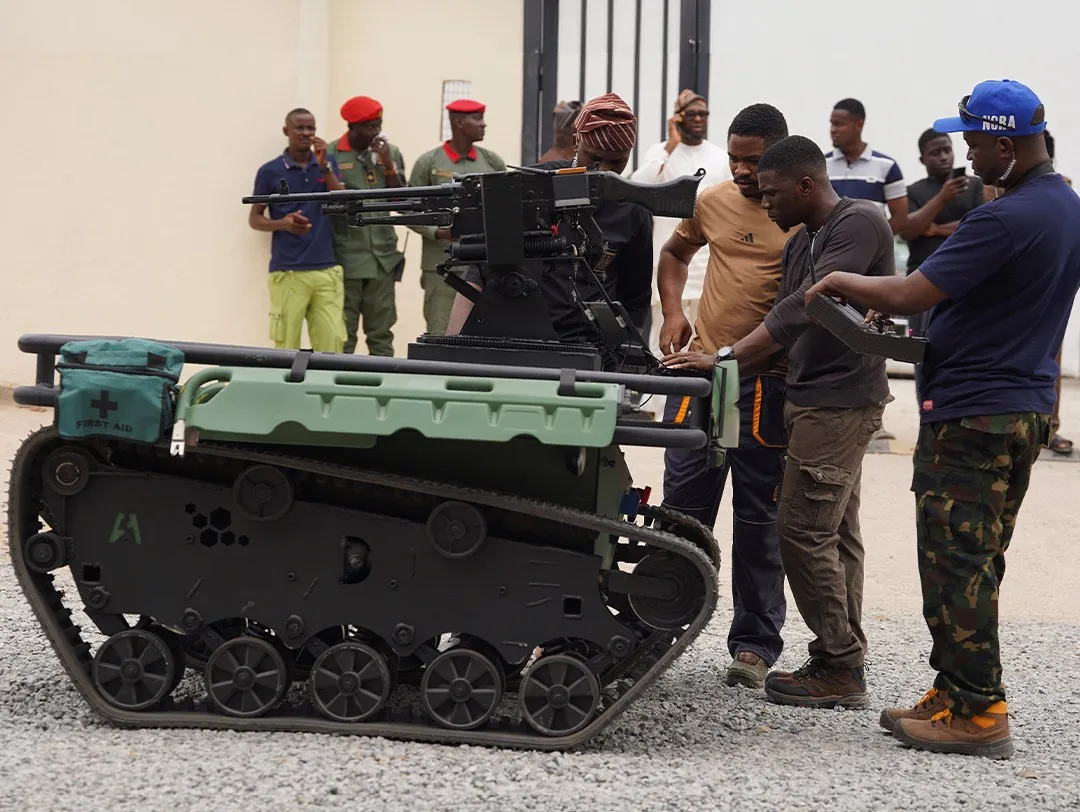
Terra Industries builds autonomous security and defence systems, including drones, interceptor drones, sentry towers and unmanned ground vehicles. The company’s stated mission is to protect critical infrastructure and borders in Africa and the wider Global South.
Its systems run on an in-house operating stack called ArtemisOS, with a hardware-plus-subscription model. Customers buy equipment and pay recurring fees for monitoring and data processing.
Founded in 2024 by Chief Executive Nathan Nwachuku and Maxwell Maduka, the company kept a low profile until early 2026, though it had already won a US$1.2 million contract to secure two Nigerian hydro plants in May 2025. Its primary facility is the Pax-1 plant in Abuja, covering around 15,000 square feet.
A larger 34,000 square foot plant in Ghana is slated to open in the fourth quarter of 2026, targeting up to 50,000 units per year by 2028. Manufacturing is anchored in Nigeria and Ghana, though Terra has a joint manufacturing venture with AIC Steel in Saudi Arabia and says it plans to extend across the Gulf, South America and South Asia. New offices are opening in London, with plans for San Francisco and a presence in Washington, D.C.
How the Terra Industries seed round came together
The $52 million seed round was not a single transaction but a series of staged financings across 2026. In January, Terra announced an initial seed of $11.75 million led by 8VC, the Silicon Valley firm co-founded by Palantir’s Joe Lonsdale.
A February extension of $22 million, led by Lux Capital, took the total to about $34 million. The final $18 million tranche, announced in mid-August 2026, brought the full seed round to $52 million.
Existing investors in the August extension included 8VC, Silent Ventures, Nova Global, Belief Capital and SV Angel. New backers included Norleo Space Investments and angel investor Grant Gordon.
The company and multiple outlets describe the round as Africa’s largest seed round or one of its largest. For scale, Nigerian startups raised US$184.7 million across 51 deals in the first half of 2026, with the top ten taking about 72 percent of disclosed funding.
Why the Terra Industries seed round matters for African tech
Most African seed rounds historically range between $1 million and $5 million, with even standout deals rarely surpassing low-eight-figure sums. Terra’s $52 million seed is therefore more than ten times the regional average.
The round signals that institutional capital is increasingly prepared to back African defence-adjacent startups when they align with global strategic interests. A new category of African venture is emerging at the intersection of national security, critical infrastructure and autonomous systems.
Terra is often compared to Western defence technology firms such as Helsing in Europe, valued around $18 billion, and Anduril and Shield AI in the United States. Its $52 million seed is small in absolute terms but huge relative to the African ecosystem.
The company reports being on track for over $100 million in contract bookings by year-end 2026, with eight-figure revenues, up from roughly $2.5 million previously. Much of that comes from industrial site security contracts.
The investors and the sovereignty pitch
8VC has deep ties to Palantir and the United States defence-intelligence community. Its defence partner Alex Moore, a Palantir board director and Palantir’s first employee, joined Terra’s board in 2025.
Other backers include Lux Capital, Valor Equity Partners, SV Angel, Nova Global, Silent Ventures, Belief Capital and Resilience17 Capital, the fund of Flutterwave chief executive Olugbenga Agboola. These are United States and global venture firms with experience backing frontier-technology and defence-adjacent companies.
Terra’s leadership emphasises sovereignty as the company’s central pitch. Systems are designed to operate under African environmental and network conditions, be manufactured on the continent, and ensure data stays within African or Global South jurisdictions.
This framing offers a third path for Global South governments that have traditionally depended on Russian and Chinese arms or expensive Western defence primes. Terra promises locally manufactured systems with Western capital and software know-how, while claiming local control over data and deployment.
Great-power competition and critical minerals
Terra’s early customers include gold and lithium mining operations in Nigeria and Ghana, tying its technology directly to strategic minerals central to energy transition supply chains. By January 2026, the company said it was already protecting infrastructure assets valued at about $11 billion.
These assets include the Geometric Power Plant in Aba, two hydropower plants in northern Nigeria, and various mining operations. The company’s framing of geofencing Africa’s critical infrastructure and resources raises questions about data governance and who ultimately controls the sensor networks watching the continent’s assets.
The London and Washington pivots are more than talent plays. London is a major node in North Atlantic Treaty Organisation and Five Eyes intelligence and defence procurement conversations, while Washington access could plug Terra into United States defence innovation ecosystems.
This pattern mirrors the broader contest for influence over African security infrastructure, a theme explored in Africa: The New Scramble. Terra’s rise shows how venture-backed platforms are reshaping the way African states protect their borders and resources.
What to watch next
The Ghana plant opening in the fourth quarter of 2026 will be a key milestone, as will progress toward the 50,000-unit annual capacity target by 2028. Terra’s ability to convert its reported contract bookings into delivered revenue will test whether the valuation implied by its seed round holds.
The company’s expansion into London, San Francisco and Washington, D.C. will reveal how deeply it integrates with Western defence ecosystems. Whether Terra can maintain its sovereignty narrative while deepening ties to United States venture capital will shape its credibility across the Global South.
Neighbouring states may feel pressure to match or counter Terra’s capabilities, potentially sparking autonomous systems arms races in regions already destabilised by insurgency. The company’s success or failure will influence how quickly other African defence-technology startups can attract institutional capital.
For now, Terra Industries has secured a financial runway that is unprecedented for an African defence-technology company. The question is whether it can turn that capital into a durable industrial base that serves African security needs without creating new forms of dependence.
Background: Cameroon Win Wafcon as Africa Sends Four to Brazil Without Nigeria.
Background: our peru raises guide.
What is Terra Industries and what does it build?
Terra Industries is a Nigerian defence-technology startup headquartered in Abuja that builds autonomous security systems including drones, interceptor drones, sentry towers and unmanned ground vehicles to protect critical infrastructure and borders.
How much has Terra Industries raised in its seed round?
Terra Industries has raised a total of US$52 million across three staged financings during 2026, the last closing on 17 August, making it one of Africa’s largest seed rounds and arguably the largest in African defence technology.
Who are the main investors backing Terra Industries?
Lead investors include 8VC, the Silicon Valley firm co-founded by Palantir’s Joe Lonsdale, and Lux Capital, with participation from Valor Equity Partners, SV Angel, Nova Global, Silent Ventures, Belief Capital, Norleo Space Investments and angel investor Grant Gordon.
Connected Coverage
For more on how venture capital and great-power competition are reshaping African security and resources, read Africa: The New Scramble.
Sources
This article was produced by The Rio Times’ automated newsroom system. How we use AI · Report an error · Editorial responsibility: Matthias Camenzind, Editor-in-Chief
LatAm Markets: Live Signals → — real-time movers, turnover leaders and FX across Latin America.