
ECONOMY · SOUTH AFRICA
Key Facts
- —The country South Africa’s factories make fuel, chemicals, cars, steel and food for home and export markets, including the United States.
- —Why it matters Factory output is a monthly test of growth, jobs and demand in one of Africa’s largest economies.
- —Why now Statistics South Africa published the August figures on Thursday 8 October 2026.
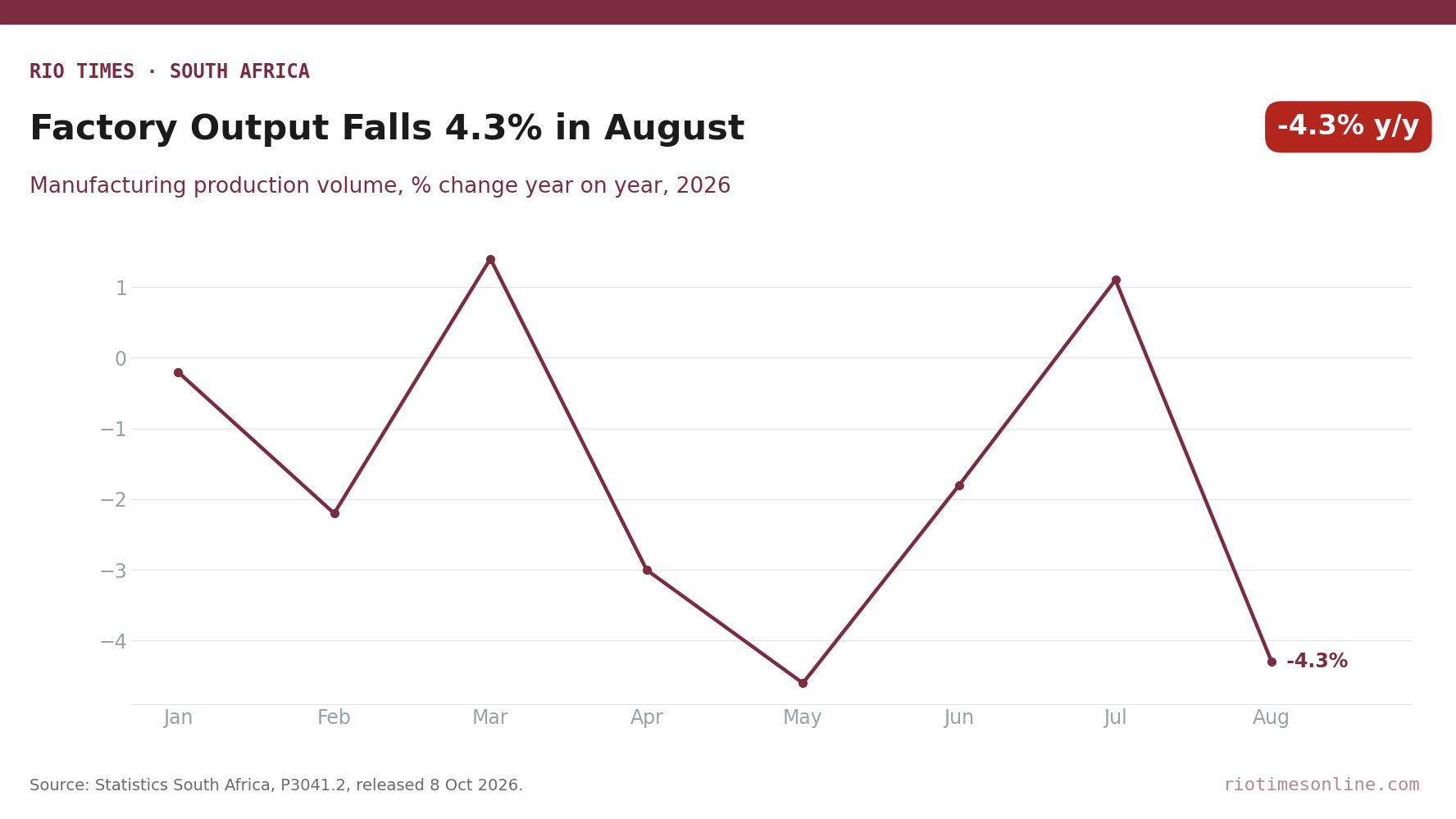
- —What happened Output fell 4.3% in August from a year earlier, after a 1.1% rise in July. On the month it fell 3.1%.
- —The numbers Nine of ten divisions shrank year on year. Vehicles fell 8.8%, petroleum and chemicals 5.0%. Output is down 1.7% so far this year.
- —What it means for you Weaker industry weighs on growth, the rand and South African assets held through US funds, and on carmakers that export.
- —Still open Whether August was a one-month dip. September data are due on Tuesday 10 November.
South Africa manufacturing production fell 4.3% in August 2026 compared with August 2025, Statistics South Africa (Stats SA) reported on Thursday 8 October. The drop was broad, hitting chemical makers, carmakers, paper and printing firms, food processors and metal and machinery plants. For US investors and companies with South African exposure, it is a sign that the country’s industrial recovery remains fragile.
The figure reversed July, when output had risen 1.1% year on year. Stats SA is the national statistics office and publishes the manufacturing survey every month. Its release, numbered P3041.2, covers the volume of goods that factories produce, adjusted for price changes.
Measured month on month and adjusted for seasonal patterns, production fell 3.1% in August after a 2.2% gain in July. Nicolai Claassen, Stats SA’s director of industry statistics, told SABC News it was the sharpest monthly fall since May 2024. Production then dropped 4.1%, a figure the release’s own tables confirm.
Where the Output Was Lost
Stats SA groups factories into ten divisions. Nine of them produced less than a year earlier. Only textiles, clothing, leather and footwear grew, up 5.7%.
The biggest drag came from petroleum, chemical products, rubber and plastic products. That division fell 5.0% and took 1.1 percentage points off the total. Within it, basic chemicals dropped 19.0% and rubber products 16.1%.
Motor vehicles, parts and other transport equipment fell 8.8%, subtracting 0.7 of a point. Vehicle assembly alone was down 10.0%, and parts and accessories 9.4%.
Three more divisions each removed 0.7 of a point. Wood, paper, publishing and printing fell 7.0%. Food and beverages fell 3.0%. Basic iron and steel, metal products and machinery also fell 3.0%.
Business Day, the Johannesburg financial daily, linked the slump to higher input costs from steep fuel price increases. Stats SA itself does not give reasons for the monthly moves.
A Weak Year With Some Offsets
August was the sixth month of 2026 with a year-on-year decline. Over the first eight months, output is 1.7% lower than in the same period of 2025. Production had already shrunk 1.3% across 2025 as a whole.
There are stabilisers in the same release. In the three months to August, seasonally adjusted production rose 1.1% against the previous three months. Eight of the ten divisions grew over that period, led by food and beverages.
Sales also held up better than volumes. Manufacturing sales at current prices rose 2.8% year on year in August and 1.1% on the month. Part of that gap reflects higher prices rather than more goods.
Earlier Rio Times coverage tracked a stronger month for car buyers: South Africa Vehicle Sales Rise 12.7% in September 2026. Local demand for cars and factory output for export do not always move together.
What It Means for US Readers
For investors, factory data feed into how markets price the rand and South African bonds and shares. US-listed funds such as the iShares MSCI South Africa ETF give American savers direct exposure to the country’s listed companies.
Several global carmakers build vehicles in South Africa for export, among them US-based Ford, which builds Ranger pick-ups at its Silverton plant in Pretoria. A 10% fall in vehicle assembly matters for their supply chains and for the ports that ship the cars.
The South African Reserve Bank (SARB), the central bank, sets interest rates with an eye on both inflation and growth. Weak industrial numbers are one input into its next decision, alongside prices and the currency.
The mining side of the economy offers a contrast. Rio Times readers can compare this release with South Africa Mining Taxes Double to US$3 Billion.
What Is Not Known
Stats SA does not say why output fell, and it does not split production by destination market. It is therefore not known how much US tariffs or weaker export orders contributed to the fall in vehicle output.
The August numbers are preliminary and can be revised. The September release is due on Tuesday 10 November 2026. It will show whether August was a one-off or the start of a deeper slide.
Nor is it clear how strongly the drop will show up in third-quarter GDP. The three-month comparison was still positive, which could soften the hit when Stats SA publishes the quarterly estimate later this year.
Frequently Asked Questions
How much did South Africa manufacturing production fall in August 2026?
It fell 4.3% compared with August 2025, according to Statistics South Africa. Seasonally adjusted, it fell 3.1% from July 2026.
Which industries pulled output down?
Petroleum, chemicals, rubber and plastics made the largest negative contribution. Motor vehicles, wood and paper, food and beverages, and basic metals and machinery followed.
Was there any good news in the release?
Yes. Output in the three months to August was 1.1% higher than in the previous three months, and sales at current prices rose 2.8% year on year.
When is the next manufacturing release?
Stats SA expects to publish the September 2026 figures on Tuesday 10 November 2026.
Sources: Statistics South Africa, Manufacturing: Production and sales, August 2026 (P3041.2), released 8 October 2026; SABC News, SA manufacturing sector records sharp decline in August; Business Day, Factory output slumps 4.3% as fuel prices surge.
Editorial responsibility: Matthias Camenzind, Editor-in-Chief · Editorial standards · Report an error