South Africa Vehicle Sales Rise 12.7% in September to 61,645 Units as Exports Fall
MARKETS · SOUTH AFRICA
Key Facts
- —The country South Africa, where the motor industry contributes 5.2% of GDP and 23.8% of manufacturing output, according to naamsa, the Automotive Business Council (1 Oct 2026).
- —What happened Domestic new vehicle sales rose 12.7% year on year to 61,645 units in September 2026, naamsa reported on Thursday 1 October.
- —The numbers Passenger cars up 14.7% to 44,291; exports down 18.8% to 31,473; January–September sales 492,201, up 12.5% (naamsa, 1 Oct 2026).
- —What it means for you Car buyers face a prime lending rate of 10.75% after September’s rate rise, yet wider choice and competitive pricing keep demand growing, naamsa says.
- —Still open Whether demand holds as the higher rate feeds into car finance, and when exports recover; they are down 10.0% in the first nine months of 2026.
South Africa vehicle sales rose 12.7% in September 2026 to 61,645 units, according to naamsa, the Automotive Business Council. The industry body published the figures on Thursday 1 October, against 54,706 units in September 2025.
The gain came in a month when the South African Reserve Bank (SARB), the central bank, raised its key rate. Exports went the other way, falling 18.8% to 31,473 vehicles.

Home Demand Holds Up After a Rate Rise
The SARB’s Monetary Policy Committee lifted the repo rate by 25 basis points to 7.25% in September. The prime lending rate, the benchmark for most bank loans, rose to 10.75%.
Headline consumer inflation edged up to 4.4% in August from 4.3% in July, naamsa noted. Higher fuel prices and global energy costs added to pressure on household budgets.
Even so, South Africa vehicle sales have kept growing at a double-digit pace. Naamsa reported an 11.4% rise for August, to 57,898 units, since revised to 57,761.
From January to September the domestic market reached 492,201 units. That is 12.5% more than the 437,377 sold in the same period of 2025.
Naamsa chief executive Mncane Mthunzi said the market closed the third quarter “on a remarkably resilient footing”. He pointed to the Absa manufacturing purchasing managers’ index, which rose to 50.7 in September, back above the 50 line that separates growth from contraction.
Exports Keep Sliding
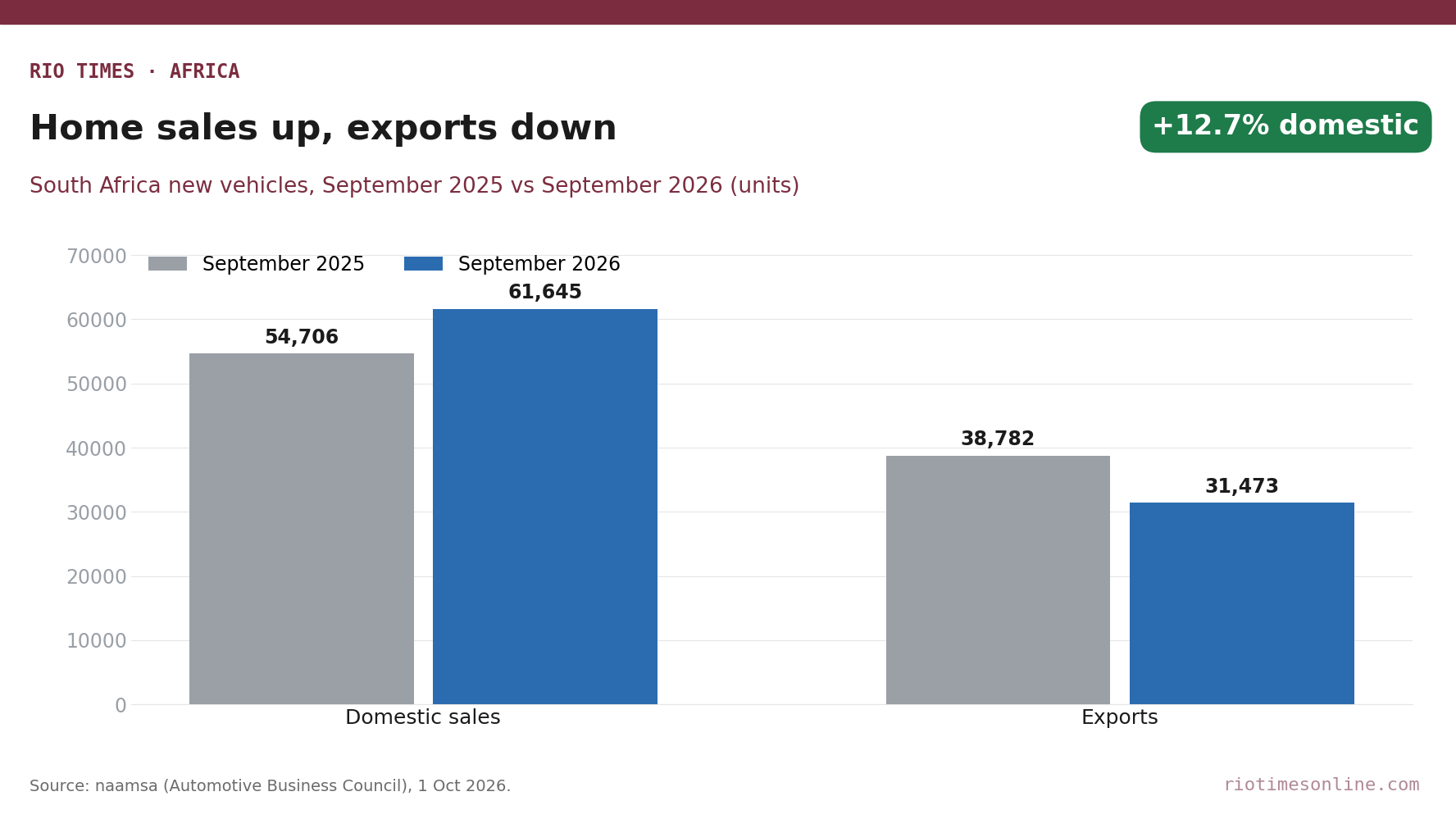
Export sales fell to 31,473 units in September from 38,782 a year earlier. Over nine months exports are down 10.0% at 281,458 vehicles, against 312,809 in 2025.
Vehicle and component exports reached a record R291.0 billion (about US$17.7 billion) in 2025, equal to 15.6% of national exports. The conversion uses R16.42 per US dollar, the open.er-api rate for 1 October 2026.
The manufacturing side employs 113,000 people, according to naamsa, so the export trend matters for factory jobs. Rio Times reported in August that US Tariffs Cut South African Car Exports by 83% in One Year.
Passenger Cars and Rental Fleets Lead
Passenger car sales rose 14.7% to 44,291 units, with the car rental industry taking 18.4% of them. Light commercial vehicles, bakkies (pick-up trucks) and minibuses gained 9.6% to 14,361 units.
Medium commercial vehicles rose 3.4% to 789 units. Heavy trucks and buses slipped by 25 units to 2,204.
Dealers handled an estimated 81.4% of all sales, and rental companies 13.8%. Government took 2.6% and corporate fleets 2.2%.
Naamsa credits more brands, models and price points for the resilience, along with competitive pricing and financing offers. Chinese brands are part of that shift, as covered in Chinese Cars Reshape South Africa Used Market as WesBank Flags Resale Risk.
Electrified Cars Gain Ground
New energy vehicles (hybrids, plug-in hybrids and battery electric cars) reached 18,945 units in the first eight months of 2026. That already exceeds the 16,703 sold in all of 2025, naamsa said.
Plug-in hybrid sales reached 6,919 units by August, against 2,810 for the whole of last year. Battery electric sales reached 2,622, up from 1,088 in 2025.
About one in twenty new vehicles sold this year is electrified, the council estimates. It says further growth depends on charging networks, affordable electricity and local production.
What Is Not Yet Known
It is not yet clear whether rental fleet purchases, 18.4% of passenger car sales in September, will hold up in the final quarter. Naamsa gave no full-year forecast in its release.
The October figures will be the first full month under the higher repo rate. Naamsa also did not say which foreign markets drove September’s 18.8% fall in exports.
Sources: naamsa (Automotive Business Council), September 2026 new vehicle sales media release and flash report, 1 October 2026; naamsa, August 2026 new vehicle sales media release, 1 September 2026; Engineering News, “New-vehicle sales up 11.4% in August, exports drop by 11.9%”, 3 September 2026; exchange rate: open.er-api, 1 October 2026.
LatAm Markets: Live Signals → — real-time movers, turnover leaders and FX across Latin America.
Read More from The Rio Times