Peru Reports 58 Active Wildfires as Troops Deploy

ENVIRONMENT · PERU
Key Facts
- —The country Peru, home to Cusco and Machu Picchu, one of the top South American destinations for US travellers.
- —Why it matters Fires are burning across the southern and central Andes, the region most foreign visitors pass through.
- —Why now Peru’s weather service has put nine regions on red alert for fire-prone conditions from Sunday 11 to Friday 16 October.
- —What happened On Sunday 11 October, Indeci chief Luis Vásquez said Peru had 58 active wildfires in seven regions, as the army and air force joined the fight.
- —The numbers Serfor’s satellite system showed 3,312 heat spots on Sunday. Officials count at least six deaths in this fire season.
- —What it means for you No road, rail or site closures have been announced. Travellers in the Andes should check with operators and avoid smoke.
- —Still open How much land has burned nationally, and whether the government will declare an emergency, is not yet clear.
Peru wildfires reached 58 active blazes on Sunday 11 October, the head of the national civil defence institute, Indeci, said. They are burning in seven regions of the Andes, including Cusco, the gateway to Machu Picchu. For American and other foreign travellers, the country’s most visited mountain areas now face a week of high fire risk.
General Luis Vásquez, an army officer who heads Indeci, gave the national count. The fires are in Cusco, Ayacucho, Apurímac, Junín, Áncash, Arequipa and Cajamarca, the Defence Ministry said on Sunday afternoon.
The government sent soldiers, aircraft and water-dropping systems to the worst areas. Peru’s weather service, Senamhi, warned that hot, dry and windy conditions will last until Friday 16 October.
This report adds the national picture to our earlier coverage of the Cusco response, Peru Sends Aircraft as Wildfires Burn in Cusco.
Troops and Aircraft Join the Fight
The Defence Ministry said on Sunday that the armed forces were working “by land and air” in the highlands. Its statement was issued at 4:29 p.m. local time.
In Ayacucho, soldiers from the Second Infantry Brigade and the Los Cabitos battalion were fighting a fire in Santillana district, Huanta province. Pasture, eucalyptus plantations and native plants were burning there. The ministry said no lives had been harmed.
In Puno, the army’s Fourth Mountain Brigade joined control work in Huacullani district, Chucuito province. The air force flew a King Air plane over Cusco to map the fires. A C-27J Spartan transport carried in a water-dropping system, and Mi-17 helicopters were assigned buckets for water drops.
The armed forces’ special command for the VRAEM, the valleys of the Apurímac, Ene and Mantaro rivers, also sent rapid-response companies to fires there.
Indeci said a regional meeting in Cusco on Sunday agreed to make Calca province the top priority. The Spartan was scheduled to fly water there on Monday 12 October, between 5 a.m. and 1 p.m., weather permitting. An air force helicopter will stay in Cusco for a month, Indeci said.
How Many Fires Are Burning
The count depends on who is counting. Indeci’s figure of 58 active fires came from its national emergency operations centre, known as COEN.
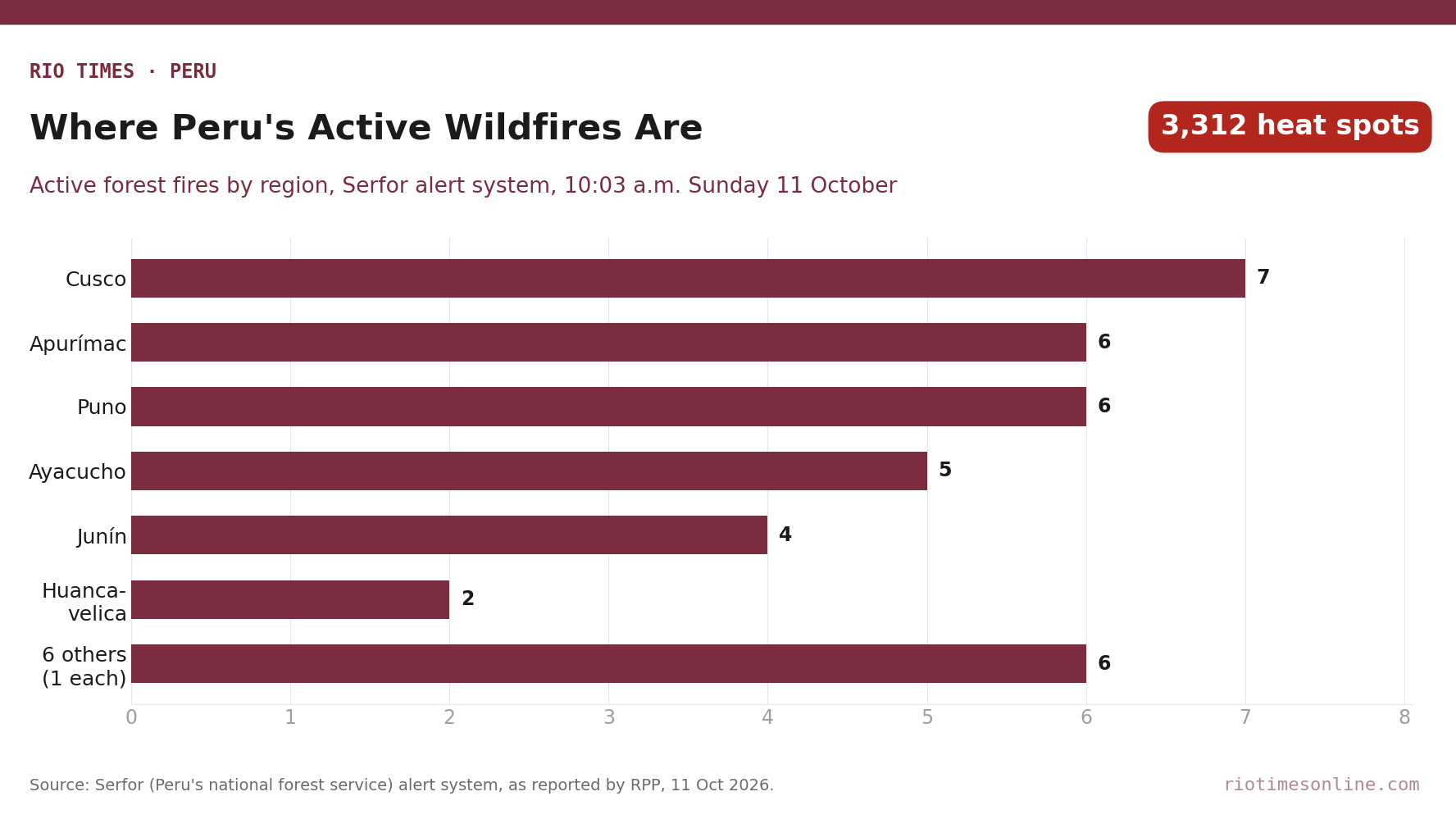
Serfor, the national forest service under the agriculture ministry, runs a separate satellite alert system. At 10:03 a.m. on Sunday, it showed more than 30 active fires, 3,312 heat spots and 63 probable fire alerts, broadcaster RPP reported.
Serfor’s list placed the most active fires in Cusco (seven), Apurímac and Puno (six each) and Ayacucho (five). Junín had four and Huancavelica two. Six other regions had one each. Serfor said 34 fires had been put out and three were under control.
Some fires are dying down. Indeci said fires in Parobamba and Matacoto, in Áncash, and Puyca, in Arequipa, were out by Sunday. A fire in Sihuas, Áncash, was under control after destroying 25 hectares, about 62 acres, of vegetation.
Others were still burning in Chaviña (Ayacucho), San Cristóbal (Moquegua) and Lampa (Puno). Indeci said no one there had been hurt. On Saturday, our report Peru Tracks 55 Open Wildfire Alerts, 25 Confirmed described the earlier count.
At least six people have died in this year’s Peru wildfires, five in Cusco and one in Puno, according to COEN and regional risk offices, RPP reported. El Comercio also reported six deaths on Saturday.
A Red Alert Until Friday
Senamhi’s Warning No. 10 puts nine regions on red alert for weather that favours fires: Apurímac, Arequipa, Ayacucho, Cusco, Huancavelica, Ica, Moquegua, Puno and Tacna. Diario Correo reported the warning on Sunday.
The service expects no rain, lower humidity, higher daytime temperatures, strong ultraviolet light and afternoon gusts. The risk ranges from moderate to extreme, mainly in the southern highlands.
Senamhi urged people not to light fires outdoors, especially near forests or pasture. Indeci asked residents not to throw cigarette ends or matches into vegetation.
Pressure on the government is growing. Senator Mirtha Vásquez of Ahora Nación, the left-leaning opposition party founded by Alfonso López Chau, asked the cabinet to carry out the national wildfire plan for 2025 to 2027. “It is not enough to approve plans, they have to be carried out,” she wrote on X, RPP reported.
What It Means for You
The fires are in rural districts, not in Cusco city or at the Machu Picchu citadel. None of the official statements reviewed announced a road, rail or site closure.
The red alert covers areas on many visitors’ routes, including the Sacred Valley, Arequipa’s Colca Canyon region and Lake Titicaca in Puno. Anyone booked on treks or rural tours this week should check with their operator before setting out.
Smoke can drift across valleys and lower air quality, so travellers with asthma or heart conditions should carry medication. Do not hike towards visible smoke, never light campfires, and follow instructions from police, rangers and firefighters.
For investors, the affected areas include mining regions such as Apurímac, Cusco and Arequipa. No company has reported an impact on operations.
What Is Not Known
Officials have not published a national total for the area burned by Peru wildfires this year, or a combined list that reconciles Indeci’s 58 fires with Serfor’s count.
It is not known whether the government will declare a state of emergency, as some lawmakers have urged. It is also unclear how many homes, crops and animals have been lost across the country, since damage surveys are still under way.
Weather is the deciding factor. If the dry, windy spell lasts until Friday as forecast, new fires are likely. Senamhi has not said what conditions will follow after Friday.
Frequently Asked Questions
How many wildfires are active in Peru?
On Sunday 11 October, Indeci chief Luis Vásquez said Peru had 58 active wildfires in seven regions. Serfor’s satellite system showed more than 30 active fires and 3,312 heat spots.
Is Machu Picchu affected by the Peru wildfires?
No official closure of Machu Picchu, its trains or roads had been announced by Sunday. The fires in Cusco are in rural districts such as Calca.
How long will the fire risk last?
Senamhi’s red alert for fire-prone weather covers nine regions from Sunday 11 October to Friday 16 October, mainly in the southern highlands.
Sources: Ministerio de Defensa; Indeci (COEN); Indeci (Cusco); Diario Correo; Diario Correo (Senamhi alert); RPP (Serfor data).
This article was produced by The Rio Times’ automated newsroom system. How we use AI · Report an error · Editorial responsibility: Matthias Camenzind, Editor-in-Chief