
ECONOMY · PERU
Key Facts
- —The country Peru is a major copper and farm exporter. Its biggest new port, Chancay, north of Lima, is run by China’s state-owned Cosco Shipping.
- —Why it matters A second deep-water port in the south would decide whether US or Chinese capital shapes Peru’s Pacific trade routes to Brazil and Bolivia.
- —Why now Arequipa’s governor, Rohel Sánchez, said in an RPP radio interview reported on Sunday 11 October that groups from four countries are interested. Officials pitch the port to investors in Lima on Monday 12 October.
- —What happened Sánchez named groups from the United States, China, India and the Netherlands. The project’s official master plan prices it at more than US$800 million.
- —The numbers The site covers 34,596 hectares, with 1,127 hectares for the port core. Natural depth is 19 to 29 metres, regional outlets reported.
- —What it means for you US port operators, shippers and grain or mineral traders may get a chance to bid. Nothing is tendered yet, and no investor is committed.
- —Still open Which companies are interested, when ProInversión, the state investment agency, opens a process, and who would finance the port.
Business groups from the United States, China, India and the Netherlands have shown interest in the planned Corío port in southern Peru, Arequipa’s regional governor said. The Corío port would sit in Islay province, on the Pacific coast of the Arequipa region in Peru’s far south. For US readers, it is a test of whether American capital competes with China for Peru’s next big gateway.
Rohel Sánchez, the elected governor of Arequipa, made the claim in an interview with RPP, a national radio network. Perú Informa and Evidencia, two Peruvian outlets, reported it on Sunday 11 October.
No company has been named, no tender exists and no money is committed. The project is still at the stage where the state decides how to offer it to private investors.
What the Governor Said
Sánchez said he had met business groups from the four countries, all interested in taking part in the port. He also said the chief executive of Hyundai, the South Korean carmaker, had shown interest in green hydrogen and car industry projects there.
According to Evidencia, Sánchez said the project would now enter a phase of talks with bidders. He said the land had been registered in the name of the Peruvian state.
Perú Informa reported that 34,596 hectares are registered to the state. Of these, 1,127 hectares are set aside for the port core, and the rest for industrial, technology and urban zones.
The governor stressed the site’s natural depth, which outlets put at 19 to 29 metres. That would let it handle very large ships. He said it could carry cargo from southern Brazil and link with the southern railway towards Bolivia and Argentina.
Where the Corío Port Stands
The official process is slower than the governor’s words suggest. On Thursday 3 September, the National Port Authority (APN), the state port regulator, approved the master plan for the Corío terminal.
The plan foresees a multipurpose terminal for containers, break-bulk and dry bulk cargo, built in three stages. It puts the investment at more than US$800 million, according to PortalPortuario, a regional shipping news site.
That is far below the figure of about US$7 billion that promoters of the project had cited. They had pitched Corío as a hub bigger than Chancay.
 .8 billion with the US billion figure promoters had cited" data-lazy-src="https://www.riotimesonline.com/wp-content/uploads/2026/10/rt-chart-peru-corio-port-us-china-interest-2026-1.png" />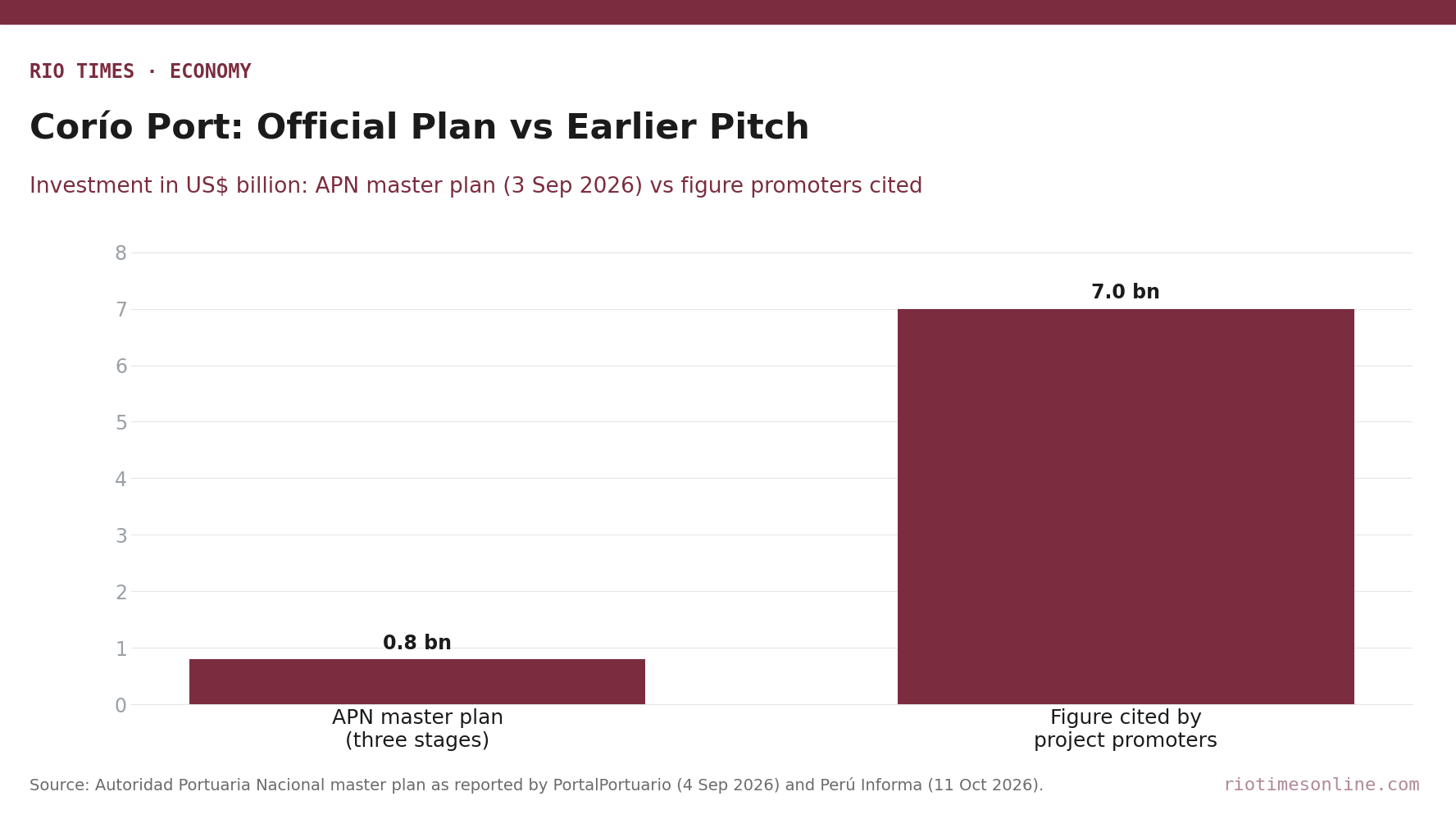
On 29 September, the APN asked ProInversión, the state agency that runs public-private partnerships, to assess the project and, if it agrees, start promoting it. The Arequipa regional government published that request on Tuesday 6 October.
The APN letter was signed by its board chairman, Abel Alvarado Huertas. Under the master plan, the terminal will be publicly owned, open to all users and of national scope.
Andina, the state news agency, reported that officials and business leaders meet for an investment presentation on Monday 12 October from 9 a.m. (10 a.m. ET) at the Hilton hotel in Lima’s Miraflores district. Sánchez, ProInversión and the APN are due to speak, and Mediterranean Shipping Company (MSC), the Geneva-based container line, is listed among the expected panel guests. ProInversión’s executive president, Luis Del Carpio Castro, is due to present the next steps.
What It Means for You
For US investors and port operators, Corío is an early chance to look at a large Pacific project before terms are set.
For Washington, the question is strategic. Chancay, which opened in 2024, gave China a major foothold on South America’s Pacific coast, and US officials have criticised that. Our earlier report, Peru Chancay Port: US Pressure Has Not Moved China, covers that dispute.
For traders in soya, minerals and other bulk goods, a southern port could shorten routes from Brazil and Bolivia to Asia. That depends on roads and railways that are not yet finished.
The risk is that interest does not become investment. Peru has announced large ports before that took years to start, and the project has no operator, no financing and no secured cargo.
What Is Not Known
Sánchez did not name the companies or say how firm their interest is. None of the groups has commented publicly, and their interest has not been independently confirmed.
It is not known whether ProInversión will formally take on the project, or when. The APN request is subject to the agency’s own evaluation.
It is not known what, if anything, officials will commit to at Monday’s presentation in Lima, or whether any of the interested groups will attend.
The timeline is long. Estimates by the consultancy Infraplan, cited by Perú Informa, suggest five to six years of structuring, promotion and building before the Corío port opens.
Frequently Asked Questions
Where is the Corío port planned?
In the district of La Punta de Bombón, in Islay province, Arequipa region, on Peru’s southern Pacific coast. The National Port Authority approved its master plan on 3 September 2026.
How much would the Corío port cost?
The official master plan puts the investment at more than US$800 million over three stages. Promoters had earlier cited a figure of about US$7 billion.
Are US companies investing in the Corío port?
Not yet. Arequipa’s governor says groups from the United States, China, India and the Netherlands are interested, but no company has been named and no tender has opened.
Sources: Gobierno Regional de Arequipa, APN request to ProInversión (6 October 2026); Perú Informa; Evidencia; Andina, 12 October presentation (9 October 2026); PortalPortuario, APN master plan.
This article was produced by The Rio Times’ automated newsroom system. How we use AI · Report an error · Editorial responsibility: Matthias Camenzind, Editor-in-Chief
LatAm Markets: Live Signals → — real-time movers, turnover leaders and FX across Latin America.