
ECONOMY · PANAMA
Key Facts
- —The country Panama uses the US dollar as its currency, runs the Panama Canal and borrows heavily from foreign investors through bonds.
- —Why it matters Without its own currency to print, Panama pays for disasters from the budget. Keeping the deficit cap protects the investment-grade rating that holds down its borrowing costs.
- —Why now A 7.7 earthquake hit the Azuero Peninsula on Friday 9 October. A Cabinet resolution on Saturday let the ministry ask lawmakers to suspend the fiscal rule.
- —What happened On Sunday 11 October the Ministry of Economy and Finance said the 2026 target stays intact and it will not seek the waiver.
- —The numbers Up to US$100 million in emergency spending; a deficit cap of 3.5% of GDP for 2026; more than 1,200 damaged homes inspected by Sunday.
- —What it means for you Bondholders get continuity. Travellers face damaged roads and bridges in Veraguas and Los Santos as repairs go on.
- —Still open The repair bill, the insurance payout and whether multilateral loans will be needed are not yet known.
Panama will not lift its deficit cap to pay for the damage from Friday’s 7.7 earthquake. The Ministry of Economy and Finance (MEF) said on Sunday 11 October that the 2026 fiscal target “remains intact” and that it will not ask the National Assembly for a waiver.
The decision matters beyond Panama. The country uses the US dollar, borrows from foreign bond investors and holds the lowest investment-grade rating at S&P Global. A looser deficit cap would have been the first test of that rating since the quake.
Instead, the ministry says it will pay for relief with insurance cover, donations and grants first. It would borrow only if “indispensable”, and then on soft terms.
A Waiver Authorised, Then Ruled Out
The waiver option lasted about a day. On Saturday 10 October the Cabinet published Resolution No. 108 in the Official Gazette, declaring a national state of emergency, La Prensa reported.
Article 3 set aside up to US$100 million for emergency purchases and works. Ministries may use a special procedure without public tenders until 31 December 2026. Article 6 authorised the MEF to ask lawmakers “immediately” to suspend the limits of Panama’s fiscal responsibility law.
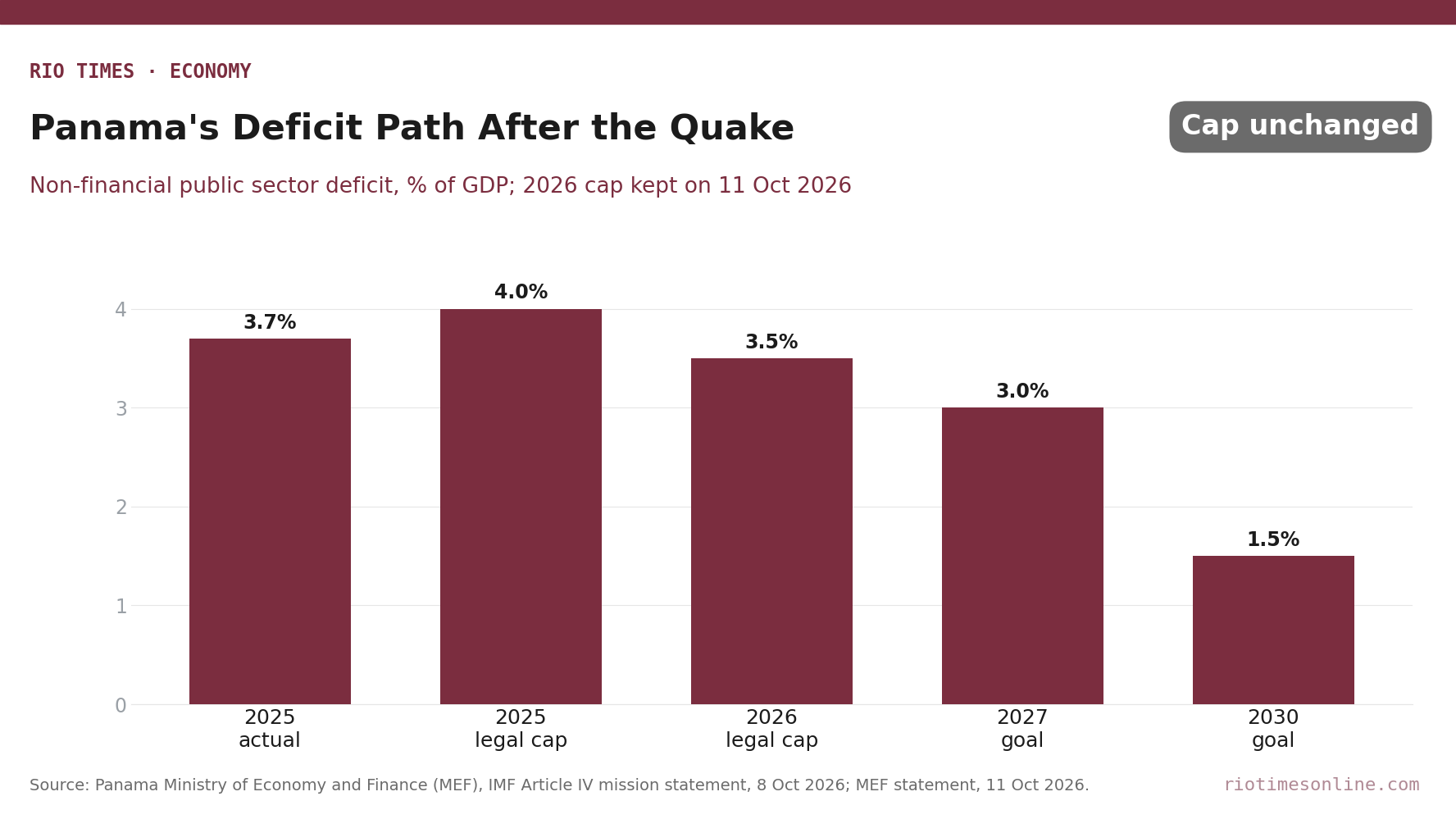
That law, Law 34 of 2008, caps the non-financial public sector deficit. For 2026 the deficit cap is 3.5% of gross domestic product (GDP). A suspension would have let the government spend above it for as long as the Assembly allowed.
On Sunday the ministry closed that door. “The 2026 fiscal target remains intact. The MEF will not request any waiver from the National Assembly,” it said in a statement reported by Eco TV. It added that the resolution allows a request but does not require one.
The ministry also said the US$100 million is a ceiling, not an automatic outlay. Money will be released only for “proven needs”, through a trust at the state-owned Banco Nacional de Panamá. Payments need the countersignature of the Comptroller General, the state’s spending watchdog.
Why the Deficit Cap Carries Weight
Panama has spent two years rebuilding its public finances. The MEF published the International Monetary Fund’s Article IV findings on 8 October. They show the 2025 deficit fell to 3.7% of GDP, under that year’s 4% ceiling.
The IMF mission said preliminary data show Panama on track to meet the 3.5% cap this year. The government aims for 3% in 2027 and 1.5% by 2030. The Fund called the public debt sustainable if that path holds.
On 22 September S&P Global Ratings reaffirmed Panama at BBB-, with a stable outlook, the MEF said. The agency tied that outlook to the planned deficit cuts in 2026 and 2027. BBB- is one notch above speculative grade.
Economy minister Felipe Chapman, who runs the MEF under President José Raúl Mulino, had set the tone earlier, La Prensa reported. “The Panamanian economy is not going to stop,” he said, adding that Panama has the resources to meet the most urgent needs. Any loans, he said, would be concessional.
Help has already been offered. CAF, the Latin American development bank, announced a US$250,000 donation on Friday. It also offered US$50 million through its disaster credit line.
What It Means for You
For investors in Panama’s dollar bonds, the message is fiscal continuity. The government is signalling that one disaster will not reopen the deficit path it promised the rating agencies. Risks remain: the repair bill is unknown, and a larger figure could still force borrowing.
For travellers, the hardest-hit areas are rural. La Prensa placed the epicentre in Tonosí district, Los Santos. The US Geological Survey located it 12 km west-southwest of Pitaloza Arriba. Public works minister José Luis Andrade said on Sunday that at least 14 bridges in Veraguas were damaged: about eight in Soná, at least six in Mariato. The Tonosí–Las Tablas road was open in one lane for light vehicles.
The University of Panama’s Institute of Geosciences counted 256 aftershocks by 11 a.m. on Sunday, four of them above magnitude 6. It said none of magnitude 5 or more had occurred since 9 p.m. on Saturday. The institute measured the main shock at 7.5; the US Geological Survey put it at 7.7.
In the affected provinces, the state marketing agency IMA will deliver food bags house by house from Tuesday. Its director, Nilo Murillo, announced the plan. Housing minister Jaime Jované is preparing a census of damaged homes.
What Is Not Known
The ministry did not say which insurance policies cover public buildings, or how much they might pay. Nor has it published a damage estimate. The public works ministry said it does not yet have a cost for road and bridge repairs.
Officials have not given a total for people affected in Coclé, Herrera, Los Santos and Veraguas. The count of more than 1,200 damaged homes is preliminary and may rise. Government goals secretary José Ramón Icaza said the US$100 million will come from the 2026 budget and part of the 2027 budget, but did not name the spending lines involved.
For background, see our reports Panama Declares State of Emergency After 7.7 Quake and US Mobilizes Help After 7.7 Panama Quake, and on the debt outlook, Panama Public Debt to Reach US$64 Billion in 2027, Finance Ministry Tells Lawmakers.
Frequently Asked Questions
Will Panama raise its deficit cap after the earthquake?
No. On Sunday 11 October the Ministry of Economy and Finance said the 2026 target stays intact and it will not ask the National Assembly for a waiver. The cap is 3.5% of GDP.
How will Panama pay for earthquake relief?
The ministry says it will use insurance cover, donations and grants first. It will borrow only if indispensable, on concessional terms. Up to US$100 million is authorised for emergency purchases.
How strong was the Panama earthquake?
The US Geological Survey measured it at magnitude 7.7; the University of Panama’s Institute of Geosciences put it at 7.5. It struck the Azuero Peninsula on Friday 9 October.
Sources: La Prensa (MEF statement); Eco TV; La Prensa (Resolution No. 108); MEF (IMF Article IV); MEF (S&P rating); La Prensa (damage update); La Prensa (MOP); La Prensa (Institute of Geosciences); La Prensa (CAF); USGS.
This article was produced by The Rio Times’ automated newsroom system. How we use AI · Report an error · Editorial responsibility: Matthias Camenzind, Editor-in-Chief
LatAm Markets: Live Signals → — real-time movers, turnover leaders and FX across Latin America.