Panama Public Debt to Reach US$64 Billion in 2027, Finance Ministry Tells Lawmakers
ECONOMY · PANAMA
Key Facts
- —The country Panama, a Central American trade and shipping hub that uses the US dollar. President José Raúl Mulino took office in July 2024; Felipe Chapman is his finance minister.
- —What happened On 28 September the Ministry of Economy and Finance (MEF) told lawmakers that public debt should end 2026 near US$62 billion and reach about US$64 billion in 2027.
- —The numbers Debt stood at US$61.9 billion at the end of August 2026, up 7.1% in a year (ministry data via Infobae). The ministry puts the 2026 level at 61% of GDP.
- —What it means for you Dollar savings face no devaluation risk. The effects run through taxes, public services and borrowing costs if Panama’s credit ratings change.
- —Still open Whether the National Assembly passes the 2027 budget, which sets aside US$5.5 billion for debt payments, and how Fitch and Moody’s judge the slower debt path.
Panama public debt should reach about US$64 billion at the end of 2027, the finance ministry told lawmakers on 28 September. That is roughly US$2 billion more than the US$62 billion it expects at the end of this year.
Officials gave the figures to the National Assembly’s Budget Committee, La Estrella de Panamá and La Prensa reported. The government says debt will keep rising, but more slowly than in recent years.

What the Ministry Told Lawmakers
Rubilú Rodríguez, the ministry’s director of public policy and economic analysis, presented the projections under the government’s 2025–2029 strategic plan. She put the 2026 close at about US$62 billion, equal to 61% of GDP.
Deputy Luis Duke noted that this means US$474 million more in the rest of 2026 and about US$2 billion in 2027. Finance Minister Felipe Chapman confirmed the figures.
“Debt will grow because every year there will be a fiscal deficit,” Chapman said, according to La Estrella. The goal, he said, is for debt to rise less each year until it stops growing.
Removing the deficit at once would mean dismissing about 50,000 public workers, Chapman told the committee, La Prensa reported. He said the government has not even considered such a step.
Where Panama Public Debt Stands
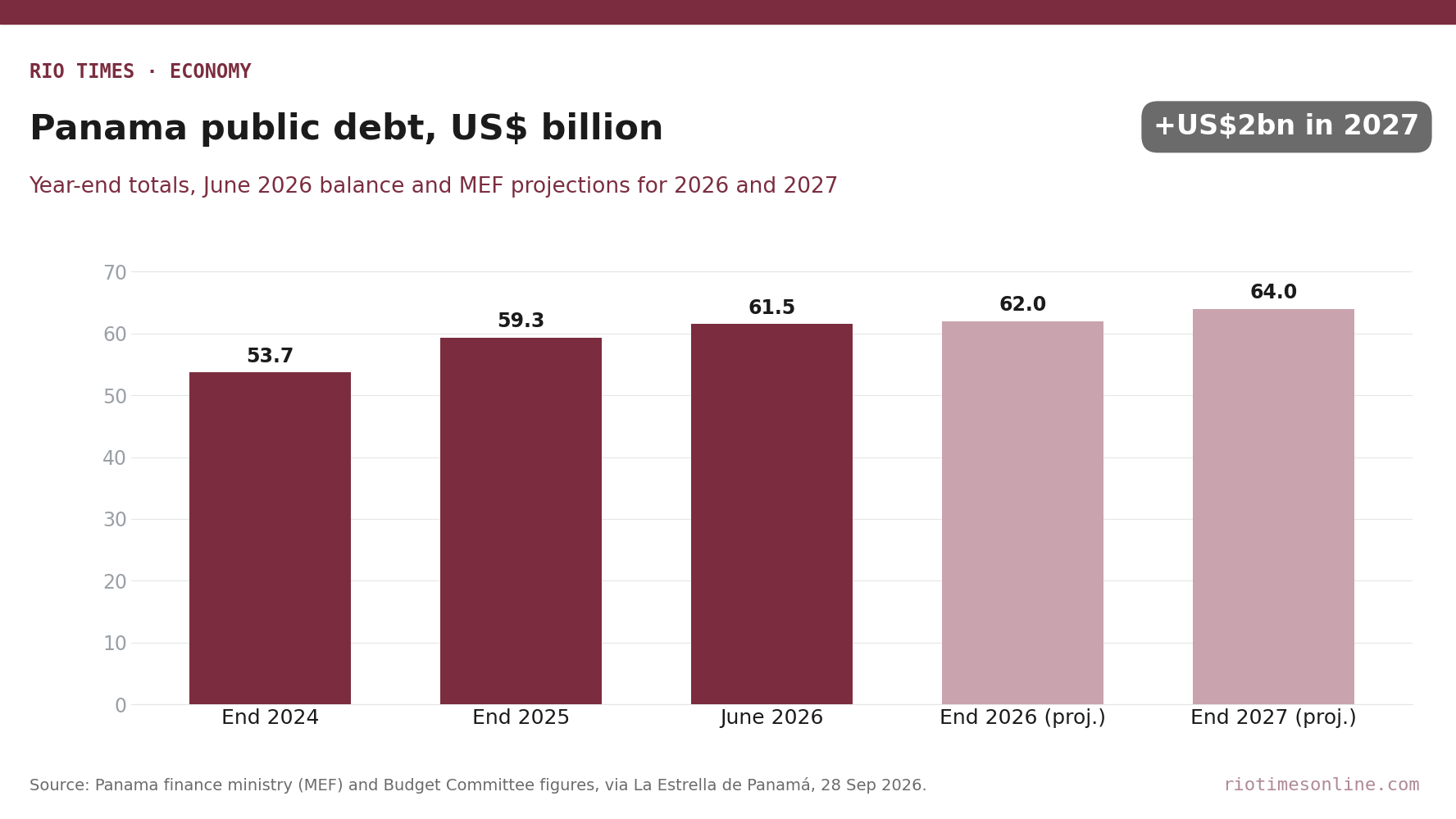
Figures read out in the committee put debt at US$53.7 billion at the end of 2024 and US$59.3 billion a year later. By June 2026 it had reached US$61.5 billion.
Ministry data for August show US$61.92 billion, 7.1% more than a year earlier, Infobae reported. About 83.8% is owed abroad, which ties public finances to global credit conditions.
Chapman says the previous government doubled the debt stock, and Infobae’s series supports that. Debt rose from about US$26.6 billion in 2019 to US$51.8 billion by June 2024.
The same series shows the other side of the ledger. Debt has risen by about US$10.1 billion, or 19.4%, since Mulino took office.
Cheaper Money, Heavier Bill
Chapman said the cost of financing the debt has fallen by more than 60% since 30 June 2024. He said the savings exceed the yearly budgets of the Assembly or the judiciary.
Even so, the 2027 budget bill sets aside US$5.5 billion for debt service, including US$3.06 billion in interest, La Prensa reported. That interest alone is about four times the ministry’s own US$733 million budget.
The deficit is shrinking, as the Panama Deficit Falls to 2.78% as Growth Forecast Rises report showed. Every remaining deficit is still financed with new borrowing.
How the Rating Agencies See It
On 22 September S&P Global Ratings affirmed Panama at BBB-, its lowest investment-grade rating, with a stable outlook. It expects the general government deficit to fall from 3.8% of GDP in 2025 to 3.3% in 2026.
S&P sees the deficit near 3% from 2027 to 2029, but warned that debt remains at record levels. It named tax revenue of only 6.9% of GDP as a lasting weakness.
Moody’s rates Panama Baa3, also the lowest investment grade, and has questioned how secure that grade is. Fitch keeps Panama at BB+, one step below investment grade.
Growth offers some room, with S&P expecting about 4.5% this year. It warns that El Niño could lower Gatún Lake, which feeds the Panama Canal, and slow growth in 2027.
What Is Not Yet Known
The ministry gave no debt-to-GDP ratio for 2027 in the reported session. That share will depend on how fast the economy grows next year.
It is also unclear how the 2027 deficit will be split between bonds and loans from multilateral lenders. The Assembly has not yet approved the 2027 budget.
S&P said it could move the rating either way within 12 to 24 months. Future reviews by Fitch and Moody’s will show whether they accept the slower debt path.
Frequently Asked Questions
How much public debt does Panama have?
Public debt was about US$61.9 billion at the end of August 2026, according to finance ministry data reported by Infobae. The ministry expects about US$62 billion at the end of 2026.
What does the finance ministry project for 2027?
About US$64 billion at the end of 2027, roughly US$2 billion more than at the end of 2026. The ministry puts the 2026 level at 61% of GDP.
Is Panama still investment grade?
Yes, with two agencies. S&P rates Panama BBB- and Moody’s rates it Baa3, both the lowest investment-grade level; Fitch rates it BB+, one step below.
Sources: La Estrella de Panamá, 28 September 2026; La Prensa, 28 September 2026; Infobae on August debt data, 17 September 2026, and on the S&P rating decision, 23 September 2026; Panama Ministry of Economy and Finance (MEF) figures as reported.
Read More from The Rio Times