Panama’s Decentralization Authority Explained

PANAMA · EXPLAINER
Key Facts
- —The country Panama has 81 municipalities, and its balboa is fixed at one to the US dollar.
- —Why it matters One national agency decides which local projects receive state money, so its rules shape roads, water and sports grounds in every district.
- —Why now Its director general put her post at the president’s disposal on Thursday 15 October, which raises the question of how the system runs without her.
- —What happened The authority has moved US$225 million to local governments since August 2024, and its leadership is now in transition.
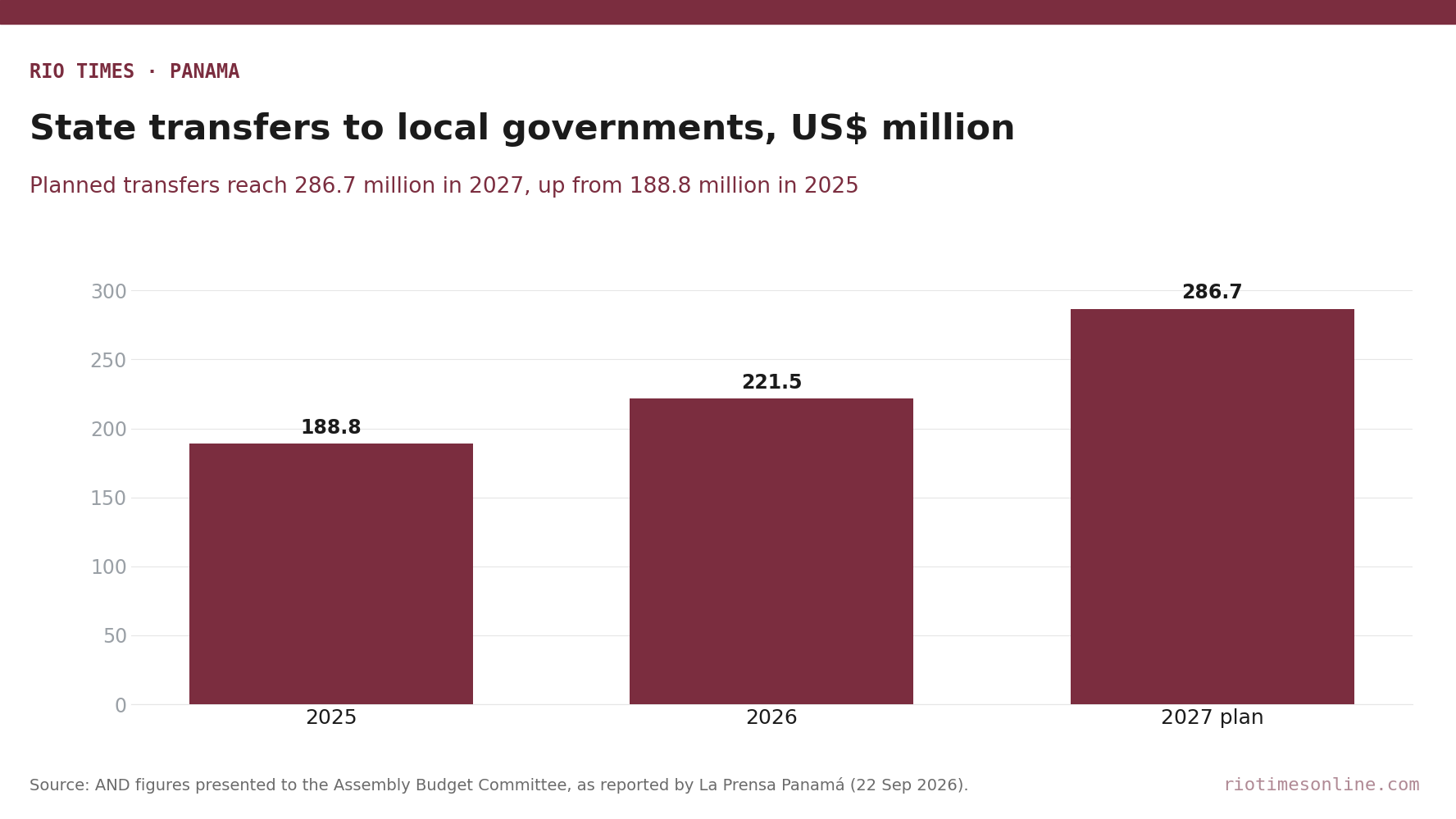
- —The numbers Planned transfers rise to US$286.7 million in 2027, up from US$221.5 million this year and US$188.8 million in 2025.
- —What it means for you Property-tax rules, project lists and payment data are public, so residents and owners can follow what their district receives.
- —Still open No successor has been named, and the audit and complaint process faces a decision on its pace.
- —Power Index Panama ranks 11th of 14 in The Rio Times Latin America Power Index, with 34.2 points (October 2026 edition).
Panama’s decentralization authority, the Autoridad Nacional de Descentralización (AND), is the state agency that decides how national money reaches municipalities and community boards. It is in the news because director general Roxana Méndez offered her post to President José Raúl Mulino on Thursday 15 October.
The resignation itself is covered in Panama’s Roxana Méndez Resigns on 15 October, so this guide looks at the machinery behind the agency. It covers the laws, the money formulas, the board and the audits.
Where Panama’s Decentralization Authority Comes From
Law 37 of 2009, signed on 29 June 2009, set out Panama’s decentralisation process and created the authority. Law 66 of 29 October 2015 reformed it and set up a transitional National Secretariat for Decentralisation to stand in for the authority until the first phase of the process ended.
The law text on the AND website gives the authority its own budget and has the president appoint the director and deputy for five years. Amendments after 2015 may not appear in that archive.
How the Money Reaches Local Governments
The largest stream is the property tax, known as the IBI, which the finance ministry collects and passes back to municipalities. Under Law 66, 50% of the tax raised in each district goes to its own municipality, and the remainder is shared by population.
A solidarity formula tops up smaller districts so that every municipality receives at least B/.500,000 (about US$500,000) a year. The same text caps routine running costs at 10% of the funds, or 25% in rural and semi-urban districts.
A second stream, the investment programme known as PIOPSM, was set in 2015 at B/.110,000 (about US$110,000) a year for each community board and each mayor’s office. At least 70% of that sum must go to projects, and the rest to running costs.
Municipal councils must approve each year’s property-tax works plan by a three-quarters vote, and the Comptroller General applies prior control to local spending. The AND says projects then pass technical, legal and financial review before its board clears them.
Who Sits on the Board and How Projects Move
Law 66 puts the minister of the Presidency in the chair, with the economy and government ministers and the president of the National Assembly. Representatives of mayors, community-board members, municipalities and Indigenous peoples join three civil-society members.
The board meets monthly, and members receive B/.100 (about US$100) per session, capped at B/.1,000 (about US$1,000) a month. In a 3 July release the AND said the board had authorised 307 property-tax projects in 2026, worth B/.134.5 million (about US$134.5 million).
Of that total, B/.44.5 million (about US$44.5 million) was cleared for immediate use. Between January and June 2026 the AND counts 2,891 municipal projects worth B/.97.1 million (about US$97.1 million), with roads reaching 711 communities.
The Audit Fight Over Parallel Decentralisation
“Parallel decentralisation” is the name for earlier transfers that Méndez says were made without a procedure manual and with little record of where the money went. La Prensa reports that this universe is about US$300 million, and El Siglo places it in the government of former president Laurentino Cortizo.
Méndez told the Assembly’s Budget Committee in September that the AND had filed 353 complaints with prosecutors, a figure Telemetro and La Prensa both carried. Of 80 cases the Comptroller General had audited, 60% could not justify spending, with documented losses above US$44 million, La Prensa reports her saying.
The AND does not audit or decide guilt, and Méndez stressed that a complaint is not an indictment. The route of those complaints drew questions in committee, because prosecutors decide whether to ask the Comptroller for audits.
The Budget Behind the Numbers
The AND says the finance ministry recommended a 2027 budget of B/.296.4 million (about US$296.4 million), up US$68.8 million, including B/.182 million (about US$182 million) of property tax for municipalities. The authority calls it the first time in five years that local governments receive the whole IBI inside the state budget.
La Prensa adds that US$222.8 million of the total is for investment and US$73.5 million for running costs. Transfers such as the IBI, PIOPSM and subsidies are planned at US$286.7 million in 2027, from US$221.5 million this year and US$188.8 million in 2025.
What It Means for You
The balboa is tied to the US dollar, so these budgets read directly in dollars for investors and property owners. Half of the property tax raised in a district returns to its municipality, so local tax payments feed local works.
The AND website lists approved projects, payments and an interactive project map, so residents can check a district before counting on promised works. For background, see Panama Explained: The Canal, the Economy, the Politics and What to Watch and the Panama City City Guide for Expats and Visitors.
The formulas above sit in law, so a change at the top of the decentralization authority does not by itself change what each municipality is owed. What can change is the speed of project approvals, audits and complaints.
What Is Not Known
Nobody has named a successor, and the authority has published no timetable. The AND communiqué also gives no reason for Méndez’s exit.
The loss figures and complaint counts come from the AND’s own account to the Assembly, and the Comptroller’s audit files were not reviewed. Anyone named in the complaints is presumed innocent, and whether the 2015 law text has since been amended is not confirmed.
Frequently Asked Questions
What is Panama’s decentralization authority?
It is the state agency that channels national funds to Panama’s 81 municipalities and community boards. Law 37 of 2009 created it, and Law 66 of 2015 reformed it.
Where does the money come from?
Mainly from the property tax collected by the finance ministry, with half of each district’s take going to its own municipality. A separate investment programme set in 2015 adds B/.110,000 (about US$110,000) a year per community board and mayor’s office.
Who oversees the spending?
Projects go through council approval and technical, legal and financial review before the AND board clears them. The Comptroller General audits spending, and prosecutors handle complaints.
What is parallel decentralisation?
It is the name for earlier transfers that Méndez says lacked a procedure manual. The AND has filed 353 complaints about them, and each remains an allegation until a court rules.
Who runs the AND now?
Roxana Méndez stays in office until a successor is designated, according to the authority’s communiqué of 15 October. No successor had been named by Friday 16 October.
Sources: Autoridad Nacional de Descentralización legal archive: Law 37 of 2009 and Law 66 of 2015; AND releases of 24 September, 7 September, 1 September and 3 July; La Prensa Panamá; Telemetro; El Siglo.
This article was produced by The Rio Times’ automated newsroom system. How we use AI · Report an error · Editorial responsibility: Matthias Camenzind, Editor-in-Chief