
BUDGET · MOZAMBIQUE
Key Facts
- —The country Mozambique is a southern African country on the Indian Ocean with more than 30 million people. It holds some of Africa’s largest offshore gas reserves.
- —Why it matters The budget shows how far a heavily indebted gas producer can cut its deficit while growth stays weak. It shapes the risks for holders of the country’s dollar debt.
- —Why now The cabinet approved the 2027 plan and budget proposal on Tuesday, 13 October, and will send it to parliament within days.
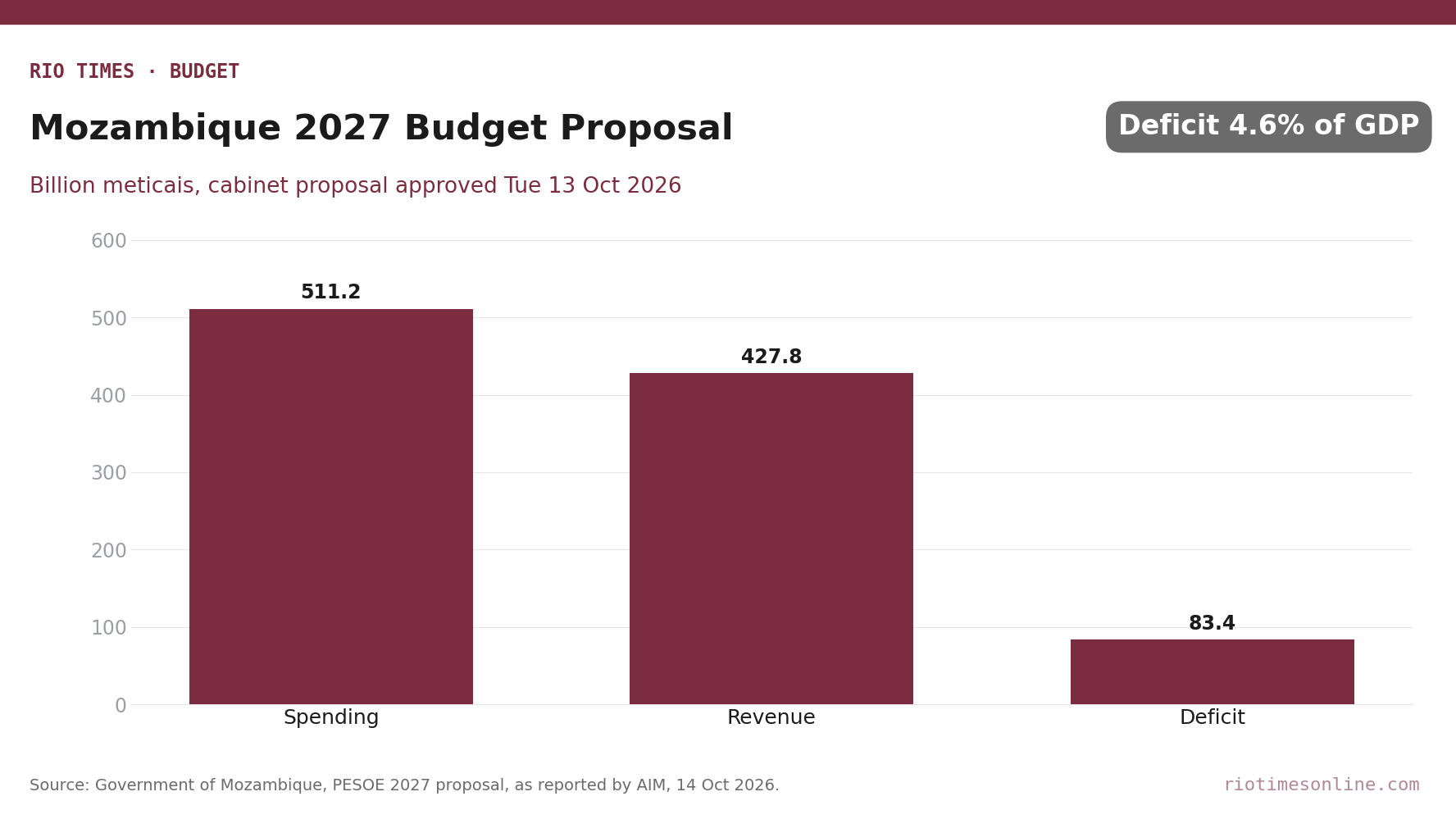
- —What happened The proposal sets 2027 spending at 511.2 billion meticais (about US$8.0 billion), about 1.8% less than this year’s budget in nominal terms.
- —The numbers Revenue is projected at 427.8 billion meticais (about US$6.7 billion), leaving a deficit of 4.6% of GDP. Growth is forecast at 1.6% and inflation at 7%.
- —What it means for you Investors get a tighter fiscal plan but thin growth to pay for it. Direct gas revenue stays small until new projects start producing.
- —Still open How parliament amends the proposal, and how the deficit will be financed, is not yet clear.
The Mozambique budget for 2027 trims state spending to 511.2 billion meticais (about US$8.0 billion), the cabinet decided on Tuesday, 13 October. The proposal now goes to parliament in Maputo and aims to narrow a deficit that has strained the country’s finances.
For US investors, the plan matters because Mozambique carries heavy debt while awaiting large gas projects, one led by ExxonMobil. A credible budget would ease pressure on its dollar bonds, while a weak one would raise the risk of fresh payment problems.
All amounts here are converted at the Bank of Mozambique reference rate of 63.91 meticais per US dollar on Wednesday, 14 October. The figures were presented after the 29th ordinary session of the Council of Ministers, the country’s cabinet.
What the Mozambique Budget Proposal Contains
Total spending of 511.2 billion meticais (about US$8.0 billion) equals 28.1% of gross domestic product, according to AIM, the state news agency. Inocêncio Impissa, the government spokesperson and minister of state administration, said spending falls about 1.8% from the 520.6 billion meticais in the 2026 budget law.
Revenue is projected at 427.8 billion meticais (about US$6.7 billion), or 23.5% of GDP, with 87% coming from taxes. That leaves a deficit of about 83 billion meticais (about US$1.3 billion), equal to 4.6% of GDP.
The 2026 budget had forecast a deficit of 7.0% of GDP, Club of Mozambique, a Maputo news service, reports. The government also plans to limit domestic borrowing to 1.9% of GDP, a step it links to macroeconomic stability.
Investment spending is set at 79.6 billion meticais (about US$1.2 billion), AIM reports. Of that, 31.1 billion meticais (about US$487 million) comes from domestic resources and 48.1 billion meticais (about US$753 million) from external sources.
Weak Growth and Heavy Fixed Costs
The macroeconomic scenario assumes real growth of 1.6% in 2027 and average annual inflation falling to 7%. Impissa said the plan balances essential state functions with “expenditure restraint and strengthened budgetary discipline,” in AIM’s English translation.
Growth of 1.6% would still mark a recovery for an economy that shrank by 0.2% in 2025, according to the Finance Ministry. Its 2027 fiscal risks report, published in September, expects growth of only 0.6% this year.
Salaries weigh heavily on the plan, and Impissa said they take about 60% to 70% of the money for running the administration. Evidências, a Maputo newspaper, reported his remarks from the cabinet briefing.
The fiscal risks report warned that the wage bill and debt service could absorb about 96% of tax revenue in 2027. That would leave only about 4% of tax revenue for goods, services, investment and emergencies.
Gas adds little to the Mozambique budget next year, with about 3.07 billion meticais (about US$48 million) expected from LNG. That money comes from the offshore Rovuma basin, where a floating plant already exports liquefied natural gas.
Why Mozambique’s Deficit Matters Now
Mozambique’s finances have been fragile since the 2016 hidden-debt scandal, when undisclosed state-guaranteed loans came to light. Club of Mozambique notes that the scandal wrecked investor confidence and curbed the country’s access to funding.
Delays to large gas projects in Cabo Delgado, where an insurgency has raged since 2017, have also pushed back expected revenue. The fiscal risks report lists insecurity in Cabo Delgado, oil prices and pressure on the metical among the main threats.
President Daniel Chapo of Frelimo, the party that has governed since independence in 1975, leads the cabinet that approved the plan. Frelimo holds a large majority in the Assembly of the Republic, although deputies can still amend the proposal.
The Bank of Mozambique, the central bank, kept its benchmark MIMO policy rate at 9.25% on 30 September. The plan’s cap on domestic borrowing could leave more bank credit available for private firms.
What It Means for US Readers
For US funds holding Mozambique’s dollar bonds, the Mozambique budget deficit target of 4.6% of GDP is the number to watch. Missing it would mean more borrowing at a time when wages and debt service already absorb most tax revenue.
ExxonMobil, the US energy company, leads the planned Rovuma LNG project, one of the gas developments Mozambique is counting on for growth. The fiscal risks report puts 2029 growth at 9.5% with the gas projects but only 3.7% without them.
US exporters and companies working in Mozambique should expect a cautious state customer, since most spending goes to wages and debt. Planned investment of about US$1.2 billion relies more on foreign partners than on domestic money.
Travellers and expatriates will see little direct change from the Mozambique budget itself. The official rate was 63.91 meticais per dollar on Wednesday, while the risk report models 76.97 in an extreme 2027 scenario.
For background, read Mozambique Explained 2026: The Gas Bet, the Insurgency, the Economy and What to Watch and Mozambique Neighbours, Six Borders and SADC Ties. For prices, see Mozambique Inflation Eases to 6.31% in September.
What Is Not Known
The full budget documents had not been published by Wednesday evening, so detailed spending by sector is not yet available. The figures here come from the cabinet briefing as reported by AIM, Carta de Moçambique and Evidências.
Carta de Moçambique gives a slightly different split: 31 billion meticais (about US$485 million) domestic and 48.5 billion meticais (about US$759 million) external. It is also not known when parliament will debate the proposal or how much it may change.
How the deficit will be financed, and whether international lenders will back the plan, was not set out at the briefing. Lower oil prices or faster gas revenue could improve the outlook, while new shocks could quickly widen the gap.
Frequently Asked Questions
How much will Mozambique spend in 2027?
The proposal sets total spending at 511.2 billion meticais (about US$8.0 billion), or 28.1% of GDP. That is about 1.8% less than the 2026 budget in nominal terms.
How large is the planned deficit?
Revenue of 427.8 billion meticais (about US$6.7 billion) leaves a gap of about 83 billion meticais (about US$1.3 billion). That equals 4.6% of GDP, down from the 7.0% forecast in the 2026 budget.
What growth does the Mozambique budget assume?
It assumes real growth of 1.6% in 2027 and average annual inflation of 7%. The economy shrank by 0.2% in 2025, according to the Finance Ministry.
When will parliament vote on the budget?
The cabinet approved the proposal on Tuesday, 13 October, and it goes to the Assembly of the Republic next. No date for a vote has been announced.
Why does the budget matter for US investors?
Mozambique has heavy debt and depends on gas projects, including one led by ExxonMobil, for future growth. A credible deficit target supports its dollar bonds, while slippage would add risk.
Sources: AIM; Carta de Moçambique; Evidências; AIM, 2026 budget; Club of Mozambique; Club of Mozambique, fiscal risks report; Banco de Moçambique exchange rates, 14 October 2026.
Editorial responsibility: Matthias Camenzind, Editor-in-Chief · Editorial standards · Report an error
Part of our ongoing coverage
Africa: The New Scramble — the great-power contest over the continent.