
ECONOMY · MOZAMBIQUE
Key Facts
- —The country Mozambique, a southern African nation of Indian Ocean ports and offshore gas fields, publishes monthly consumer prices through its statistics office, INE.
- —Why it matters Fuel and transport costs drive prices there, so oil shocks in the Middle East and the dollar price of crude feed straight into Mozambican shopping baskets.
- —Why now INE published the September consumer price index on Friday 9 October, nine days after the central bank held its key rate.
- —What happened Annual Mozambique inflation eased to 6.31% in September from 6.45% in August, while monthly prices rose 0.16% after two months of declines.
- —The numbers Prices have risen 4.99% since January. Transport costs are up 14.72% on a year earlier and food and non-alcoholic drinks 8.69%.
- —What it means for US readers The 9.25% policy rate sits about 2.9 points above inflation, a cushion for the metical that fuel shocks could erode.
- —Still open Whether September’s small rise is a one-off, and how far oil prices and climate shocks push food and fuel costs into year-end.
Mozambique inflation slowed to 6.31% in the year to September, from 6.45% in August. The national statistics office INE reported the figure on Friday 9 October. Month on month, consumer prices rose 0.16%, ending two straight months of falling prices. For foreign investors, the figure matters because fuel and transport, priced off world oil markets, remain the main source of price pressure.
INE, the Instituto Nacional de Estatística, is Mozambique’s official statistics agency. It compiles the index from eight collection centres across the country. Its September release was carried in full by the Maputo daily O País and the business paper Diário Económico. The Banco de Moçambique, the central bank, posted the headline rate on its own site the same day.
The rise in September was small. Prices had fallen 0.26% in July and 0.28% in August, so the index is still only slightly above its June level.
What Drove Mozambique Inflation in September
Three groups of spending pushed the monthly index up. Restaurants, hotels and cafés added 0.07 percentage points, according to INE as reported by both papers. Food and non-alcoholic drinks added 0.03 points, and transport another 0.03.
Individual items moved sharply. Onions rose 11.4% in the month and maize grain 10.4%. Second-hand cars gained 3.9%, and the snack category that covers burgers and prego steak rolls rose 2.5%. Together with horse mackerel, beer drunk outside the home and cement, these products added about 0.19 points.
Other prices fell and pulled the index back. Kale-type greens (couve) dropped 6.3%, cabbage 3.9%, tomatoes 2.4% and cooking oil 0.4%. Those declines took about 0.13 points off the monthly rate.
On the annual measure, the central bank said food and non-alcoholic drinks, together with clothing and footwear, did most to slow inflation. That is a comparison with prices a year earlier, so it can sit alongside a small monthly rise in food.
Fuel and Transport Remain the Pressure Point
Over the full year, transport is the outlier in Mozambique inflation. Transport prices were 14.72% higher than in September 2025, and food and non-alcoholic drinks 8.69% higher, INE data show.
Since January, transport has contributed 2.09 points of the 4.99% cumulative rise, and food 1.55 points. Diesel, urban and suburban minibus fares, fresh fish, petrol, taxi services, onions and greens explain about 2.81 points between them.
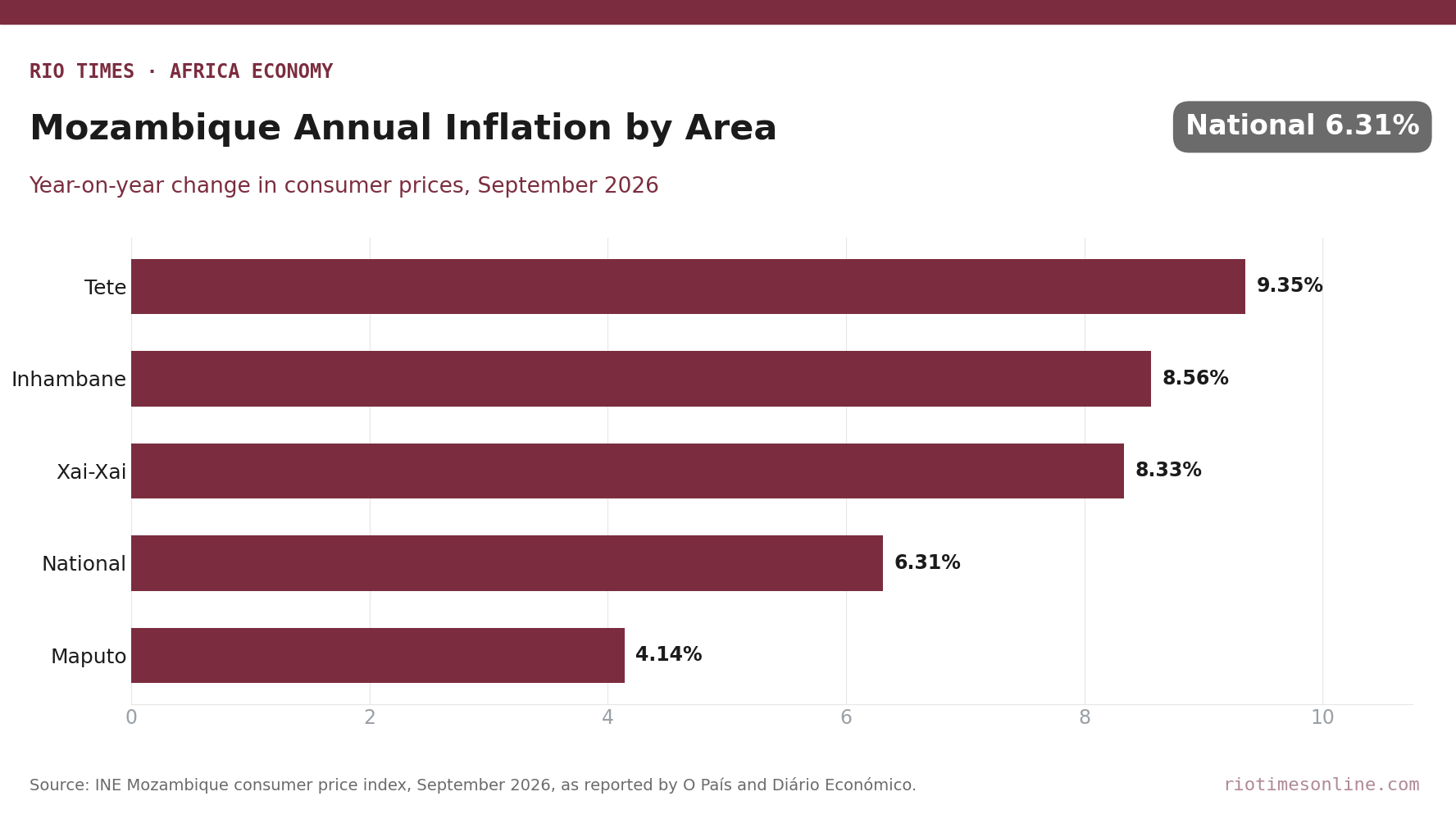
The regional picture is uneven. Tete, the coal-mining city on the Zambezi, has the highest annual rate at 9.35%. Inhambane province, home to the Tofo beach resorts, follows at 8.56%, then Xai-Xai at 8.33%. The capital, Maputo, has the lowest rate at 4.14%.
In September alone, only Chimoio and Tete saw prices fall, by 0.17% and 0.05%. Beira led the increases with 0.43%, ahead of Inhambane province at 0.37% and Xai-Xai at 0.32%.
The government’s forecast for 2026 inflation is around 7%, O País reported, so the current reading sits inside that target. Prices rose 3.23% across 2025, according to earlier INE data cited by the paper.
What It Means for US Readers
The central bank’s Monetary Policy Committee sets the MIMO policy rate and meets every two months. It held that rate at 9.25% on Wednesday 30 September. It warned that climate shocks and tensions in the Middle East and Europe could lift world fuel and food prices.
With annual inflation at 6.31%, the policy rate is roughly 2.9 points above inflation. That positive real rate supports the metical and the returns on local-currency debt for any foreign holder. It also limits how fast the bank can cut while recovery in the economy stays slow, as the committee itself noted.
For Americans, the main transmission channel is oil. Mozambique imports its fuel, and diesel and petrol are among the biggest year-to-date contributors to its inflation. A sustained rise in crude prices would show up in Mozambican transport fares within months.
Travellers should note that the beach province of Inhambane runs well above the national average, at 8.56%. Recent fuel shortages in Tete show why the interior is more exposed: see Mozambique Petrol Shortage Returns to Coal Hub Tete, One Pump Left. The wider fiscal backdrop is set out in Mozambique Gas Revenue Stays Tiny as Debt Nears 96% of GDP.
The stabiliser is that Mozambique inflation is still easing on the annual measure. The annual rate dipped, the cumulative rate remains below 5%, and the capital’s rate is near 4%.
What Is Not Known
INE’s statement, as reported, does not explain why Tete and Inhambane run so far above Maputo. Fuel logistics and food supply routes are plausible factors, but the office has not said so.
It is not yet clear whether September’s 0.16% rise ends the mid-year dip. It may be a one-off driven by onions and maize. October data will show more.
The central bank has not signalled when it might move the MIMO rate again. Its committee meets every two months, which points to a decision around late November, but the exact date was not confirmed.
Nor is it known how far oil prices will move. The bank itself named the Middle East as a key risk to fuel costs.
Frequently Asked Questions
What Was Mozambique’s Inflation Rate in September 2026?
Annual inflation was 6.31% in September 2026, down from 6.45% in August, according to INE, the national statistics office. Monthly prices rose 0.16%.
Why Did Prices Rise in September After Two Months of Declines?
Restaurants and hotels, food and transport pushed the monthly index up. Onions rose 11.4% and maize grain 10.4%, while greens, cabbage and tomatoes became cheaper.
Which Part of Mozambique Has the Highest Inflation?
Tete has the highest annual rate at 9.35%, followed by Inhambane province at 8.56% and Xai-Xai at 8.33%. Maputo has the lowest at 4.14%.
What Is the Central Bank’s Policy Rate?
The Banco de Moçambique held its MIMO policy rate at 9.25% on 30 September 2026. It cited climate risks and Middle East tensions that could lift fuel and food prices.
Why Does Mozambique’s Inflation Matter to US Investors?
Fuel and transport drive Mozambique inflation, so it tracks world oil markets. The gap between the 9.25% policy rate and 6.31% inflation also shapes returns on local-currency debt.
Sources: O País; Diário Económico; Banco de Moçambique, inflation note; Banco de Moçambique, MIMO decision.
This article was produced by The Rio Times’ automated newsroom system. How we use AI · Report an error · Editorial responsibility: Matthias Camenzind, Editor-in-Chief
Part of our ongoing coverage
Africa: The New Scramble — the great-power contest over the continent.