BRAZIL · FISCAL POLICY
Key Facts
—The decree. President Lula signed Decree 12.990 on Friday, May 29, freezing R$23.7bn ($4.7bn) in discretionary federal spending for 2026.
—The scope. The freeze affects almost every federal ministry and is split between contingenciamento and bloqueio under the spending-cap rules.
—The fiscal framework. The freeze is required by the arcabouco fiscal, the 2023 spending rule that caps real growth in federal expenses at 0.6 to 2.5 percent above inflation.
—The cumulative cut. The Friday measure follows an earlier announcement of R$22.1bn ($4.4bn) in cuts a week earlier and a R$1.6bn freeze in March, taking the running total to R$47.4bn ($9.4bn) for the year.
—Latin American impact. Brazil is the region’s largest economy, and the fiscal discipline signal carries into market pricing across Latin America.
The Lula decree signed Friday freezes R$23.7bn ($4.7bn) in discretionary federal spending and meets the arcabouco fiscal target for the year. The Lula decree affects almost every ministry and arrives a week after a smaller R$22.1bn ($4.4bn) freeze. The Ibovespa closed the month down sharply, with the real weakening 1.82 percent against the dollar across May.
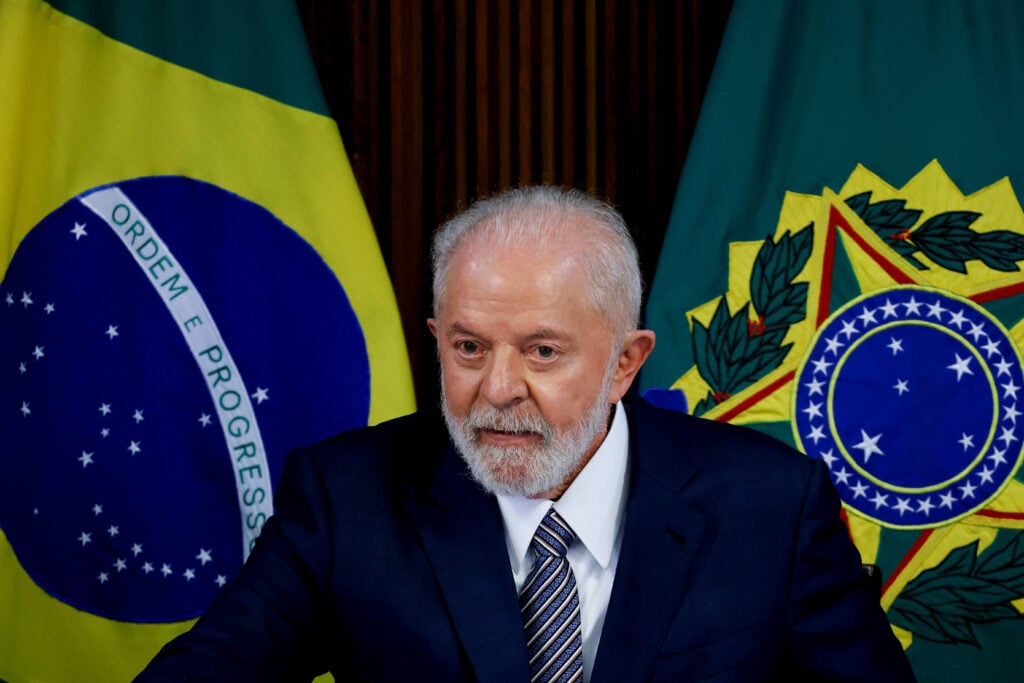
What the Lula decree actually does
Decree 12.990 of May 29, 2026, is a 3-megabyte document published in the official gazette on Friday. It freezes R$23.7bn ($4.7bn) of discretionary spending across the federal budget for the remainder of 2026, with the cuts split between contingenciamento, the deferral of authorised spending, and bloqueio, the freezing of unallocated reserves.
The breakdown follows the standard practice of distributing cuts proportionally across ministries on a discretionary basis. The Planning Ministry, run by Simone Tebet, coordinated the inter-ministerial allocation in the week leading to the signing.
The freeze leaves intact constitutionally mandated spending such as health, education, salaries, and social transfers. Discretionary spending makes up roughly 15 percent of the federal budget, and the R$23.7bn cut works out to between 5 and 6 percent of that discretionary envelope.
Why the Lula decree was needed under the arcabouco fiscal
The arcabouco fiscal is the 2023 spending-cap framework that replaced the older teto de gastos. It limits real growth in federal expenses to between 0.6 and 2.5 percent above inflation, tied to the previous year’s revenue performance.
The first-quarter revenue figures showed federal tax collection running below the projection used to set 2026 spending limits. The Treasury was then required to bring the spending envelope into compliance by year-end, which the cumulative cuts now do.
Treasury Secretary Rogerio Ceron has signalled at multiple investor events through May that the framework will be respected. Friday’s signing is the formal closure of that commitment for the first half of the fiscal year.
Live Market IntelligenceBrazil — Live Market Board
Rio Times · Live Market Intelligence
Brazil — Live Market Board
+2.63%
192,114.55
+2.63%
64,531.68
+1.10%
10,916.57
+0.08%
2,767,663
+0.32%
2,515.02
-0.59%
59,751.67
+0.18%
| Instrument | Last | Change | YoY | Prev. | High | Low | Volume |
|---|---|---|---|---|---|---|---|
| IBOV | 192,114.55 | +2.63% | +21.85% | 187,197.46 | 168,310 | 167,142 | — |
| USD/BRL | 5.16 | +0.01% | -5.13% | 5.16 | 5.18 | 5.14 | — |
| SELIC | 14.00% | — | — | — | — | — | |
| PETR4 | 41.64 | -0.05% | +35.19% | 41.66 | 41.97 | 41.15 | 41,499,400 |
| VALE3 | 72.97 | +0.83% | +30.75% | 72.37 | 73.54 | 72.66 | 17,658,000 |
| ITUB4 | 38.60 | -1.03% | +4.57% | 39.00 | 39.34 | 38.39 | 29,487,800 |
| BBDC4 | 16.85 | +0.36% | +3.50% | 16.79 | 16.90 | 16.67 | 19,416,900 |
| BBAS3 | 19.37 | +0.47% | +0.73% | 19.28 | 19.44 | 19.16 | 11,069,200 |
| B3SA3 | 14.26 | -0.21% | +12.73% | 14.29 | 14.47 | 14.11 | 33,037,800 |
| ABEV3 | 14.89 | -0.80% | +21.91% | 15.01 | 15.07 | 14.81 | 16,453,100 |
| WEGE3 | 47.59 | +0.49% | +29.99% | 47.36 | 48.08 | 47.36 | 3,364,600 |
| PRIO3 | 59.14 | -0.19% | +50.67% | 59.25 | 59.81 | 58.74 | 3,325,600 |
| SUZB3 | 41.33 | +2.35% | -23.55% | 40.38 | 41.48 | 40.35 | 3,914,900 |
| RENT3 | 34.68 | -0.09% | +0.84% | 34.71 | 34.96 | 34.35 | 7,979,100 |
| AZZA3 | 15.89 | -2.63% | -53.76% | 16.32 | 16.42 | 15.82 | 1,330,300 |
| CSNA3 | 4.30 | +0.47% | -42.65% | 4.28 | 4.41 | 4.26 | 10,076,100 |
| GGBR4 | 24.69 | +2.19% | +51.38% | 24.16 | 24.85 | 24.18 | 7,047,600 |
| ENEV3 | 24.21 | -1.38% | +70.49% | 24.55 | 24.64 | 23.99 | 9,297,000 |
The cumulative running total in the Lula decree sequence
March 2026 saw the first freeze of the year, at R$1.6bn ($318m), covering January and February revenue underperformance. The Planning Ministry described that measure as procedural at the time.
A second tranche of R$22.1bn ($4.4bn) was announced in the week of May 19. That measure was framed as a precautionary block to be formalised through a subsequent decree. The Friday decree closes the loop by giving the cut its legal form and adding the further R$23.7bn.
The cumulative total is now R$47.4bn ($9.4bn) for the year, roughly 3.3 percent of total discretionary federal spending. Further freezes through the second half of the year remain possible if revenue underperforms again.
Market reaction to the Lula decree
The Ibovespa posted its worst monthly performance since 2023 across May, closing the month down sharply. The Brazilian real weakened 1.82 percent against the dollar across the month, ending Friday at R$5.06 per dollar in the spot market.
Commodity heavyweights led the equity-market decline. Petrobras and Vale gave back substantial ground through the month on softer external demand and lower commodity prices. Bank stocks held up better, supported by elevated domestic interest rates.
The IPCA-15 inflation print released on May 27 came in above expectations, reinforcing the Banco Central‘s hawkish messaging from earlier in the month. The pricing of further freezes through the fiscal year is now visibly built into yield curves.
The Lula decree and the regional picture
Brazil is the largest economy in Latin America, and Friday’s signal lands at a moment when several regional peers face their own fiscal pressures. Mexico’s Banxico recently revised its 2026 growth forecast downward, and Chile reported a first-quarter contraction of 0.5 percent.
The Brazilian discipline signal reads as positive for sovereign-bond pricing across emerging markets. Argentine and Colombian sovereign-debt instruments respond directly to changes in Brazilian credit perception given the size and correlation of the market.
The 2026 Brazilian election begins in October, with President Lula seeking a fourth non-consecutive term, paired again with Vice-President Geraldo Alckmin. Fiscal-policy framing through the second half of the year will shape the campaign environment.
What does Decree 12.990 do?
It freezes R$23.7bn ($4.7bn) of discretionary federal spending for 2026 to bring the budget into compliance with the arcabouco fiscal spending-cap framework.
Is health and education spending cut?
No. Constitutionally mandated spending on health, education, salaries, and social transfers is protected. The cut covers only discretionary spending, which makes up roughly 15 percent of the federal budget.
What is the cumulative cut for 2026 so far?
R$47.4bn ($9.4bn) including R$1.6bn in March, R$22.1bn announced in mid-May, and R$23.7bn formalised on Friday by Decree 12.990.
What is the arcabouco fiscal?
A 2023 spending-cap framework that limits real growth in federal expenses to between 0.6 and 2.5 percent above inflation. It replaced the older teto de gastos.
How did markets react?
The Ibovespa posted its worst monthly performance since 2023 across May. The real weakened 1.82 percent against the dollar across the month, closing Friday at R$5.06 per dollar in the spot market.
For the regional fiscal context, see our coverage of the Banxico 2026 growth forecast cut and Moody’s downgrade. For the wider economic backdrop, read our piece on Dominican Republic Q1 foreign investment hitting record.
This article was produced by The Rio Times’ automated newsroom system. How we use AI · Report an error · Editorial responsibility: Matthias Camenzind, Editor-in-Chief