Bab el-Mandeb: US, China Forces Guard Oil Chokepoint
Defense Monitor · Analysis
Key Facts
—Base cluster. Djibouti hosts US, Chinese, French and other forces within a few dozen kilometres of the strait.
—US footprint. Camp Lemonnier is the only permanent US base in Africa, with 4,000+ personnel, rented for about US$60 million a year.
—Oil at stake. Roughly one-tenth of the world’s seaborne oil passes through Bab el-Mandeb.
—Convergence, not command. Rivals share an interest in an open strait but operate under separate flags and rules of engagement.
—The real risk. The danger is an accidental strike on a great power’s asset, not a planned great-power war.
Bab el-Mandeb looks like a great-power flashpoint waiting to ignite, but the more accurate reading is stranger and, for now, more stable. The world’s rival militaries are packed together opposite the strait because they all depend on the same water – and that shared dependence, not their rivalry, is driving events.
Why ‘Flashpoint’ Is the Wrong Lens for Bab el-Mandeb
A flashpoint implies two sides looking for advantage over each other. At Bab el-Mandeb, the immediate adversary is neither Washington nor Beijing; it is a non-state movement using cheap drones and missiles to tax everyone’s shipping at once.
Camp Lemonnier, the only permanent US base in Africa with more than 4,000 personnel, sits roughly five kilometres from China’s fortified base at Doraleh. Neither capital has any interest in a clash that would close the very lane both are there to protect.
That is why the dominant behaviour is wary coexistence rather than maneuvering for a fight. China has escorted merchant traffic through these waters since 2008, and the European Union has extended its defensive Operation Aspides into 2027 – rivals, separately, guarding the same channel.
How Djibouti Became the World’s Most Crowded Coastline
Djibouti’s use is geography turned into rent. A small, resource-poor state at the mouth of the Red Sea has monetised its position by leasing ground to almost anyone who asks, and Washington alone pays about US$60 million a year for Camp Lemonnier.
The outcome is a shoreline where American, Chinese, French, Japanese, Italian and Gulf forces operate within a few dozen kilometres of one another. That concentration is not a product of the current crisis; it is the accumulated residue of two decades of anti-piracy patrols, counter-terrorism missions and Belt-and-Road logistics all reaching for the same door.
Convergent Interests, Incompatible Command
The catch is that shared interest does not translate into shared action. Each navy answers to its own capital, protects its own flagged carriers, and operates under its own rules of engagement.
A US-flagged tanker, a Chinese-escorted convoy and a Saudi-led patrol can pass the same chokepoint within hours of one another without a common operating picture or a joint chain of command. That is enough sea power to deter a total closure, but it leaves seams – gaps in coverage and coordination that a nimble actor can probe.
This is the situation’s true signature: convergent ends, fragmented means. The strait is over-watched and under-coordinated at the same time.
Not Another Hormuz
It is tempting to file Bab el-Mandeb alongside the Strait of Hormuz, but the threat is a different animal. Hormuz is shadowed by a state actor, Iran, whose navy can be deterred by the classic logic of matching force against force.
Bab el-Mandeb is being squeezed by a non-state movement that owns no fleet to sink and no capital to hold at risk. That makes the pressure cheaper to sustain and far harder to deter, which is precisely why massed great-power firepower has not simply ended it.
The Real Risk Is a Seam, Not a Showdown
Because a planned great-power war here would be self-defeating, the danger shifts to the accidental. The sharpest scenario is an errant strike – a missile or drone meant for a Saudi-linked hull that instead hits a warship or base belonging to a major power.
One such incident could force a response that neither Washington nor Beijing wants, dragging a shipping dispute toward a confrontation nobody chose. A crowded battlespace, thick with drones over shared water, is what makes that low-probability event less remote than it ought to be.
The more likely path is episodic: strikes on Houthi launch sites, renewed threats, and a slow ratchet of militarisation, all kept below the threshold of direct great-power conflict. But each contested passage narrows the margin for error.
What Each Player Is Likely to Do
Expect the United States and its partners to lean on freedom-of-navigation language and periodic strikes, while leaning harder on coalitions because their own hulls are stretched thin. The appetite for an open-ended solo campaign is low.
Expect China to prioritise stability over side-taking, expanding escorts and calling for de-escalation rather than joining a Western-led operation. A direct threat to Chinese-linked ships, however, could harden that posture quickly.
Expect the Gulf states to deepen a years-long militarisation of the Red Sea shoreline, with more port and base investment on both the African and Arabian coasts. That pulls outside powers further into Yemen’s fractured politics rather than out of them.
How Long the Truce of Convenience Holds
The convergence is durable precisely because it is self-interested, not friendly. It survives as long as every party judges an open strait worth more than a point scored against a rival.
It frays if the costs of restraint rise – if a great-power asset is hit, if the Houthis broaden their target list, or if intra-Gulf rivalry turns the coalition against itself. Watch the rules of engagement and the target lists more closely than the official statements; that is where the convergence will either hold or crack.
Why Latin America Should Read This Closely
The military drama is distant, but the economic transmission is direct. War-risk premiums stay elevated, cautious shippers keep diverting around Africa’s Cape of Good Hope, and the roughly one-tenth of seaborne oil that uses Bab el-Mandeb now carries a standing risk discount.
Longer routes and higher insurance feed into freight and fuel costs that reach Latin American importers and squeeze the margins of the region’s commodity exporters. The deeper lesson also travels: a non-state actor has shown a single chokepoint can be taxed cheaply, a precedent anyone watching Hormuz, Suez or even the Panama Canal will quietly file away.
The Bottom Line
The Djibouti cluster does not make Bab el-Mandeb a great-power battlefield. It makes it something rarer – a lane that rivals are jointly compelled to keep open and jointly unable to defend, held steady less by cooperation than by a shared, self-interested reluctance to see it close.
That equilibrium is real, but it is not guaranteed. The question for the months ahead is not who wins the strait, but how long convergence under distrust can absorb the shocks before a seam gives way.
Frequently Asked Questions
Is Bab el-Mandeb likely to trigger a war between the United States and China?
It is unlikely. Both keep major bases in Djibouti but share a stronger interest in keeping the strait open than in confronting each other there.
The more realistic danger is an accidental strike hitting a major power’s ship or base, not a planned clash.
Why don’t the foreign navies simply combine forces?
Because their interests converge but their command structures do not. Each navy protects its own flag under its own rules of engagement, so the strait ends up heavily watched yet loosely coordinated – a gap a non-state actor can exploit.
How does the Bab el-Mandeb crisis affect Latin America?
Indirectly but concretely. Elevated war-risk insurance and diversions around Africa raise freight and fuel costs for the region’s importers and exporters, and the weaponisation of one chokepoint sets a precedent relevant to Hormuz, Suez and the Panama Canal.
Connected Coverage
Bab el-Mandeb Security: Saudi-led Fleet Shields Oil Route
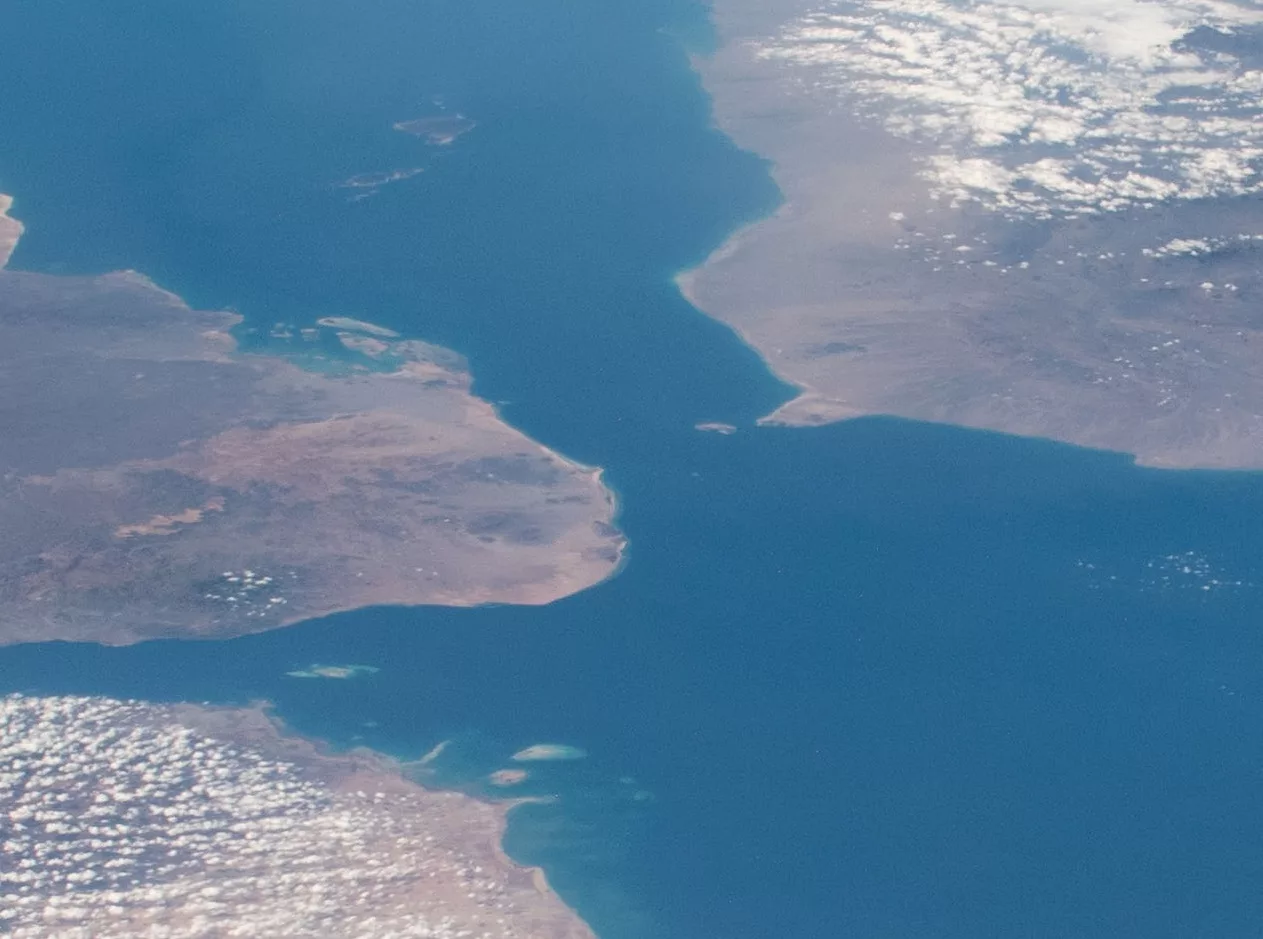
Featured image: the Bab el-Mandeb Strait from orbit — NASA Johnson Space Center, public domain, via Wikimedia Commons.
Sources: Camp Lemonnier.
This article was produced by The Rio Times’ automated newsroom system. How we use AI · Report an error · Editorial responsibility: Matthias Camenzind, Editor-in-Chief
Horn of Africa and the Red Sea
- Horn of Africa 2026: Why It Matters and Who Backs Whom
- Ethiopia’s Neighbors Explained, Ports, Eritrea, Somalia
- Eritrea Explained 2026, a Red Sea Country Guide
- Somalia Explained: Al-Shabaab, Somaliland, the Ports and the Fight Over a 2026 Vote