Key Facts
- Asia slipped overnight as chip nerves and pre-earnings caution left Nasdaq futures a shade lower and S&P 500 futures roughly flat, a timid handoff for Latin America.
- Oil is steady after a heavy fall with Brent near US$92.08 a barrel and WTI around US$85.09, leaving energy exporters with a still-elevated oil price after Monday’s Iran-driven pullback.
- The dollar is steady near US$1.1668 per euro, while the real (Brazil’s currency) closed the prior session under mild strain versus the dollar.
- Chile and Argentina led Monday’s region-wide value move with Santiago’s IPSA up 1.76% and Buenos Aires’ Merval up 2.81%, while Colombia’s COLCAP gained 2.09%.
- Wednesday’s Brazil inflation print the IPCA mid-month CPI, is expected at 4.5% year-on-year, a direct input for Selic (the central bank’s benchmark rate) and carry-trade positioning.
Today’s Focus
Latin America opens Tuesday with the overnight tape offering no strong push either way. Asia’s tech caution and a flat US futures screen blunt Monday’s regional momentum, while oil’s small rebound after a sharp drop keeps energy-sensitive exchanges like Brazil’s and Colombia’s on a short leash.
The regional board remains genuinely mixed rather than one-way. Santiago and Buenos Aires are still digesting the previous session’s strong gains — the IPSA (Chile’s benchmark) up 1.76% and the Merval (Argentina’s) up 2.81% — while Mexico’s Mexbol sits 7.7% below its 52-week high, a value pocket foreign desks continue to watch.
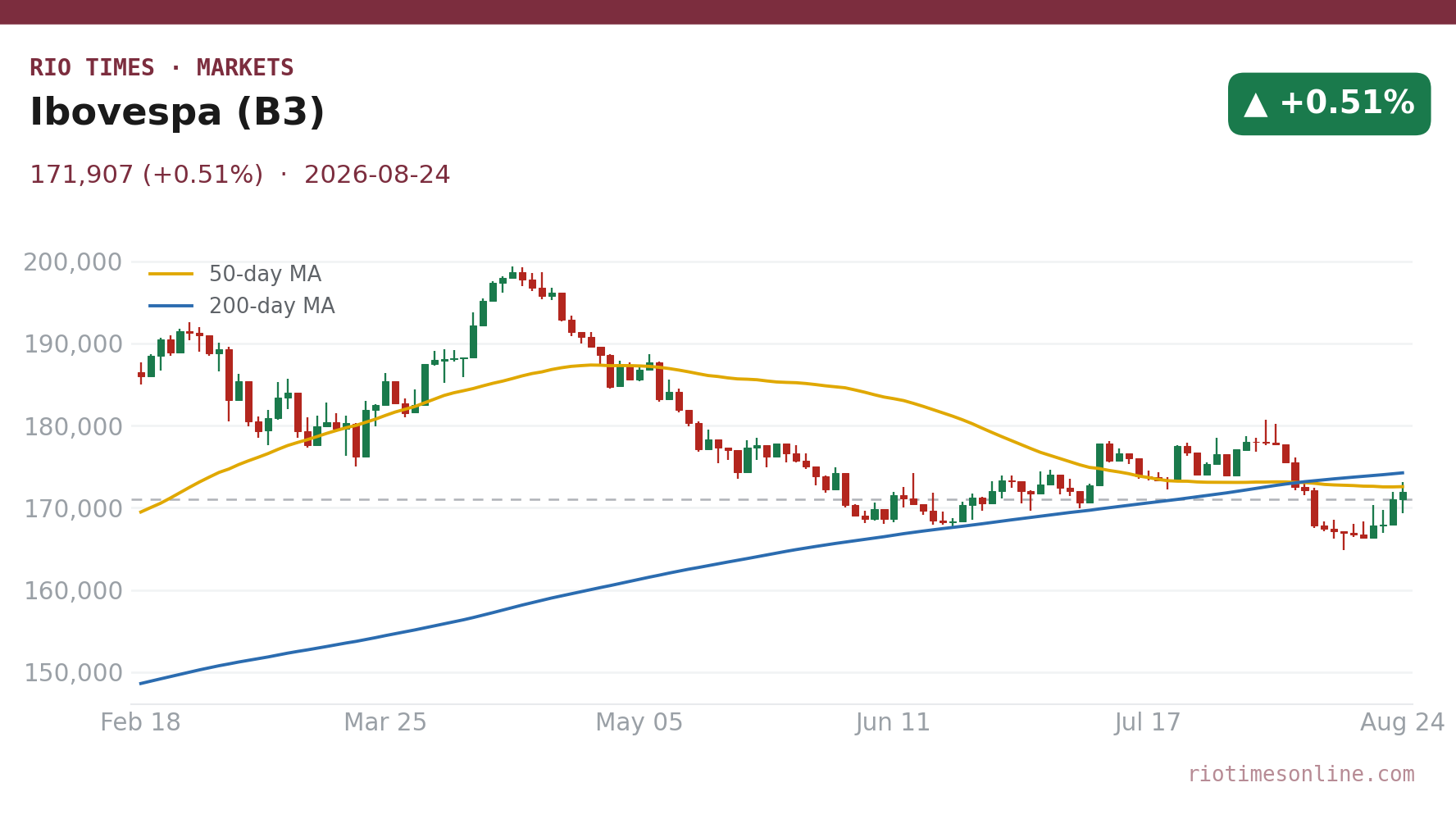
Brazil’s Ibovespa closed at 171,907, up 0.51% and decoupled from a weak S&P 500. Four straight daily gains and Vale led the advance while Petrobras fell 2.79%, so the bid was selective rather than broad that may pause today ahead of the mid-month inflation print and the US PCE report.
The dollar tone is the regional thread. Most Latin American currencies were calm into the close, though the real firmed only modestly as flows stayed selective. For foreign investors the message is clear: no macro accident overnight, but no meaningful risk appetite either.
What matters today. Wednesday’s IPCA print and US PCE data will decide whether the regional value trade keeps its four-day halo or stalls later in the week.

| Instrument | Level | Session |
|---|---|---|
| Ibovespa (Brazil) | 171,907 | +0.51% |
| S&P 500 (US) | 7,653 | -0.28% |
| USD/BRL | 5.153 | +0.17% |
| USD/MXN | 16.9485 | +0.23% |
| USD/CLP | 912.82 | -0.24% |
| USD/COP | 3,044 | -0.99% |
| USD/ARS | 1,510 | +0.67% |
Source: market close, 24 August 2026.
01 The overnight tape in one read
The handoff from Asia is cautious. Chinese and Japanese tech names drifted lower, and US futures are offered a touch — Nasdaq futures a shade lower and S&P 500 futures roughly flat — ahead of Nvidia’s results and Wednesday’s American inflation data.
Europe is not giving the region a reliable lead either. EURO STOXX 50 futures, a gauge of eurozone blue chips, are hovering about 0.05% lower, suggesting a soft start for European risk that could stretch into Latin America’s early trade.
Oil is holding steady after Monday’s 1.3% drop. Brent crude futures are near US$92.08 a barrel and US WTI near US$85.09, which matters directly for Petrobras, Ecopetrol and Argentine energy producers, as well as for government revenue expectations across the region.
The dollar is steady against major peers, with the euro around US$1.1668. That backdrop of mild dollar stability and flat commodities has not disturbed Latin American foreign-exchange markets, though it also offers little new ammunition for a fresh leg higher in local equities.
Four straight daily gains for the Ibovespa, heavy turnover in resource names and a weak S&P 500 point to genuine foreign rotation into Latin America rather than passive beta. But the absence of fresh oil momentum and soft US futures suggests the region opens in repair mode, not breakout mode. The variable to watch is Wednesday’s IPCA mid-month CPI: a print at or below the 4.5% estimate would reinforce the local carry and likely extend steady inflows into B3’s large caps.
02 The board before the open
| Instrument | Level | Change | Read |
|---|---|---|---|
| S&P 500 futures | — | −0.08% | US risk appetite flat to soft before PCE |
| Brent crude | US$92.08/bbl | −0.1% | Energy anchors steady after Monday’s slide |
| WTI crude | US$85.09/bbl | +0.1% | Small bounce, no trend confirmation |
| USD/BRL | 5.153 | +0.17% | Real mildly heavier into Tuesday’s open |
| USD/MXN | 16.9485 | +0.23% | Peso calm, carry still supported |
| Gold | US$4,680/oz | +1.56% | Haven bid quietly rising, not a panic |
The board reads as a pause after Monday’s regional strength. Brent’s fractional dip keeps the energy complex honest, while gold’s gain of 1.56% hints at quiet portfolio hedging rather than outright risk-off.
Latin American currencies are the story of calm. The Colombian peso, not shown here, strengthened notably in the previous session, while the real and Mexican peso trade with small losses that reflect a steady dollar more than any local stress. Rio Times · Live Market Intelligence
Live Market IntelligenceLatin America — Cross-Market Board
Latin America — Cross-Market Board
Instrument Last Change YoY Prev. High Low Volume
IBOV
207,668.41
+0.70%
+21.85%
206,220.24
168,310
167,142
—
IPSA
11,051.39
+0.25%
—
11,024.22
11,210
10,984
1,513,213,483
IPC MEX
64,986.91
+0.52%
+12.17%
64,653.33
66,121
65,405
108,886,187
MERVAL
2,828,812
-0.13%
+30.51%
3,022,485
3,042,365
2,991,150
—
COLCAP
2,534.92
+0.36%
—
9.04
9.05
9.02
4,133
BVL PERÚ
59,610.00
+0.97%
—
—
—
—
—
USD/BRL
5.16
+0.01%
-5.13%
5.16
5.18
5.14
—
EUR/BRL
5.95
+1.01%
-5.83%
5.89
5.98
5.94
—
USD/MXN
17.06
-0.24%
-8.58%
17.10
17.08
17.01
—
USD/CLP
913.98
+0.04%
-5.67%
913.65
915.11
906.68
—
USD/COP
3,140
+0.03%
-22.04%
3,139
3,141
3,105
—
USD/PEN
3.36
-0.66%
-4.82%
3.38
3.38
3.35
—
USD/ARS
1,493
+0.10%
+12.96%
1,491
1,494
1,480
—
USD/UYU
40.27
+1.24%
+1.80%
39.77
40.27
40.23
—
USD/PYG
5,939
+1.68%
-19.54%
5,841
5,939
5,925
—
USD/BOB
11.64
-0.76%
+72.04%
11.73
11.72
11.64
—
USD/DOP
58.34
+1.25%
-3.44%
57.62
58.34
58.04
—
USD/CRC
445.92
+0.89%
-9.71%
441.97
448.50
445.92
—
03 What the data shows — Vale and Petrobras anchor a resource-heavy session
| Stock | Move | Turnover | Note |
|---|---|---|---|
| VALE3 | +2.93% | R$2,218m | Mining giant Vale led turnover; iron ore stable overnight |
| PETR4 | -2.79% | R$2,083m | Petrobras preferred; fell with crude |
| SUZB3 | +3.34% | R$903m | Suzano; pulp names caught the value bid |
| SBSP3 | +1.14% | R$878m | Sabesp water utility; heavy volume |
| ITUB4 | +0.73% | R$734m | Itaú Unibanco preferred; financials remain in demand |
| BOVA11 | +0.51% | R$642m | Bovespa ETF; proxy for broad index flows |
| AXIA3 | — | R$576m | Axia Energia, the renamed Eletrobras and Brazil’s largest listed power utility |
Turnover is concentrated in exactly the names foreign desks expect: Vale (VALE3) and Petrobras (PETR4) together drew roughly R$4.3 billion in one session, confirming that the local bid was selective rather than a broad commodity trade rather than a broad domestic re-rating.
The presence of Sabesp (SBSP3) in fourth place by turnover, behind Suzano, is notable. Utility names rarely compete with the miners and banks for volume, which suggests a domestic investor base is rotating toward dividends and regulated cash flows as the Selic outlook softens.
04 Brazil and the currencies
Brazil opens with the real at 5.153 per dollar, a 0.27% leg higher for the greenback, and all eyes on Wednesday’s mid-month IPCA consumer price index. The estimate of 4.5% year-on-year would keep inflation near the top of the central bank’s tolerance band, complicating the case for aggressive Selic relief.
The Selic, Brazil’s benchmark interest rate, remains the linchpin of the carry trade funding foreign flows into B3. Monday’s four-day winning streak on the Ibovespa suggests investors are positioning for a manageable inflation print and continued real-economy resilience.
Foreign flows into the broad Bovespa ETF BOVA11 reached R$642 million in turnover, a useful proxy for offshore participation. That flow, combined with Petrobras and Vale volume, suggests foreign capital is buying Brazilian cash flows rather than chasing a weak-dollar story.
Across the region, the Colombian peso was the standout gainer, touching its strongest level against the dollar since 2018, while Argentina’s peso remains under chronic pressure despite a strong Merval equity market that is once again being used as an inflation hedge by local investors.
05 The regional setup
| Index | Country | Change |
|---|---|---|
| Ibovespa | Brazil | +0.51% |
| IPC (Mexbol) | Mexico | +0.06% |
| IPSA | Chile | +1.76% |
| Merval | Argentina | +2.81% |
| COLCAP | Colombia | +2.09% |
| BVL Perú | Peru | −0.17% |
Monday’s regional board was all about value and commodities. Chile’s IPSA jumped 1.76% and Argentina’s Merval 2.81%, while Colombia’s COLCAP surged 2.09% as local pension money rotated back into liquid large caps.
Mexico’s Mexbol, the IPC, is the laggard on a 52-week basis, still 7.7% below its high. That discount, plus a stable peso and solid bank earnings, is the clearest regional value case for foreign investors willing to tolerate political noise.
06 The technical picture
The Ibovespa’s four straight daily gains have carried it to 171,907, but the index remains about 13.5% below its 52-week high of 198,657. The recovery is real but still well short of a breakout.
The S&P 500 sits just 1.9% from its own high and, after Monday’s 0.28% dip, is showing the kind of wobble that tends to slow Latin American momentum. The VIX, a gauge of US stock-market fear, rose near 5% to 15.85, hinting traders are buying a little protection into the PCE report.
For Latin America, the technical levels that matter most are USD/BRL around 5.15 and the Mexican peso near 16.95. Both currencies are consolidating after two weeks of strength against the dollar, and Wednesday’s US data will decide whether that pause turns into a deeper correction.
The regional trade stays long resource exporters and dividend payers until the inflation picture changes. If IPCA surprises low and core PCE lands soft, expect one more leveraged push into B3’s value complex later in the week.
07 What to watch
- IPCA mid-month CPI: A 4.5% or softer print would anchor Selic expectations and keep real-denominated carry attractive.
- US core PCE: That is the Federal Reserve’s preferred inflation gauge; a hot number would lift the dollar and squeeze emerging-market flows.
- Nvidia earnings Wednesday: Nasdaq futures are already hesitant; any guidance shock would hit Mexican and Brazilian tech exporters hardest.
- Energy sector reaction: Oil is steady after a 1.3% slide, but a break below US$85 WTI would drag Petrobras, Ecopetrol and the Merval’s energy names lower.
Frequently Asked Questions
What is driving Latin America’s pre-open today?
A cautious Asian session, steady oil after a 1.3% slide, and flat US futures are cutting the momentum from Monday’s broad regional rally.
Which Latin American market is leading?
Argentina’s Merval and Colombia’s COLCAP led the prior session with gains of 2.81% and 2.09%, but the pre-open setup is now more selective.
Why does the real matter this morning?
The real is at 5.153 per dollar and Brazil’s mid-month IPCA inflation print is due Wednesday; the result will frame Selic expectations and foreign demand for Brazilian assets.
What should I watch in US data?
Core PCE inflation is the headline. A hot reading would push the dollar up and likely cool the regional value trade into the New York afternoon.
This article was produced by The Rio Times’ automated newsroom system. How we use AI · Report an error · Editorial responsibility: Matthias Camenzind, Editor-in-Chief
LatAm Markets: Live Signals → — real-time movers, turnover leaders and FX across Latin America.