LatAm Pre-Open — Monday, September 14, 2026
Key Facts
- Oil is the story, with Brent crude jumping to $107.48 a barrel and WTI to $102.59, lifting the entire commodity complex and offering clear support for the region’s exporters.
- Wall Street closed higher, with the Dow up 0.98%, the S&P 500 up 0.86% and the Nasdaq up 0.96%, but the VIX’s 11.21% tumble shows fear is leaving the market fast.
- Brazil outperformed on the week, with the Ibovespa down 0.56% on Friday but up 1.11% over five sessions, while the Dow lost 1.6%.
- China’s data lands Tuesday, with industrial production and retail sales the headline numbers, an event that could reset the mood for Chile’s copper and Brazil’s iron ore miners.
- The dollar is mixed, with the Brazilian real weaker at 5.125 per US dollar while the Mexican peso firmed to 16.9705, keeping currency traders on their toes.
Today’s Focus
Latin America walks into Monday with a simple equation: oil is up sharply, China is about to speak, and the region’s own Friday session was cautious. The rise in crude prices — Brent up 2.74% to $107.48 — is a direct tailwind for Colombia’s Ecopetrol, Brazil’s Petrobras and Mexico’s peso, which all feed off the energy trade.
But there is a catch. China’s industrial production and retail sales are due before many Latin American desks even get going, and a weak number could quickly cool the commodity cheer. Chile’s IPSA and Brazil’s Vale will be the first to feel any disappointment.
The dollar index barely moved, which means currency traders are left to focus on local stories. Brazil’s July retail sales land on Tuesday, alongside Peru’s GDP and unemployment figures. Argentina’s peso trades near 1,508.50 to the US dollar.
For now, the tone is cautiously constructive. The market has a bid, but it is waiting for a reason to push risk harder. That reason will come from China.
What matters today. Whether China’s data justifies the oil rally, and whether Brazil’s retail sales can break its decoupling from Wall Street.
| Instrument | Level | Session |
|---|---|---|
| Ibovespa (Brazil) | 187,207 | -0.56% |
| S&P 500 (US) | 7,657 | +0.86% |
| USD/BRL | 5.125 | +0.44% |
| USD/MXN | 16.9705 | -0.17% |
| USD/CLP | 942.45 | -0.27% |
| USD/COP | 3,084.49 | -0.80% |
| USD/ARS | 1,508.50 | -0.80% |
Latin American markets — Sources: B3, BMV, Bolsa de Santiago, bvc, BYMA and BVL closing levels, 11 September 2026.
01 The overnight tape in one read
The global tape has a single, unmistakable pulse this morning: oil. With Brent crude at $107.48 a barrel and WTI at $102.59, the energy complex is the market’s main driver, and that matters enormously for Latin America, where exporters from Mexico to Colombia swing with the price of a barrel.
European shares opened higher, rebounding from Thursday’s decline. Asian markets were mixed overnight.
In Washington, the week turns on Wednesday’s Federal Reserve decision. Markets price roughly a 90% chance of a rise to 4.00%, after August inflation came in at 3.4% headline and 2.4% core. Tuesday brings the Empire State manufacturing survey and a 20-year Treasury auction.
The evidence paints a mixed picture. Oil is clearly bid, Wall Street closed strong, and fear has drained out of the volatility index. Yet Latin America’s own boards closed mostly lower on Friday — from the Ibovespa’s 0.56% loss to the Merval’s 1.87% slide — which suggests local caution is still present. The variable to watch is China’s data release: if industrial production beats forecasts, the commodity complex will likely extend its rally and drag the region higher at the open.
02 The board before the open
| Instrument | Level | Change | Read |
|---|---|---|---|
| Ibovespa | 187,207 | −0.56% | Brazil lagged Wall Street on Friday |
| S&P/BMV IPC | 63,925 | −0.28% | Mexico eased but held its range |
| S&P IPSA | 11,221 | −0.16% | Chile barely moved, watching copper |
| Merval | 3,098,898 | −1.87% | Profit-taking after three gains |
| COLCAP | 2,590 | −1.41% | Colombia slid despite firm oil |
| USD/BRL | 5.125 | +0.44% | The real weakened into the weekend |
| USD/MXN | 16.9705 | −0.09% | The peso firmed marginally |
The board shows a region that closed Friday on the back foot, even as Wall Street rallied. The most striking number is the Merval’s 1.87% drop, which local desks read as profit-taking after three straight gains. Country risk actually improved, to 485 basis points, a one-month low.
What matters now is whether Monday’s open can reverse that tone. Oil’s climb is the strongest reason to think it might, especially for Mexico, which benefits doubly — through its exporters and through the peso, which tends to track the energy trade closely. Rio Times · Live Market Intelligence
Live Market IntelligenceLatin America — Cross-Market Board
Latin America — Cross-Market Board
Instrument Last Change YoY Prev. High Low Volume
IBOV
187,206.89
-0.56%
+21.85%
188,268.59
168,310
167,142
—
IPSA
11,220.60
-0.16%
—
11,238.58
11,210
10,984
1,513,213,483
IPC MEX
63,924.77
-0.28%
+12.17%
64,106.82
66,121
65,405
108,886,187
MERVAL
3,098,898
-1.87%
+30.51%
3,022,485
3,042,365
2,991,150
—
COLCAP
2,589.69
-1.41%
—
9.04
9.05
9.02
4,133
BVL PERÚ
59,373.28
—
—
—
—
—
—
USD/BRL
5.16
+0.01%
-5.13%
5.16
5.18
5.14
—
EUR/BRL
5.95
+1.01%
-5.83%
5.89
5.98
5.94
—
USD/MXN
17.06
-0.24%
-8.58%
17.10
17.08
17.01
—
USD/CLP
913.98
+0.04%
-5.67%
913.65
915.11
906.68
—
USD/COP
3,140
+0.03%
-22.04%
3,139
3,141
3,105
—
USD/PEN
3.36
-0.66%
-4.82%
3.38
3.38
3.35
—
USD/ARS
1,493
+0.10%
+12.96%
1,491
1,494
1,480
—
USD/UYU
40.27
+1.24%
+1.80%
39.77
40.27
40.23
—
USD/PYG
5,939
+1.68%
-19.54%
5,841
5,939
5,925
—
USD/BOB
11.64
-0.76%
+72.04%
11.73
11.72
11.64
—
USD/DOP
58.34
+1.25%
-3.44%
57.62
58.34
58.04
—
USD/CRC
445.92
+0.89%
-9.71%
441.97
448.50
445.92
—
03 What the data shows — Brazil’s local logic defies the oil rally
| Stock | Move | Turnover | Note |
|---|---|---|---|
| PETR4 | — | R$1.358bn (US$265m) | Petrobras preferred — the oil trade |
| VALE3 | — | R$1.092bn (US$213m) | Vale common — China’s iron ore bellwether |
| ITUB4 | — | R$1.007bn (US$196m) | Itaú preferred — bank proxy for Selic hopes |
| BBDC4 | — | R$0.796bn (US$155m) | Bradesco preferred — rate-sensitive |
| AXIA3 | — | R$0.712bn (US$139m) | Axia Energia, formerly Eletrobras — power utility |
The turnover leaders tell a clear story: Petrobras and Vale dominate the B3 tape, which means the first move on Monday will be dictated by oil and China. Petrobras, as Brazil’s state-controlled oil giant, is the most direct play on the Brent price, while Vale is the country’s main iron ore exporter and lives and dies by Chinese demand.
The presence of Itaú and Bradesco preferred shares among the most-traded names shows that the local interest-rate debate is alive and well. Brazil’s Selic rate sits at 14.00%, a magnet for foreign flows. Copom is expected to cut it to 13.75% on Wednesday.
04 Brazil and the currencies
Brazil enters Monday with a distinct problem: it decoupled from Wall Street on Friday, falling 0.56% while the S&P 500 rose 0.86%. That gap is the single most important local signal, because it suggests domestic investors are worried about something specific — politics, fiscal slippage or the pace of rate cuts — rather than global risk appetite.
The real’s move to 5.125 per dollar tells the same story. A weaker real alongside a firm oil price is unusual, since Brazil is a net oil exporter and the currency often tracks the energy trade. The market is effectively saying it needs more local evidence before buying the real again.
Tuesday’s July retail sales data will test that mood. A strong number would support the idea that Brazil’s economy is still stable enough to keep foreign capital interested, especially with the Selic still high enough to offer a real yield premium over most developed markets.
Across the region, the currency picture is more nuanced. Mexico’s peso firmed to 16.9705 per dollar, buoyed by oil but also by a sense that the Bank of Mexico will stay hawkish. Argentina’s peso held near 1,508.50 — a level that says more about capital controls and political risk than about any fundamental trend.
05 The regional setup
| Index | Country | Change |
|---|---|---|
| Merval | Argentina | −1.87% |
| COLCAP | Colombia | −1.41% |
| Ibovespa | Brazil | −0.56% |
| S&P/BMV IPC | Mexico | −0.28% |
| S&P IPSA | Chile | −0.16% |
The regional board is a study in contrasts. Argentina’s Merval fell hardest, down 1.87% on profit-taking. The political risk premium now attaches to the 2027 cycle, not the near term. Colombia’s COLCAP slid 1.41% even as the peso firmed 0.8% — a warning that the energy trade is not a magic wand for every market.
Mexico and Chile held up best, with the IPC down just 0.28% and the IPSA down 0.16%. Both have levers that oil and copper can pull, and both benefit from proximity to the US market, though Wall Street finished the week lower.
The question for today is whether the oil bid can pull the laggards higher. If China’s data is strong, the whole region should catch a bid; if it disappoints, the divergence between commodity-rich markets and domestic-demand stories will widen further.
06 The technical picture
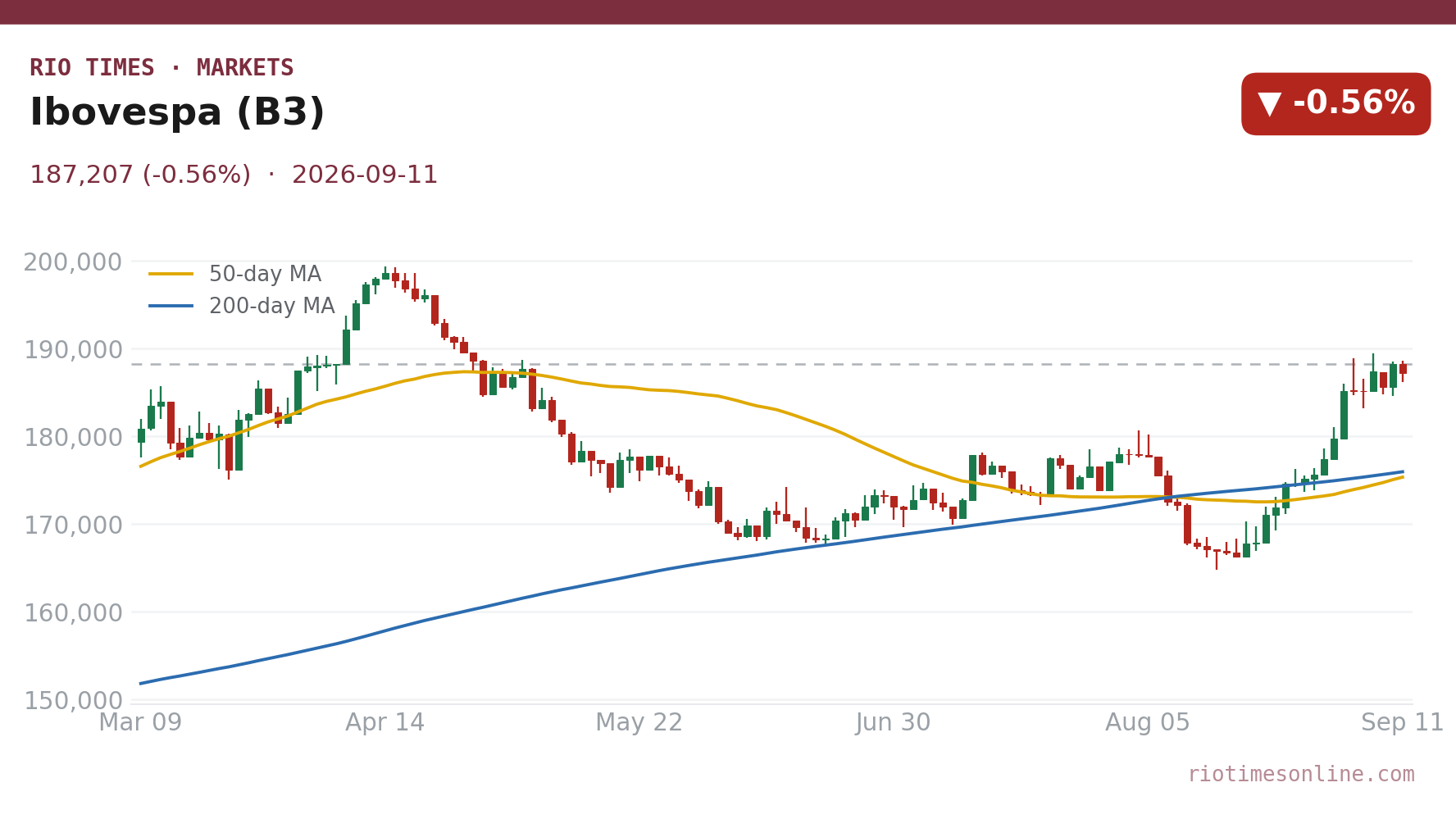
The technical picture is quietly encouraging for the region, even after Friday’s soft close. The VIX — Wall Street’s fear gauge — tumbled 11.21% to 15.84, which means options traders no longer see a near-term crash as likely. That is exactly the kind of environment where emerging-market equities can outperform.
The Ibovespa’s 52-week range is wide: from 140,680 to 198,657, and the index at 187,207 is far closer to the top than the bottom. Yet the index is still nearly 5.8% below its recent high, leaving room for a run if the macro stars align.
For Mexico, the IPC sits at 63,925, well below its 52-week high of 71,601. That is a 10.7% gap, the largest among the region’s main indices, which could make Mexican equities the most attractive catch-up trade if oil keeps climbing.
The key technical test for today is simple: can the commodity-heavy markets — Brazil, Mexico, Colombia — open higher and hold those gains through the session? If they do, the Friday decoupling from Wall Street will look like a blip, not a trend.
07 What to watch
- China’s industrial production: A beat on the expected 4.8% would lift copper and iron ore, driving Chile’s IPSA and Brazil’s Vale; a miss would do the opposite.
- Brazil retail sales, Tuesday: The July figure is the clearest read on whether domestic demand is holding up before Wednesday’s Copom decision.
- The Federal Reserve, Wednesday: A rise to 4.00% is about 90% priced. Copom decides the same day, with a cut to 13.75% expected, and Mexican markets are shut for Independence Day.
- Oil’s follow-through: Brent at $107.48 is already a strong level; if it holds above that, Mexico’s peso and Colombia’s COLCAP should extend their recovery.
Frequently Asked Questions
Why is oil so important for Latin America today?
Because several of the region’s largest companies and currencies are directly tied to oil prices. Higher oil means better earnings for Petrobras in Brazil, Ecopetrol in Colombia and Pemex-linked suppliers in Mexico, and it often strengthens the Mexican peso.
Why did Brazil fall on Friday when Wall Street rose?
The Ibovespa’s 0.56% drop while the S&P 500 gained 0.86% points to domestic concerns — possibly fiscal risk or political noise — rather than global factors. The market is waiting for local data to decide whether that decoupling continues.
What is the Selic and why does it matter for foreign investors?
The Selic is Brazil’s benchmark interest rate, set by the central bank. When it is high, as it has been, it attracts foreign capital into Brazilian bonds and equities, supporting the real. Any hint of faster rate cuts can reverse those flows.
How does China’s data affect Latin American stocks?
China is the biggest buyer of Latin American commodities — copper from Chile, iron ore from Brazil, soy from Argentina. If Chinese industrial production and retail sales come in strong, those exports rise and the region’s big exporters rally.
Market data: RT
This article was produced by The Rio Times’ automated newsroom system. How we use AI · Report an error
LatAm Markets: Live Signals → — real-time movers, turnover leaders and FX across Latin America.
Read More from The Rio Times