LatAm Pre-Open — Thursday, September 10, 2026
Key Facts
- Asian trade was mixed with a softer dollar and stronger energy prices cushioning equities ahead of the key US inflation report
- A modest risk-on pulse ran through commodities, lifting copper and gold, which tends to help miners in Chile, Peru and Brazil
- The real weakened in the settled session, keeping pressure on São Paulo even as the Merval in Buenos Aires rose
- Traders are positioning for Brazil’s monthly services survey today and the IPCA inflation print on Friday, the last major local data before the Selic decision
- Mexico reports industrial production while Argentina releases its own monthly inflation number, leaving three separate domestic catalysts on the regional board
Today’s Focus
The global tape gives Latin America a reason for guarded optimism on Thursday. A softer US dollar, firmer oil and robust metals prices are the main supportive forces flowing into the region’s pre-open.
Yet the settled session showed the mood is not uniform. The Merval in Buenos Aires and the COLCAP in Bogotá advanced, while the Ibovespa in São Paulo tracked Wall Street lower and the real lost ground against the dollar.
Today’s Big Domestic Data is Brazil’s monthly services survey, with the IPCA inflation print following on Friday at noon local time. Economists polled expect the monthly inflation reading to have deflated slightly, which would feed directly into expectations for the central bank’s next move on the Selic, Brazil’s benchmark interest rate.
Mexico’s industrial production and Argentina’s monthly inflation number add regional spice. Across the Andes, copper’s strength is a quiet tailwind for Chilean equities and the peso, even as the IPSA slipped in the prior session.
What matters today. Whether Brazil’s inflation print confirms enough cooling to keep local rates on a downward path, which would matter more for the real and B3 than any single overnight move.
| Instrument | Level | Session |
|---|---|---|
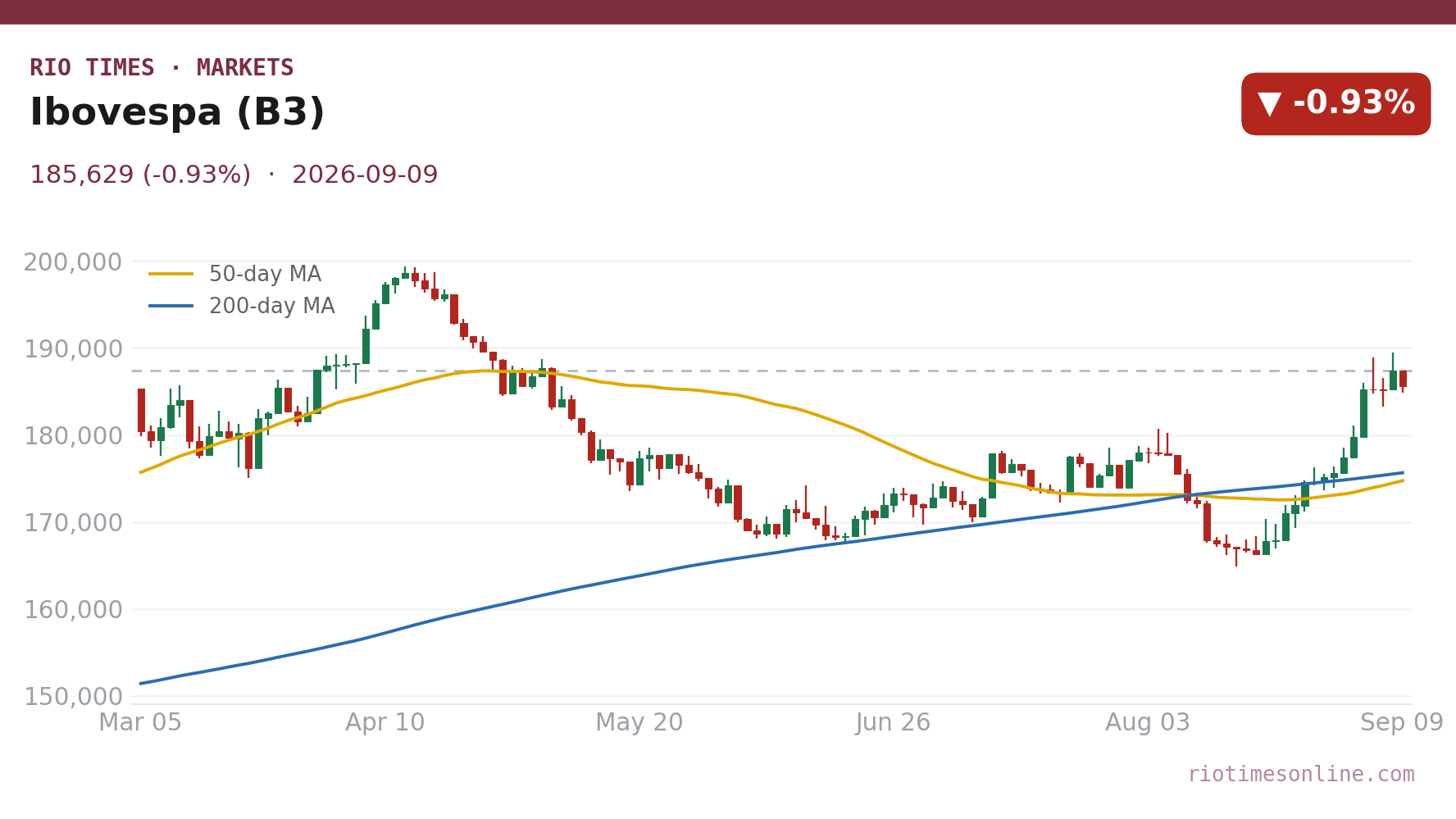
| Ibovespa (Brazil) | 185,629 | -0.93% |
| S&P 500 (US) | 7,636 | -0.48% |
| USD/BRL | 5.1086 | +0.45% |
| USD/MXN | 16.896 | -0.12% |
| USD/CLP | 927.66 | +0.26% |
| USD/COP | 3,117 | -0.30% |
| USD/ARS | 1,514 | +0.13% |
Source: market close, 9 September 2026.
01 The overnight tape in one read
Trade date: Wednesday 9 September 2026.
Asian markets were mixed on Thursday, with Japan’s Nikkei 225 slightly lower and China’s Shanghai Composite higher. The dollar stayed under pressure against several Asian currencies, while energy prices firmed.
That combination — a soft greenback and rising oil — typically helps emerging markets that export commodities. Latin America imports less oil than many regions and exports copper, iron ore and soybeans, so the regional calculus is different from Asia’s chip-and-tech tilt.
Gold and silver both rose in the verified figures, with silver up strongly. Copper’s continued firmness, noted across Asia, is an important signal for Chile and Peru, where miners are central to the domestic exchange indexes.
US futures are not uniformly higher, and the prior Wall Street session was down across the board. That restraint keeps the regional pre-open cautious rather than euphoric.
The evidence points to a tempered risk-on tone at the open: a soft dollar, firmer metals and stable-to-lower US core inflation expectations are supportive. However, the verified board shows the real weakened and the Ibovespa fell more than the S&P 500 in the last session, so São Paulo enters on slightly shaky ground.
The variable to watch is Friday’s IPCA monthly deflation print: if it confirms the consensus, rate-cut bets should anchor the real and could lift rate-sensitive stocks on B3; a hotter number would do the opposite.
02 The board before the open
| Instrument | Level | Change | Read |
|---|---|---|---|
| Gold | $4,394/oz | +1.00% | Safe-haven bid alive |
| Silver | $67.20/oz | +2.46% | Metals complex firm |
| VIX | 16.46 | +4.71% | Hedging demand ticked up |
| US 10Y yield | 4.844% | +1.04% | Long rates nudged higher |
| DXY | 98.79 | +0.00% | Dollar flat, not falling |
The board is a study in quiet tension. Gold and silver firmed, and the VIX — Wall Street’s so-called fear gauge — rose, suggesting that caution and a search for cushions coexisted overnight.
The US 10-year Treasury yield moved higher in the prior session. That matters because rising US long rates can pull capital away from riskier emerging-market assets, even when the dollar itself is flat. Rio Times · Live Market Intelligence
Live Market IntelligenceLatin America — Cross-Market Board
Latin America — Cross-Market Board
Instrument Last Change YoY Prev. High Low Volume
IBOV
205,082.56
+0.47%
+21.85%
204,120.12
168,310
167,142
—
IPSA
10,746.36
-0.31%
—
10,780.31
11,210
10,984
1,513,213,483
IPC MEX
69,879.62
-0.01%
+12.17%
69,889.73
66,121
65,405
108,886,187
MERVAL
3,017,221
—
+30.51%
3,022,485
3,042,365
2,991,150
—
COLCAP
2,540.10
+0.46%
—
9.04
9.05
9.02
4,133
BVL PERÚ
57,021.19
+0.13%
—
—
—
—
—
USD/BRL
5.16
+0.01%
-5.13%
5.16
5.18
5.14
—
EUR/BRL
5.95
+1.01%
-5.83%
5.89
5.98
5.94
—
USD/MXN
17.06
-0.24%
-8.58%
17.10
17.08
17.01
—
USD/CLP
913.98
+0.04%
-5.67%
913.65
915.11
906.68
—
USD/COP
3,140
+0.03%
-22.04%
3,139
3,141
3,105
—
USD/PEN
3.36
-0.66%
-4.82%
3.38
3.38
3.35
—
USD/ARS
1,493
+0.10%
+12.96%
1,491
1,494
1,480
—
USD/UYU
40.27
+1.24%
+1.80%
39.77
40.27
40.23
—
USD/PYG
5,939
+1.68%
-19.54%
5,841
5,939
5,925
—
USD/BOB
11.64
-0.76%
+72.04%
11.73
11.72
11.64
—
USD/DOP
58.34
+1.25%
-3.44%
57.62
58.34
58.04
—
USD/CRC
445.92
+0.89%
-9.71%
441.97
448.50
445.92
—
03 What the data shows — steel and silver linings on B3
| Stock | Move | Turnover | Note |
|---|---|---|---|
| CSNA3 | +7.4% | R$251m (US$49 million) | Steelmaker led the gainers |
| SLCE3 | +6.1% | R$159m (US$31 million) | Agribusiness strength |
| CMIN3 | +3.6% | R$64m (US$13 million) | Iron-ore miner lifted by metals |
| YDUQ3 | +2.5% | R$105m (US$21 million) | Education name bounced |
| CVCB3 | −9.8% | R$31m (US$6 million) | Travel platform sold off sharply |
The B3 scan tells a clear story: even on a down day for the Ibovespa, investors were selectively buying commodities-linked stories. Steelmaker CSN led the local gainers with a strong move on meaningful turnover, while CSN Mineração and agribusiness name SLC Agrícola also rose.
Meanwhile, travel platform CVC was the weakest name among the losers, a sign that domestic consumption and services are not yet winning favour. The turnover leaders remain the classic heavyweights — Petrobras, Vale and Itaú — which gives the tape its defensive, liquid character.
04 Brazil and the currencies
The real is the main source of friction for Brazilian assets this morning. In the prior session, the currency weakened against the dollar, which tends to amplify losses in the Ibovespa even when global markets are merely soft.
Brazil releases the monthly services survey today, and the IPCA consumer-price index on Friday at noon local time. The consensus is for a monthly decline in the headline inflation number, which would be the strongest evidence yet that inflation is cooling on schedule.
If the print confirms disinflation, the central bank has more room to keep easing monetary policy — that is the basis of the carry trade logic that has supported the real. A hot number would invert that logic and put further pressure on the Selic-sensitive parts of the local market.
Speculative positioning data for both the real and the Mexican peso is also scheduled later, via the CFTC. Those numbers can reveal whether global traders have been building or cutting exposure to Latin currencies.
05 The regional setup
| Index | Country | Change |
|---|---|---|
| Merval | Argentina | +1.11% |
| COLCAP | Colombia | +0.57% |
| BVL Perú | Peru | +0.76% |
| IPC | Mexico | −0.06% |
| IPSA | Chile | −0.39% |
| Ibovespa | Brazil | −0.93% |
The Latin American board was split between the Atlantic and Pacific stories. Argentina led the region higher, with the Merval in Buenos Aires advancing, while Peru’s Lima exchange also gained, lifted by mining strength.
Mexico and Chile were essentially flat to modestly lower, while Brazil brought up the rear. Brazil’s underperformance is a reminder that local factors, particularly the real and inflation expectations, can outweigh the global mood.
Colombia’s COLCAP also rose, continuing a quiet streak of resilience. With US long rates only slightly higher and metals firm, the region is not facing a single unifying shock — just a mixed bag of domestic data and commodity cross-currents.
06 The technical picture
The Ibovespa remains well off its 52-week high, sitting roughly 6.6 per cent below the peak. It is not at oversold extremes, but it is closer to the middle of its annual range than to the top, which leaves room for either a rebound or another leg down.
The IPC in Mexico is deeper into its own annual range, about 9.2 per cent below its 52-week high. Traders sometimes read that distance as a sign of limited downside if the domestic data surprises positively.
For the real, the exchange rate is around 8.6 per cent stronger than its 52-week worst level. A softer dollar helps, but the IPCA print and the CFTC positioning numbers will do more to set the short-term direction for the currency pair.
07 What to watch
- Brazil IPCA (Friday): A monthly deflation print would anchor Selic-easing bets; a surprise hot number would pressure the real and B3
- Mexico industrial production: A beat would reinforce the peso’s stability and support the IPC’s domestic plays
- Copper and silver: Sustained metals strength matters for Chile, Peru and Brazilian miners — watch Vale and CSN shares
- CFTC positioning: Speculative net positions for the real and peso reveal whether global capital is increasing or cutting LatAm exposure
Frequently Asked Questions
What is the Selic and why does it matter?
The Selic is Brazil’s benchmark interest rate, set by the central bank. It influences borrowing costs, inflation and the attractiveness of Brazilian assets to foreign investors.
Why does the real matter for the Ibovespa?
The Ibovespa is Brazil’s main stock index. When the real weakens against the dollar, Brazilian stocks lose value in dollar terms, which can discourage foreign inflows.
What is the IPCA?
The IPCA is Brazil’s official consumer-price index, the main measure of inflation used by the central bank to decide monetary policy.
Why are copper prices relevant for Latin America?
Copper is a major export for Chile and Peru. Its price affects mining profits, local currencies and the Lima and Santiago stock exchanges.
Market data: RT
This article was produced by The Rio Times’ automated newsroom system. How we use AI · Report an error · Editorial responsibility: Matthias Camenzind, Editor-in-Chief
LatAm Markets: Live Signals → — real-time movers, turnover leaders and FX across Latin America.