Ibovespa Falls Amid Petrobras Pressure and Global Trade Tensions
The Brazilian stock market faced a turbulent session on April 7, 2025, as the Ibovespa index dropped 1.31% to close at 125,588.09 points.
The decline reflected investor concerns over global trade tensions and domestic policy uncertainty surrounding Petrobras’ pricing strategy. The Brazilian real weakened further, with the dollar rising 1.30% to R$5.91.
Petrobras (PETR4), a key component of the Ibovespa, led losses with a drop of over 3%. The company faced pressure from falling global oil prices and rumors of government intervention in fuel pricing.
Brent crude oil fell 2.08% to $64.21 per barrel, driven by increased supply and fears of reduced demand amid escalating trade disputes. Reports suggested that Brazil’s Minister of Mines and Energy proposed reducing fuel prices, citing higher global oil supply and declining international prices, which added to market uncertainty.
Global trade tensions weighed heavily on sentiment after U.S. President Donald Trump announced plans to raise tariffs on Chinese imports from 34% to 50%. China responded with retaliatory measures, intensifying fears of a prolonged trade war that could harm global growth.
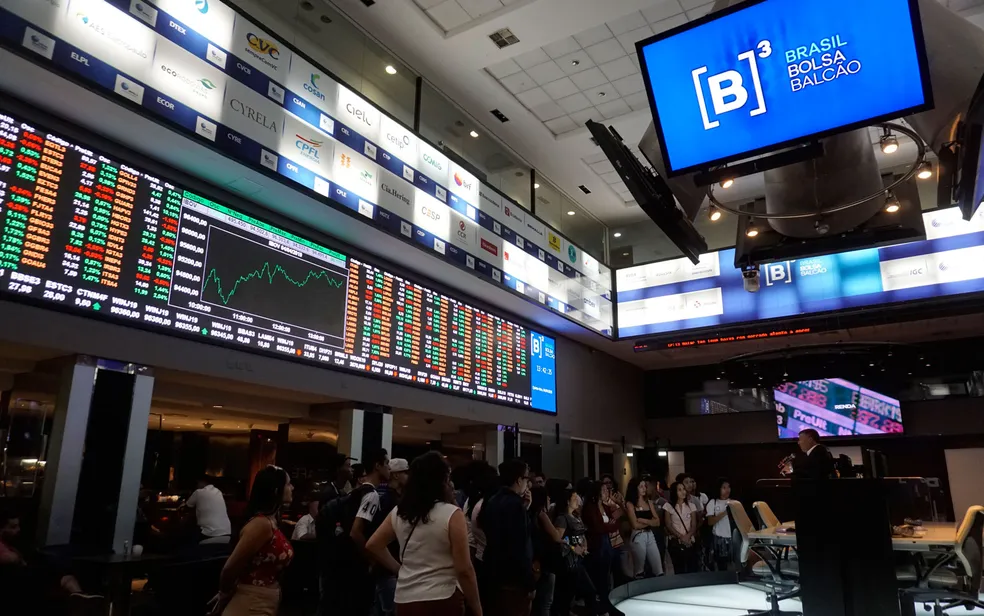
This uncertainty hit Brazil’s export-driven sectors hard, particularly commodities like iron ore. Vale (VALE3), another major Ibovespa component, fell sharply as iron ore futures in China dropped 3.29% to $98.86 per ton.
Brazilian Markets Under Pressure
Retail stocks also struggled, with Magazine Luiza (MGLU3) leading losses after falling 6.37%, reflecting weak consumer sentiment amid broader economic concerns.
However, some stocks bucked the trend. Natura & Co (NTCO3) rose 2.84%, supported by strong operational results, while IRB Brasil Resseguros (IRBR3) gained 2.66%, benefiting from defensive positioning by investors.
Trading volumes on the B3 exchange reached R$13 billion, slightly below the annual average of R$15 billion, indicating cautious investor sentiment.
Meanwhile, foreign investors continued to pull back from Brazilian equities, with the iShares MSCI Brazil ETF recording $30 million in outflows.
Globally, markets remained volatile as trade tensions dominated headlines. U.S. indices closed mixed, with the Dow Jones down 0.03% and the Nasdaq up 0.87%. European markets suffered steep losses, while Asian markets also declined as fears of slowing global growth spread.
Technically, the Ibovespa broke below its key support level of 130,000 points, signaling bearish momentum. Analysts pointed to external shocks rather than domestic structural issues as the primary driver behind the decline.
The combination of global trade uncertainties and domestic policy risks created a challenging environment for Brazilian equities. Investors remain cautious as they await further developments in U.S.-China trade negotiations and clarity on Petrobras’ pricing policies. The outlook for the market hinges on these critical factors in the coming weeks.
Key Facts
— Deep Dive
Live Company IntelligencePetroleo Brasileiro Petrobras SA ADR — the full investor dossier
Wall Street view
Valuation & profitability
Price & risk
$10.7852-wk high
$26.39
Revenue trend · 6y
Ownership
Dividend
— For the complete picture, read our in-depth guide: Latin America Stock Markets 2026: Ibovespa, Merval, COLCAP, IPSA and IPC Guide
More: Brazil news in English, every day from The Rio Times.
This article was produced by The Rio Times’ automated newsroom system. How we use AI · Report an error · Editorial responsibility: Matthias Camenzind, Editor-in-Chief
LatAm Markets: Live Signals → — real-time movers, turnover leaders and FX across Latin America.
Brazil runoff, Sunday, October 25: Brazil runoff start time and results schedule. Latest: Brazil runoff polls, Flávio 51%, Lula 49%.