Tegucigalpa Cuts Water Rationing to 9 Days as Dam Fills

INFRASTRUCTURE · HONDURAS
Key Facts
- —The country Honduras. Its capital, Tegucigalpa, and the twin city of Comayagüela form the Distrito Central municipality, which also hosts the US Embassy.
- —Why it matters Piped water in much of the capital arrives in rotating cycles rather than around the clock, so households, hotels and businesses plan their week around delivery days.
- —Why now Recent rains filled the Los Laureles dam to 100% and lifted La Concepción above 40%, the level city hall set for easing the schedule.
- —What happened On Sunday 11 October, Mayor Juan Diego Zelaya said the distribution cycle falls from 12 days to 9 from Monday 12 October, sector by sector.
- —The numbers Los Laureles holds about 10.5 million cubic metres. La Concepción holds 14.57 million, or 40.24% of capacity. A 10-km pipe will move about 500 litres a second between them.
- —What it means for you Water remains rationed. Visitors and residents should check their sector’s delivery days and keep storage tanks topped up.
- —Still open Whether La Concepción reaches 50%, which could allow further easing, before the dry months set in.
Tegucigalpa water rationing is easing. From Monday 12 October, homes in the Honduran capital will receive piped water every 9 days instead of every 12, Mayor Juan Diego Zelaya said on Sunday 11 October.
The change follows recent rains that filled one of the city’s two main reservoirs. Many Americans live in, work in or visit Tegucigalpa, from embassy staff to aid workers and business travellers. For them, taps should run more often, though not every day.
Zelaya is mayor of the Distrito Central, the municipality that covers Tegucigalpa and Comayagüela. He took office in January for the conservative National Party, the party of President Nasry Asfura.
“La Concepción has passed 40%, so we can now take the decision to move distribution from 12 days to 9 days,” Zelaya told the programme Noticieros Hoy Mismo, according to the Honduran daily El Heraldo. “We will start that tomorrow.”
How the New Schedule Works
The shorter cycle will not reach every neighbourhood on the same day. Zelaya said it would be applied gradually, sector by sector, until all sectors are on the new calendar.
The regional news site Infobae, citing the mayor, reported that the transition should take about seven to ten days. Until a sector moves over, its old delivery dates still apply.
The city’s water service, UMAPS (the Unidad Municipal de Agua Potable y Saneamiento), runs the distribution. It has shared delivery hours by neighbourhood for Monday 12 to Friday 16 October, which the broadcaster Televicentro published in full.
The 12-day cycle had been in force in recent weeks because of low reservoir levels and a lack of rain. Residents are advised to check their sector’s day and store water for the gaps between deliveries.
Two Dams and a New Pipe
The capital relies mainly on two reservoirs. Los Laureles is the smaller one. La Concepción is larger and has been slower to recover.
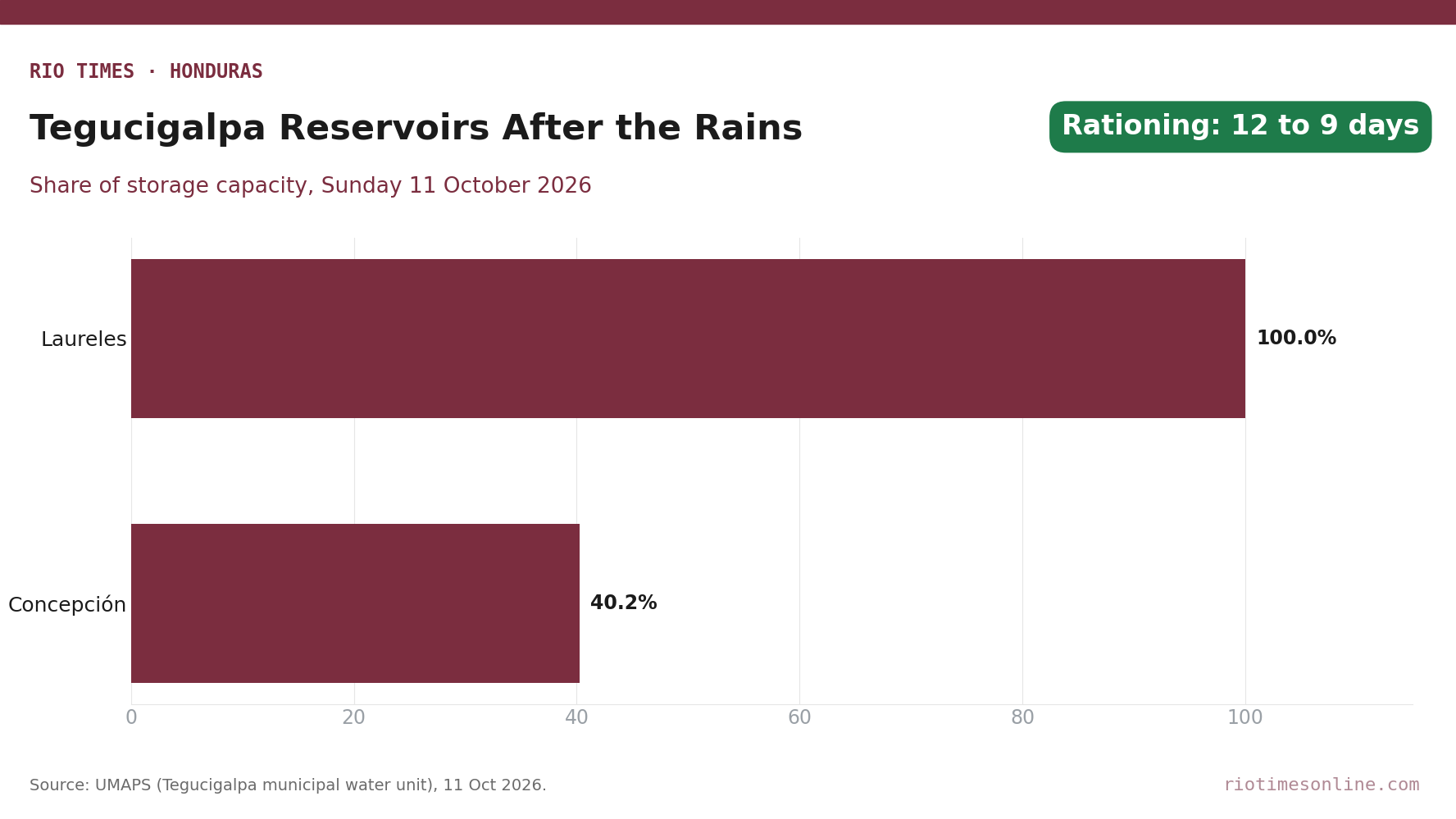
UMAPS said on Sunday that Los Laureles had reached 100% of its capacity, holding 10.503 million cubic metres. Its treatment plant was producing 450 litres of drinking water a second.
La Concepción held 14.570 million cubic metres, or 40.24% of capacity, and its plant produced 700 litres a second. UMAPS still rates the reservoir’s water risk as high.
With Los Laureles full, the city has raised the dam’s inflatable barrier, and UMAPS said it would start moving surplus water to La Concepción on Monday. The water runs through a pipe of about 10 kilometres that passes under the Anillo Periférico ring road.
Zelaya said the pumps can move about 500 litres a second. UMAPS set the test flow at 518 litres a second. At that pace, the mayor said, La Concepción could gain roughly one percentage point every 10 days.
The goal is to bank as much water as possible before the dry season. UMAPS said the transfer is meant to strengthen supply over the next six months, a period in which little or no rain is expected.
Zelaya also called for progress on the planned San José dam, saying the capital needs more storage to cope with future droughts. He did not give a timetable or a cost.
What It Means for You
For residents and long-stay visitors, the easing of Tegucigalpa water rationing is a modest relief rather than a return to normal. Water still arrives on set days, and supply in any given street depends on its sector.
If you are staying in Tegucigalpa or Comayagüela, ask your landlord or hotel which sector you are in and whether the building has its own tank. Keep a reserve of drinking water and follow the published schedules.
Recent posts on fuel costs, such as Honduras Fuel Prices Rise Again From 12 October, show other pressures on household budgets. September price data are covered in Honduras Inflation Climbs to 6.28% on Fuel and Food.
For investors and companies with operations in the capital, the reservoir levels are a useful early signal. A full Los Laureles and a rising La Concepción lower the risk of tighter rationing in the coming months.
What Is Not Known
It is not yet clear which sectors will move to the 9-day cycle first or on which exact dates each one changes. The city has said only that the switch is gradual.
Nor is it known whether La Concepción will reach 50%. Zelaya said further changes to the Tegucigalpa water rationing schedule could be considered at that level. The gain depends on pumping and on how much water the city draws.
The mayor stressed that the crisis is not over. “The fact that Los Laureles is full and La Concepción is rising does not mean we have left the water crisis behind,” he said, urging people to keep saving water.
Frequently Asked Questions
How often does Tegucigalpa get piped water now?
Under the schedule announced on Sunday 11 October, each sector of the capital receives water on a 9-day cycle instead of the previous 12-day cycle. The change is being phased in sector by sector from Monday 12 October.
Why did the city ease water rationing?
Recent rains filled the Los Laureles dam to 100% of its capacity and lifted La Concepción to 40.24%. Mayor Juan Diego Zelaya said that passing 40% at La Concepción allowed the shorter cycle.
Is the water shortage in Tegucigalpa over?
No. The mayor said the capital is still in a water crisis and asked residents to keep saving water. The municipal water unit expects little or no rain for about the next six months.
Sources: El Heraldo, mayor Juan Diego Zelaya on the 9-day cycle, 11 October 2026 (elheraldo.hn); El Heraldo, UMAPS reservoir data, 11 October 2026 (elheraldo.hn); Infobae, rollout over seven to ten days, 11 October 2026 (infobae.com); Televicentro, sector schedule 12 to 16 October (televicentro.com).
This article was produced by The Rio Times’ automated newsroom system. How we use AI · Report an error · Editorial responsibility: Matthias Camenzind, Editor-in-Chief