Honduras Inflation Climbs to 6.28% on Fuel and Food

ECONOMY · HONDURAS
Key Facts
- —The country Honduras, a Central American economy of about 10 million people that imports its fuel and relies heavily on money sent home by workers abroad.
- —Why it matters Inflation is now above the central bank’s 4% target range and above its 6% policy rate, squeezing households that live on remittances from the United States.
- —Why now The Banco Central de Honduras published its September price report on Saturday 10 October.
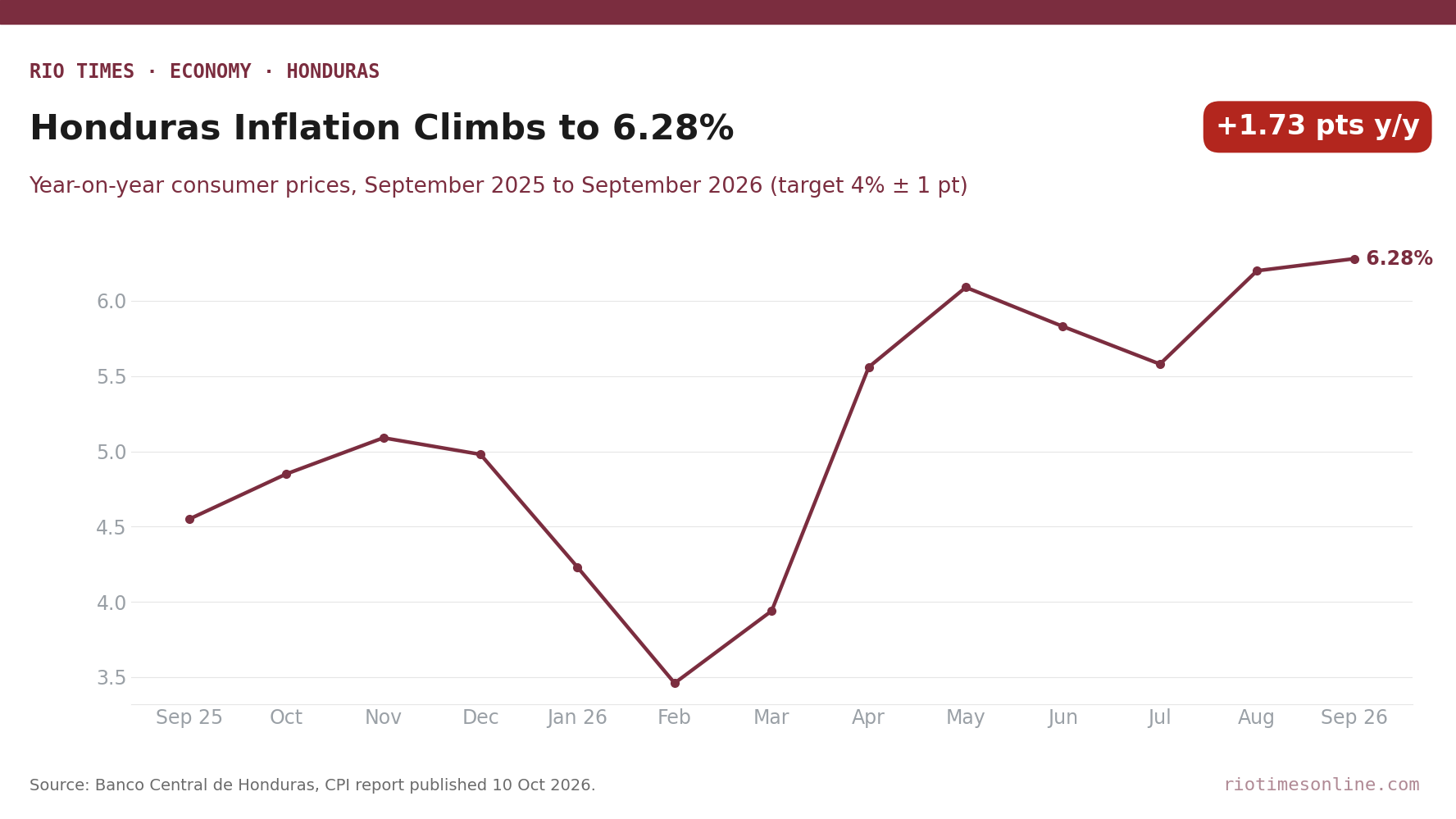
- —What happened Annual inflation rose to 6.28% in September from 6.20% in August and 4.55% a year earlier. Monthly inflation slowed to 0.48% from 0.79%.
- —The numbers Transport prices are up 16.05% on the year and added 2.67 points. Food added 1.57 points. Core inflation was 3.47%.
- —What it means for you Dollars sent to Honduras buy less food and transport than a year ago. Travellers and investors face higher local costs, led by fuel.
- —Still open Whether the central bank raises its policy rate again after September’s hike, and whether world oil prices ease before the dry season.
Honduras inflation rose to 6.28% in September, the highest annual rate in the past year of official data. The Banco Central de Honduras (BCH), the country’s central bank, published the figure on Saturday 10 October. For Americans, the number matters because millions of Hondurans live on dollars sent from the United States, and those dollars now stretch less far.
The bank blamed imported fuel and the weather. Higher world oil prices, linked to tensions in the Middle East, raised transport and logistics costs. The El Niño weather pattern pushed up prices of dairy, sugar, beef and red beans.
There is a stabiliser in the same report. Prices rose 0.48% in September alone, down from 0.79% in August. Core inflation, which strips out the most volatile items, was 3.47%, inside the bank’s target band.
Fuel and Food Drive the Rise
Transport is the largest single driver. Its prices are 16.05% higher than a year ago, and the division added 2.67 percentage points to the annual rate, according to the BCH tables.
Food and non-alcoholic drinks rose 6.01% on the year and added 1.57 points. The bank named fizzy drinks, potatoes, eggs and chicken among the items that weighed most.
Housing, water, electricity and gas added 0.74 points. Restaurants and hotels added 0.52 points, as eateries passed on higher costs for food and cooking fuel.
Looked at another way, energy alone contributed 2.40 points. The bank linked this to higher international oil prices and to consecutive increases in the electricity tariff over the past year.
In September itself, the items with the biggest price rises included diesel, super and regular petrol, eggs, onions, maize and beans. Prices fell for potatoes, airfares, avocados, butter, beds, refrigerators and motorcycles. The bank said cheaper flights reflected the low travel season.
The rise was broad but narrowing. Of the 405 goods and services in the basket, 59.5% rose in price in September, down from 64.0% in August.
Where Prices Rose Fastest
The southern region, which borders El Salvador and Nicaragua on the Gulf of Fonseca, had the highest annual rate at 7.49%. It was also the only region where inflation slowed, from 7.79% in August.
The rest of the north stood at 6.77% and the rest of the central region at 6.71%. The capital district of Tegucigalpa recorded 6.07%. Metropolitan San Pedro Sula, the country’s main industrial city, recorded 5.94%.
The year so far tells a similar story. Prices are up 5.29% since December, against 4.00% at the same point in 2025. The trough came in February, when the annual rate fell to 3.46%.
The BCH sets a target of 4% with a tolerance of one point either side. Headline Honduras inflation has been above that band since April. On Friday 18 September the bank raised its policy rate by a quarter point to 6.00% from 5.75%, effective 21 September, citing fuel prices and a US Federal Reserve hike. That rate is now slightly below annual inflation.
Fuel has also been a political issue under President Nasry Asfura, of the conservative National Party, who took office in January. Background on the government’s price steps is in Honduras Freezes Diesel at US$5.72 for 30 Days and Honduras Energy Justice Law in Force, Tariffs Frozen.
What It Means for You
If you send money to family in Honduras, each dollar buys less food and transport than a year ago. Remittances have still grown fast. BCH data show US$8.92 billion arrived from January to August, up about 12% from US$7.94 billion a year earlier.
For travellers, the biggest increases are in fuel, buses and restaurant meals. Airfares within the index fell in September. The central bank’s reference rate was 26.89 lempiras per US dollar on Wednesday 7 October.
For investors and exporters, higher fuel and logistics costs raise operating costs in the maquila factories and farms that supply the US market. September’s rate hike already makes local borrowing dearer, and the bank has not said whether more will follow.
What Is Not Known
It is not known whether the BCH will raise its 6% policy rate again after the September hike. The September report describes prices but does not set out a policy decision.
It is unclear how long fuel relief measures will last, or how world oil prices will move. The bank says Honduras depends heavily on imported fuel, so any shock abroad reaches pump prices quickly.
The weather is another unknown. Heavy rains have hit parts of the country this month, and the bank warns that climate effects keep pushing up farm prices. The October figure is due in November.
Frequently Asked Questions
What was Honduras inflation in September 2026?
Annual consumer price inflation was 6.28% in September 2026, up from 6.20% in August and 4.55% in September 2025, according to the Banco Central de Honduras.
Why are prices rising in Honduras?
The central bank points to higher world oil prices, which lift transport and logistics costs, and to El Niño weather effects on farm products such as dairy, sugar, beef and beans.
What is the central bank’s inflation target?
The target is 4% with a tolerance of one percentage point either side. Core inflation, at 3.47%, is inside that band, while headline inflation is above it.
Sources: Banco Central de Honduras, Índice de Precios al Consumidor, September 2026 report; Banco Central de Honduras, consumer price index page and indicators (inflation, policy rate, remittances, exchange rate); Banco Central de Honduras, Resolution No. 393-9/2026 on the policy rate; HCH, “Inflación en Honduras alcanza 6.28% en septiembre por alza de combustibles y factores climáticos”, 10 October 2026.
This article was produced by The Rio Times’ automated newsroom system. How we use AI · Report an error · Editorial responsibility: Matthias Camenzind, Editor-in-Chief
LatAm Markets: Live Signals → — real-time movers, turnover leaders and FX across Latin America.