Guatemala Logs 55,061 Returnees, Opens Izabal Office

MIGRATION · GUATEMALA
Key Facts
- —The country Guatemala, Central America’s most populous country, borders Mexico and sends large numbers of migrants north to the United States.
- —Why it matters Guatemala deportations are the receiving end of the US enforcement drive. The returnee count is the clearest local measure of it.
- —Why now The Guatemalan Migration Institute (IGM) opened its fourth regional office on Friday 9 October in Morales, Izabal, and released its 2026 returnee total.
- —What happened The IGM said it had received 55,061 deported or voluntarily returning Guatemalans this year, counted up to Thursday 8 October.
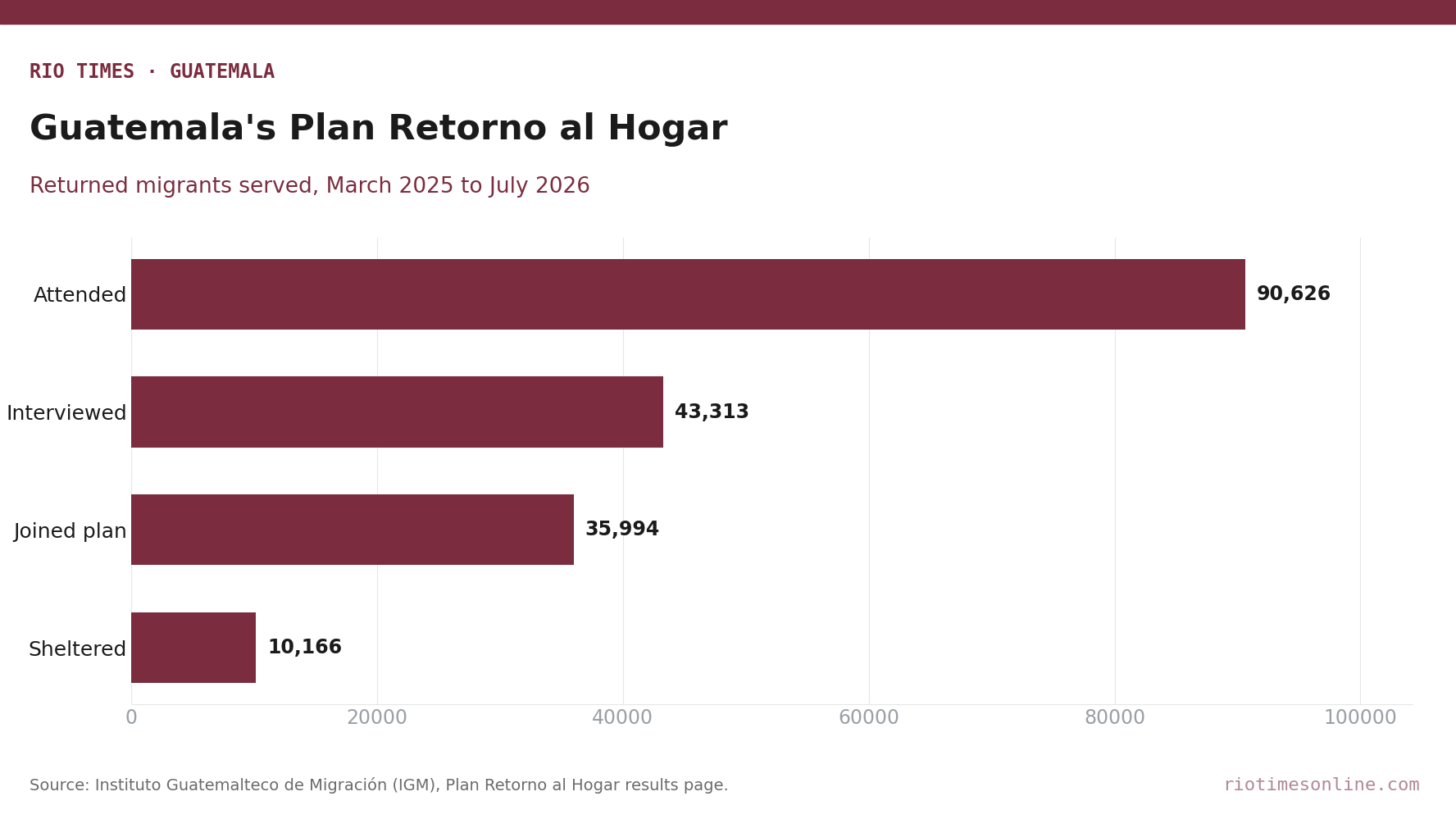
- —The numbers The IGM’s reintegration plan attended 90,626 returnees between March 2025 and July 2026. Another 10,166 used its shelters.
- —What it means for you Families in the US with relatives facing removal now have an eastern Guatemala office for passports, records and missing-migrant reports.
- —Still open The IGM has not said how many 2026 returnees came from the United States and how many from Mexico.
- —Prediction markets Polymarket gives a 68% chance that ICE removals for fiscal 2026 land between 400,000 and 500,000 (10 October, 2:07 p.m. ET).
Guatemala has received 55,061 deported or voluntarily returning citizens so far this year, its migration institute said as it opened a new office in the east. The figure runs to Thursday 8 October. For US readers, Guatemala deportations show the receiving end of the enforcement push in American cities.
The Guatemalan Migration Institute (IGM), the state agency for passports, border control and returnees, opened the office on Friday 9 October in Morales, Izabal. It is the institute’s fourth regional office outside Guatemala City.
The IGM’s director general, Alfredo Danilo Rivera, said the 2026 total will exceed last year’s, according to Infobae. He said the rise in deportations and voluntary returns pushed the institute to expand its reintegration programme, known as Plan Retorno al Hogar (Return Home Plan).
A Fourth Office on the Caribbean Side
The new office sits at kilometre 245 of the CA-9 highway, in the village of La Ruidosa. The CA-9 links Guatemala City with the Caribbean ports of Izabal.
It brings together all four of the IGM’s operating divisions: passports, foreigners’ affairs, migration control and the protection of migrants’ rights. Residents can renew a passport and collect it the same day, the institute said.
Foreign residents can extend visas and apply for temporary or permanent residence there. The office also issues certificates of travel records, handles court-ordered travel bans and calculates fines for overstays.
Until now, people in Puerto Barrios, El Estor, Livingston, Morales and Los Amates had to travel to Río Hondo, in neighbouring Zacapa, for these services. The other regional offices are in Chiquimula, Zacapa and Quetzaltenango.
Gilda Ismelda Córdoba Pacheco, the departmental governor of Izabal, attended the opening. “Services should reach the people, not the people the services,” she said, in remarks reported by Infobae.
Diplomats, members of Congress, human-rights officials and the UN refugee agency, UNHCR, were also present. The office opens Monday to Friday, from 7 a.m. to 3 p.m.
Why Deportation Numbers Matter Here
Plan Retorno al Hogar began in March 2025, two months into the second Trump administration. It interviews returnees, refers them to state programmes and offers temporary shelter.
According to the IGM’s own results page, the plan attended 90,626 returned migrants between March 2025 and July 2026. Of those, 43,313 were interviewed for referral and 35,994 agreed to join the plan. Another 10,166 used its shelter services.
Between March and December 2025 alone, the plan attended more than 55,200 people, the institute says. The 2026 total had already reached 55,061 by early October.
The two figures are not exactly comparable. The 2025 number covers only the plan’s first ten months, while the 2026 tally counts deportees and voluntary returns together.
Rivera said Izabal also needs priority attention for people seeking international protection. Its five municipalities have been declared “solidarity territory” in coordination with UNHCR.
The department borders Honduras at El Cinchado, one of four migration control posts in Izabal. The others are Puerto Barrios, Santo Tomás de Castilla and Livingston.
President Bernardo Arévalo, in office since January 2024, and Vice President Karin Herrera have made the reintegration plan a public priority. ICE officials have also held repatriation talks in the country, as covered in ICE Officials Hold Security and Repatriation Talks in Guatemala as US Trade Ties Deepen.
What It Means for You
For Guatemalan families in the United States, the Morales office matters in three ways. Relatives can report a missing migrant there and receive psychological support, under an inter-agency search mechanism.
Returnees from the east can be interviewed and followed up locally, rather than only in the capital. And passports can be issued in one day, which helps relatives preparing legal paperwork.
For investors and travellers, the office is a small sign of a state adjusting to steady returns. Rising Guatemala deportations mean more working-age people returning to a country that relies on money sent home from abroad. That is a slow-burning pressure rather than a sudden shock.
The mitigating factor is capacity. The institute is spreading services outside the capital, which should ease pressure at the reception centre in Guatemala City.
What Is Not Known
The IGM did not break down the 55,061 returnees by country of departure. It also did not separate forced deportations from voluntary returns, or give the exact 2025 full-year total it is comparing against.
It is not clear how many returnees go back to Izabal specifically. Nor is it known how many staff the new office has, or whether funding for it is secured in the 2027 budget.
The US has also sent some non-Guatemalans to Guatemala, a practice Mexico has objected to, as covered in Mexico Rejects US Deportations of Its Migrants to Guatemala and Honduras. Whether such cases appear in the count of Guatemala deportations is not stated.
What Prediction Markets Say
Bettors on Polymarket are wagering on how many people US Immigration and Customs Enforcement (ICE) removed in fiscal 2026, which ended on 30 September. The market settles on ICE’s own annual report.
At 2:07 p.m. ET on Saturday 10 October, the 400,000 to 500,000 range traded at 68%, up about 5.5 points in a day. The 500,000 to 600,000 range stood at 12%, and 300,000 to 400,000 at 8%.
The market has drawn about US$130,000 in total trading volume. For scale, ICE reported 271,484 removals in fiscal 2024.
Why we show this: prediction markets turn real-money bets into a live probability that moves within minutes of the news, which is why investors, campaigns and newsrooms in the United States now follow them closely. We show them next to polls and official results, never instead of them.
Frequently Asked Questions
How many Guatemalans have been deported in 2026?
The Guatemalan Migration Institute says it received 55,061 deported or voluntarily returning Guatemalans this year, counted up to Thursday 8 October. It has not split the figure by country or by type of return.
What is Plan Retorno al Hogar?
It is the Guatemalan government’s reintegration programme for returned migrants, launched in March 2025. It interviews returnees, refers them to state services and offers temporary shelter. It attended 90,626 people by July 2026.
Where is the new migration office in Izabal?
The office is in Morales, Izabal, at kilometre 245 of the CA-9 highway in the village of La Ruidosa. It opens Monday to Friday, from 7 a.m. to 3 p.m., and issues passports the same day.
Sources: Instituto Guatemalteco de Migración, Plan Retorno al Hogar results; Infobae, IGM opens fourth regional office in Izabal; Agencia Guatemalteca de Noticias, Migración abrirá cuarta sede regional; Diario de Centro América, IGM abrirá cuarta sede en Morales.
This article was produced by The Rio Times’ automated newsroom system. How we use AI · Report an error · Editorial responsibility: Matthias Camenzind, Editor-in-Chief