
Key Facts
- Corn proxy jumped 3.59% to US$18.20 as USDA surprised traders with a lower US yield projection in the August WASDE.
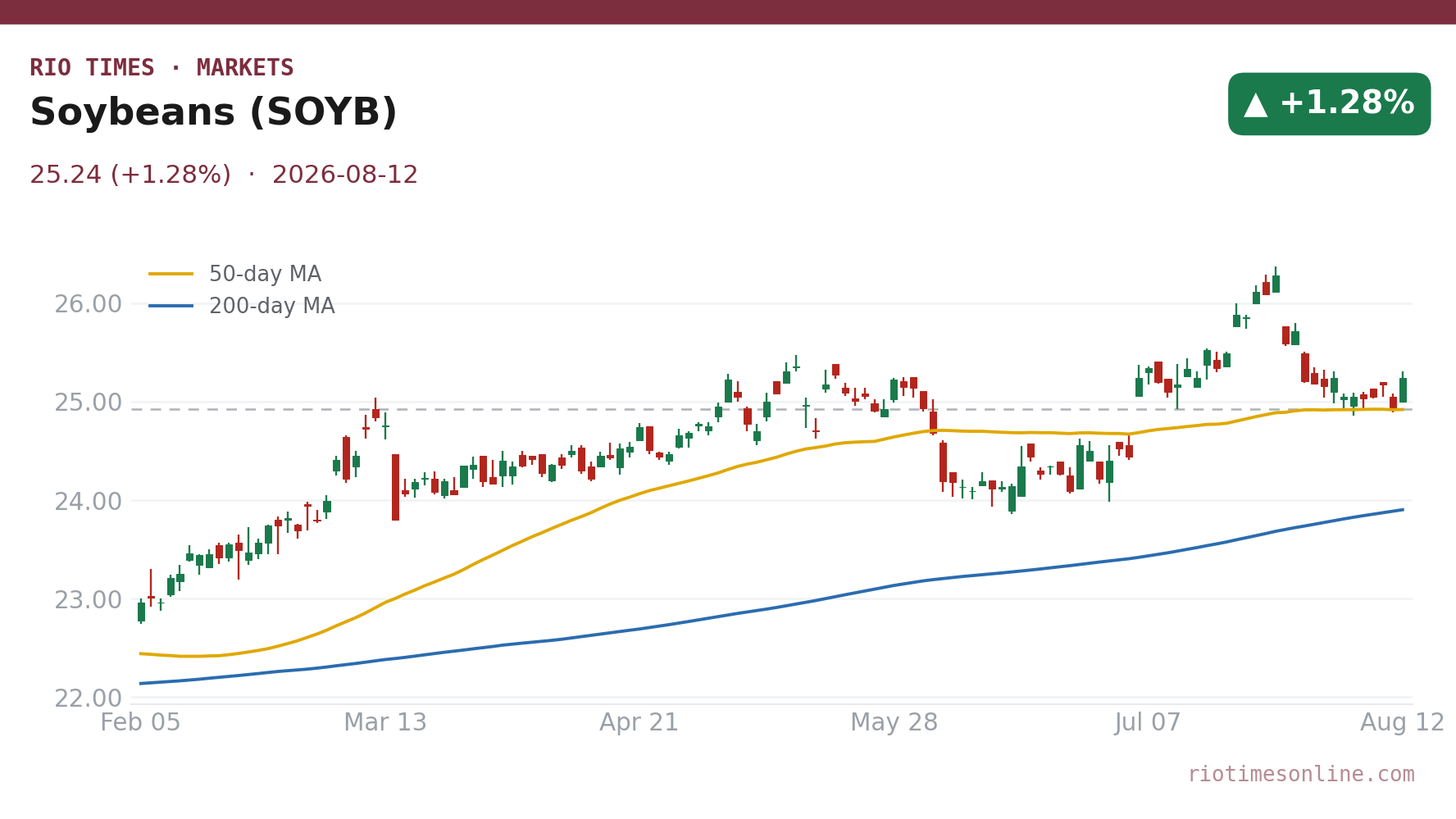
- Soybean tracker rose 1.28% to US$25.24 after USDA trimmed the soybean yield to 52.7 bushels an acre. Note that the soybean balance sheet in fact loosened: ending stocks were raised 10 million bushels to 320 million on a record 4.519 billion bushel crop.
- Wheat fund gained 2.74% to US$24.36 as the USDA cut US wheat ending stocks by 5 million bushels to 717 million, 22% below a year earlier. The WASDE also cited constrained Ukrainian exports.
- The Brazilian real weakened 0.69% to 5.1639 per dollar on the central bank PTAX close, making Brazil’s dollar-priced grain exports more competitive at the margin.
- The Ibovespa fell 0.23% to 167,491 in the same session, hit by domestic fiscal noise and a JP Morgan warning on Brazil’s spending path.
- USDA also confirmed steady ethanol use for the 2026-27 corn crop, keeping an important demand floor under the corn rally.
Today’s Focus
Grain trackers climbed in unison on Wednesday after the US Department of Agriculture cut its corn and soybean yield forecasts in the August WASDE report. Production still rose for both crops on larger harvested area: corn to 16.013 billion bushels, the second largest US crop on record, and soybeans to a record 4.519 billion.
The corn fund led the move, jumping 3.59% to US$18.20, reflecting a surprise reduction in US yield potential. The soybean tracker added 1.28% to US$25.24 and the wheat fund rose 2.74% to US$24.36 as the US wheat carryout was cut.
For Latin America, the session offered a double tailwind: higher dollar benchmark prices and a weaker Brazilian real at 5.1639 per dollar, which boosts local-currency revenue for exporters in Mato Grosso and Paraná.
The move came despite a 0.23% dip in the Ibovespa to 167,491, driven by political noise and a JP Morgan fiscal warning, showing that grain strength is being driven by global crop fundamentals rather than Brazilian macro sentiment.
What matters today. USDA’s unexpected yield cuts restarted the global grain rally, handing Brazil and Argentina a pricing tailwind even as Brazil’s domestic markets wobbled.
01 The session in one read
Wednesday’s grain session belonged to the USDA, whose August WASDE report surprised the market with lower corn and soybean yield estimates. The corn tracker led all movers, up 3.59% to US$18.20, a jump that caught analysts leaning the other way.
The soybean fund gained 1.28% to US$25.24, while the wheat tracker climbed 2.74% to US$24.36. The tightening is real for corn, where ending stocks fell 137 million bushels to 1.653 billion, and for US wheat, where stocks were cut to 717 million. Globally the WASDE pointed the other way, projecting larger foreign coarse grain and world wheat ending stocks.
The WASDE-driven bounce has substance because it revises the physical balance sheet, not just sentiment: lower yields mean tighter carryout and a higher price floor for the next three months. For Brazilian sellers, the weak real magnifies the move, since every dollar per bushel converts into more reais per sack. The variable to watch is whether China’s August soybean purchases confirm the USDA’s tighter global oilseed picture within the next two weeks, because Chinese demand can either validate the rally or expose it as US-centric.
02 The board
The corn-tracking fund’s US$18.20 close was the standout, up 3.59% on the session, its strongest directional signal in the grain complex. The soybean tracker settled at US$25.24, a 1.28% gain that kept it comfortably above the corn fund but with a softer percentage move.
The wheat fund closed at US$24.36, up 2.74%, landing between the two other proxies in percentage terms. All three trade in US dollars, so the moves read as pure global crop-market repricing rather than any Brazilian currency distortion.
| Asset | Level | Change |
|---|---|---|
| Soybeans (SOYB) | US$25.24 | +1.28% |
| Corn (CORN) | US$18.20 | +3.59% |
| Wheat (WEAT) | US$24.36 | +2.74% |
Source: RT close, 2026-08-12. Where a commodity has no spot feed, an exchange-traded tracker or leading producer is shown as a labelled proxy.
Live Market IntelligenceThe live market board
Rio Times · Live Market Intelligence
Latin America — Cross-Market Board
| Instrument | Last | Change | YoY | Prev. | High | Low | Volume |
|---|---|---|---|---|---|---|---|
| IBOV | 206,220.24 | +0.94% | +21.85% | 204,302.33 | 168,310 | 167,142 | — |
| IPSA | 11,024.22 | +0.22% | — | 10,999.64 | 11,210 | 10,984 | 1,513,213,483 |
| IPC MEX | 64,851.89 | +0.31% | +12.17% | 64,653.33 | 66,121 | 65,405 | 108,886,187 |
| MERVAL | 2,832,472 | +0.30% | +30.51% | 3,022,485 | 3,042,365 | 2,991,150 | — |
| COLCAP | 2,525.90 | -0.36% | — | 9.04 | 9.05 | 9.02 | 4,133 |
| BVL PERÚ | 60,766.81 | -1.71% | — | — | — | — | — |
| USD/BRL | 5.16 | +0.01% | -5.13% | 5.16 | 5.18 | 5.14 | — |
| EUR/BRL | 5.95 | +1.01% | -5.83% | 5.89 | 5.98 | 5.94 | — |
| USD/MXN | 17.06 | -0.24% | -8.58% | 17.10 | 17.08 | 17.01 | — |
| USD/CLP | 913.98 | +0.04% | -5.67% | 913.65 | 915.11 | 906.68 | — |
| USD/COP | 3,140 | +0.03% | -22.04% | 3,139 | 3,141 | 3,105 | — |
| USD/PEN | 3.36 | -0.66% | -4.82% | 3.38 | 3.38 | 3.35 | — |
| USD/ARS | 1,493 | +0.10% | +12.96% | 1,491 | 1,494 | 1,480 | — |
| USD/UYU | 40.27 | +1.24% | +1.80% | 39.77 | 40.27 | 40.23 | — |
| USD/PYG | 5,939 | +1.68% | -19.54% | 5,841 | 5,939 | 5,925 | — |
| USD/BOB | 11.64 | -0.76% | +72.04% | 11.73 | 11.72 | 11.64 | — |
| USD/DOP | 58.34 | +1.25% | -3.44% | 57.62 | 58.34 | 58.04 | — |
| USD/CRC | 445.92 | +0.89% | -9.71% | 441.97 | 448.50 | 445.92 | — |
03 What moved it
The USDA’s surprise cut to corn yield projections was the session’s primary engine. The August WASDE held corn use in ethanol at 5.6 billion bushels, so demand was unchanged while the corn carryout tightened. Soybean supply did not shrink: the crop was raised to a record.
Wheat’s 2.74% rise carried an extra layer: the WASDE cited constrained exports for Ukraine, which kept traders nervous about replacement supply from Ukraine and Russia. With the USDA also cutting US wheat stocks, the export risk and the domestic fundamentals pointed the same way.
04 The Latin American read
A cheaper real at 5.1639 per dollar strengthens the case for Brazilian exporters to sell aggressively into higher dollar grains prices. Farmers in Mato Grosso receive more reais per tonne when the currency is weak and international benchmarks rally.
Argentina’s export engine typically responds with slower farmer selling when global prices rise, as producers hold grain as a store of value against inflation. But the tighter global balance sheet still rewards the broader Mercosur supply complex.
05 The names to watch
Brazil’s domestic equities diverged sharply from the grain strength, with the Ibovespa down 0.23% to 167,491 on the day. JP Morgan’s fiscal warning and central bank minutes signalling high borrowing costs for longer drove that move.
The split matters for investors: grain export revenue is repricing higher at the same time Brazilian risk assets are repricing lower. That keeps the exchange rate, more than the yield estimate alone, central to how Latin American producers will lock in this rally.
06 The outlook
The key question now is whether China steps up near-term soybean purchases to confirm the tighter global oilseed math. If buying accelerates, the soybean tracker’s 1.28% gain could prove the start of a longer leg rather than a one-session repricing.
07 What to watch
- China soybean purchases: Confirm whether Chinese buyers lift near-term US or Brazilian cargoes to validate the tighter US balance sheet.
- Brazilian farmer selling: Watch forward sales from Mato Grosso and Paraná as the weak real and higher dollar benchmarks align to boost realised revenue.
- Black Sea war risk: Track insurance and shipment headlines from Ukrainian and Russian ports; wheat’s premium is partly geopolitical.
- US weather into late August: The USDA cut yield estimates with most of August still ahead; any heat stress would tighten the corn balance further.
Frequently Asked Questions
Why did corn jump more than soybeans?
The USDA surprised the market with a cut to its corn yield projection, catching traders positioned for stable supply; soybeans received a smaller cut and a gentler price response.
Is the weak Brazilian real good for grain exporters?
Yes. A weaker real means dollar-priced grain sales convert into more reais, boosting producer margins even before the global price rally.
Does the Ibovespa fall affect grain prices?
Not directly. The 0.23% Ibovespa dip was driven by weakness in heavyweight shares, while grain trackers moved on USDA supply revisions and Black Sea risk.
Are these tracker prices the same as commodity futures?
No. SOYB, CORN and WEAT are exchange-traded funds that track the underlying grains; they move in the same direction but are not the spot or futures contracts themselves.
This article was produced by The Rio Times’ automated newsroom system. How we use AI · Report an error · Editorial responsibility: Matthias Camenzind, Editor-in-Chief
LatAm Markets: Live Signals → — real-time movers, turnover leaders and FX across Latin America.