
Key Facts
- Hurricane Isaias shut in 1.28 million barrels per day of US Gulf oil output, up from 185,120 bpd two days earlier, removing 62.89% of current Gulf production.
- The USO fund tracking WTI crude exposure settled at US$147.58 on Thursday, a rise of 2.55% on the day.
- OPEC+ held November targets steady at 31.01 million barrels per day as seven members including Saudi Arabia and Russia paused target increases.
- President Trump ruled out attacks on Iran before November’s midterm elections in a Truth Social post, briefly easing the geopolitical risk premium.
- Petrobras shares rose 2.92% to US$24.69, outpacing the WTI tracker as Brazil’s state producer leveraged higher crude benchmarks.
- Prediction markets: Polymarket’s October WTI market gives 65.5% to a touch of US$95 and 33.5% to US$100 (US$1.34 million traded, as of 8:23 pm ET, 8 October). Bets, not forecasts.
Today’s Focus
Hurricane Isaias knocked out 1.28 million barrels per day of US Gulf oil production by Thursday, up from 185,120 bpd two days before, as operators cleared personnel from the storm’s path. Operators reported to the US offshore regulator that 62.89% of current Gulf oil output and 57.35% of natural gas production were offline, sharply tightening the US benchmark.
The WTI-tracking USO fund rose 2.55% to US$147.58, supported by the supply shock and by tanker attacks near the Strait of Hormuz. President Trump then said he would not attack Iran before November’s midterm elections, briefly shaving the session’s gains.
OPEC+ kept November production targets unchanged at 31.01 million barrels per day for seven members including Saudi Arabia, Russia and Iraq, extending a pause in increases while actual Gulf output stays below official quotas. The group’s next meeting is scheduled for November 1, when a delayed capacity review will inform future quotas.
Latin American producers rode the higher benchmark: Petrobras added 2.92% to US$24.69, Ecopetrol rose 1.86% to US$16.94, and Argentina’s YPF gained 0.85% to US$49.90. Vitol’s chief executive warned that without ship-to-ship transfers in the Gulf of Oman, a US$200-a-barrel scenario could not be ruled out.
What matters today. A hurricane-driven supply shock combined with constrained Gulf exports to push WTI proxies sharply higher, even as Trump’s election-cycle Iran pledge cooled the geopolitical premium.
01 The session in one read
Oil markets closed firmly higher on Thursday, October 8, 2026, as Hurricane Isaias physically removed 1.28 million barrels per day of US Gulf oil production from the market, up from 185,120 bpd just two days earlier. The storm idled 62.89% of current Gulf oil production and 57.35% of natural gas output as operators evacuated platforms.
The WTI-tracking USO fund settled at US$147.58, a gain of 2.55% on the day, while President Trump’s midday Truth Social post ruling out attacks on Iran before the midterms briefly took the edge off the rally. Ship-to-ship transfers in the Gulf of Oman continued to provide a lifeline to Gulf producers, with Vitol’s Russell Hardy warning that without them a US$200-a-barrel scenario could not be excluded.
Hurricane Isaias delivered the session’s most concrete driver by physically removing 1.28 million barrels per day of US Gulf output, a shock that easily outweighed Trump’s Truth Social pledge to avoid Iran strikes before November. OPEC+ added a second pillar by freezing November targets at 31.01 million bpd while tanker attacks keep pressure on supply. The variable to watch is the pace of Gulf production restoration once Isaias passes.
02 The board
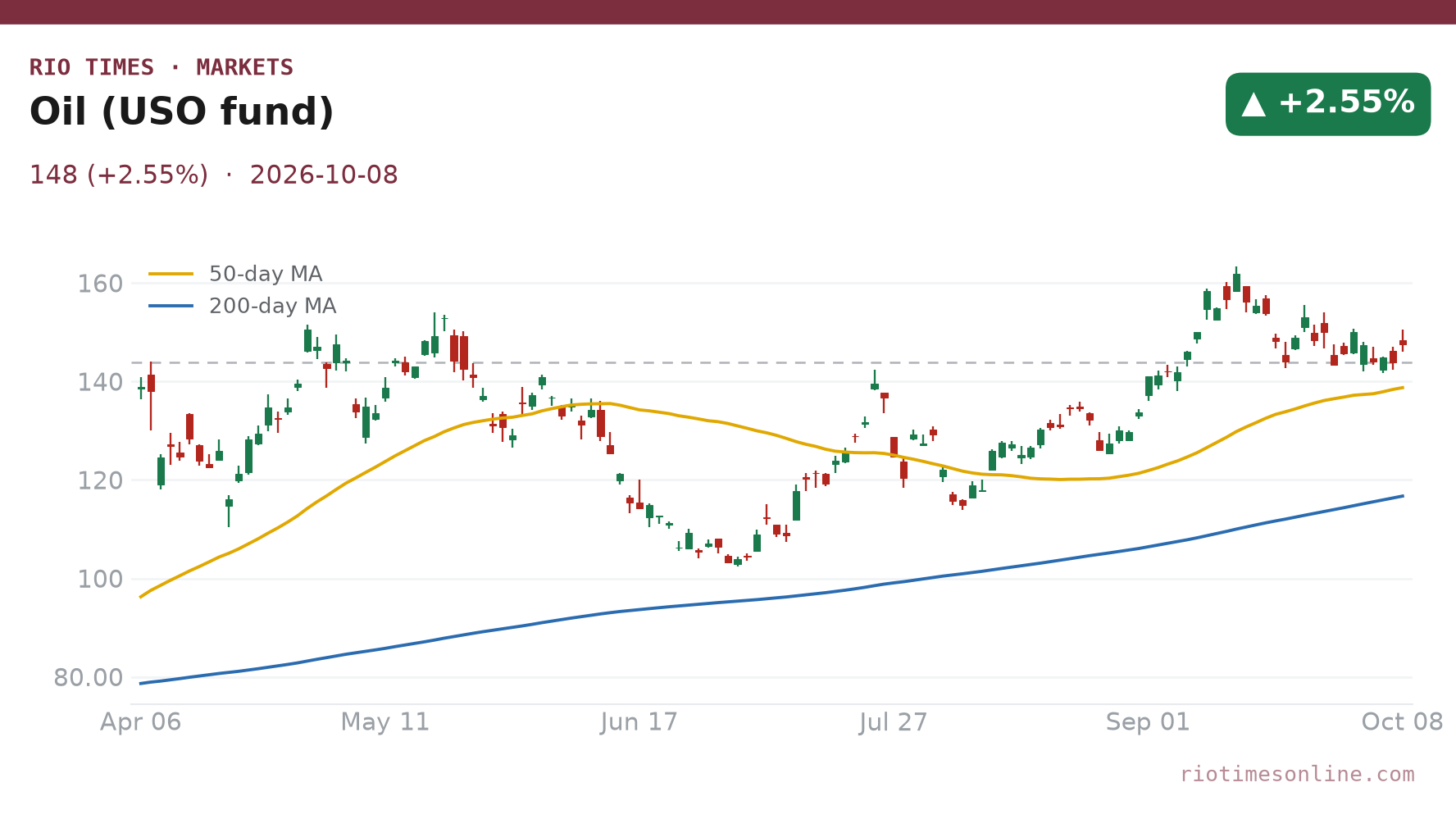
The USO fund, which tracks WTI crude exposure, led the Latin American energy complex higher with a 2.55% advance to US$147.58. Petrobras outperformed the underlying commodity proxy, adding 2.92% to US$24.69 as investors priced Brazil’s pre-salt operator as a geared play on tighter global supply.
Colombia’s Ecopetrol rose 1.86% to US$16.94, a more modest gain reflecting softer liquidity and a smaller export base. Argentina’s YPF lagged with a 0.85% increase to US$49.90, held back by Vaca Muerta logistics constraints and domestic pricing pressure.
| Asset | Level | Change |
|---|---|---|
| WTI crude (USO) | US$147.58 | +2.55% |
| Petrobras | US$24.69 | +2.92% |
| Ecopetrol | US$16.94 | +1.86% |
| YPF | US$49.90 | +0.85% |
Source: RT close, 2026-10-08. Where a commodity has no spot feed, an exchange-traded tracker or leading producer is shown as a labelled proxy.
Live Market IntelligenceThe live market board
Rio Times · Live Market Intelligence
Latin America — Cross-Market Board
| Instrument | Last | Change | YoY | Prev. | High | Low | Volume |
|---|---|---|---|---|---|---|---|
| IBOV | 206,220.24 | +0.94% | +21.85% | 204,302.33 | 168,310 | 167,142 | — |
| IPSA | 11,024.22 | +0.22% | — | 10,999.64 | 11,210 | 10,984 | 1,513,213,483 |
| IPC MEX | 64,851.89 | +0.31% | +12.17% | 64,653.33 | 66,121 | 65,405 | 108,886,187 |
| MERVAL | 2,832,472 | +0.30% | +30.51% | 3,022,485 | 3,042,365 | 2,991,150 | — |
| COLCAP | 2,525.90 | -0.36% | — | 9.04 | 9.05 | 9.02 | 4,133 |
| BVL PERÚ | 60,766.81 | -1.71% | — | — | — | — | — |
| USD/BRL | 5.16 | +0.01% | -5.13% | 5.16 | 5.18 | 5.14 | — |
| EUR/BRL | 5.95 | +1.01% | -5.83% | 5.89 | 5.98 | 5.94 | — |
| USD/MXN | 17.06 | -0.24% | -8.58% | 17.10 | 17.08 | 17.01 | — |
| USD/CLP | 913.98 | +0.04% | -5.67% | 913.65 | 915.11 | 906.68 | — |
| USD/COP | 3,140 | +0.03% | -22.04% | 3,139 | 3,141 | 3,105 | — |
| USD/PEN | 3.36 | -0.66% | -4.82% | 3.38 | 3.38 | 3.35 | — |
| USD/ARS | 1,493 | +0.10% | +12.96% | 1,491 | 1,494 | 1,480 | — |
| USD/UYU | 40.27 | +1.24% | +1.80% | 39.77 | 40.27 | 40.23 | — |
| USD/PYG | 5,939 | +1.68% | -19.54% | 5,841 | 5,939 | 5,925 | — |
| USD/BOB | 11.64 | -0.76% | +72.04% | 11.73 | 11.72 | 11.64 | — |
| USD/DOP | 58.34 | +1.25% | -3.44% | 57.62 | 58.34 | 58.04 | — |
| USD/CRC | 445.92 | +0.89% | -9.71% | 441.97 | 448.50 | 445.92 | — |
03 What moved it
Hurricane Isaias was the session’s most quantifiable driver, shutting in 1.28 million bpd of US Gulf oil output and tightening the WTI benchmark. The storm’s rapid escalation from 185,120 bpd of shut-ins two days prior caught traders off guard and forced immediate repricing of short-term supply.
OPEC+ reinforced the supply-side story by keeping November production targets for seven members unchanged at 31.01 million bpd. Tanker attacks near the Strait of Hormuz kept pressure on physical supply.
Trump’s Truth Social post that the US would not attack Iran before the November midterms briefly dampened the rally, but the market’s focus returned to the storm and ongoing export disruptions. Brent settled at US$104.28 and WTI at US$91.49, a spread of about US$12.8, reflecting the outsized impact of US Gulf outages on American benchmarks.
04 The Latin American read
Petrobras was the clearest regional beneficiary, its New York shares climbing 2.92% to US$24.69 as higher global benchmarks flow directly into pre-salt export revenue. Brazil’s state firm raised fuel prices in line with international levels earlier this year, keeping refining margins resilient.
Ecopetrol’s 1.86% gain to US$16.94 reflects Colombia’s smaller production base but steady dividend appeal for yield-seeking investors. YPF rose just 0.85% to US$49.90 because Vaca Muerta’s shale output remains constrained by takeaway capacity and Argentine peso volatility.
Guyana’s Exxon-led Stabroek boom continued to reshape regional supply, with its low-cost barrels increasingly displacing Venezuelan heavy crude in Asian refining diets. India’s Reliance Industries drove Venezuelan imports to a seven-year high, taking more than three-quarters of all purchases from Caracas.
05 The names to watch
Petrobras shares at US$24.69 remain the most liquid Latin American vehicle for exposure to pre-salt output and higher Brent-linked export pricing. Its 2.92% session gain shows how quickly the name gears to global supply shocks.
YPF at US$49.90 is the purest Vaca Muerta proxy but carries Argentine country risk and infrastructure limits that cap upside despite world-class shale geology. Ecopetrol at US$16.94 offers a lower-beta regional energy play with a strong dividend track record.
Vitol’s Russell Hardy flagged ship-to-ship transfers in the Gulf of Oman as the critical mechanism keeping global export flows moving; any disruption there would justify a far higher risk premium. OPEC+ meets on November 1 to review production capacity, with Mexico’s Pemex and Venezuela’s state firm likely topics in supply discussions.
06 The outlook
The immediate path for WTI proxies depends on how quickly US Gulf production returns after Hurricane Isaias passes, with 1.28 million bpd currently offline. A slow restart would keep USO near US$147.58, while a rapid normalisation could unwind part of the storm premium.
The delayed OPEC+ capacity review due by the November 1 meeting adds a structural question: whether members can actually raise output given the pressure on real exports. That physical gap, more than headline quotas, will define the market into year-end.
What Prediction Markets Say
Polymarket’s market on what WTI crude will hit in October priced a rise to US$95 at 65.5%, a rise to US$100 at 33.5% and a rise to US$105 at 18.5%, with US$1.34 million traded (read at 8:23 pm ET on 8 October). A separate market on where Isaias makes landfall as a hurricane priced Alabama at 52.0% and Florida at 51.5%, with US$15,000 traded.
These prices are bets on price levels and storm tracks, not forecasts. WTI settled at US$91.49 on Thursday.
Why we show this: prediction markets turn real-money bets into a live probability that moves within minutes of the news, which is why investors, campaigns and newsrooms in the United States now follow them closely. We show them next to polls and official results, never instead of them.
07 What to watch
- US Gulf restart pace: How quickly the 1.28m bpd of Isaias shut-ins returns will determine if the WTI premium holds or deflates.
- OPEC+ November 1 meeting: The delayed capacity review could revise quotas for Saudi Arabia, Russia and Iraq, resetting supply expectations for 2027.
- Strait of Hormuz tanker attacks: Tanker attacks keep a floor under benchmarks; any escalation would spike USO sharply.
- India’s Venezuelan crude buying: Reliance taking three-quarters of Venezuelan imports signals a shift in Asian refining diets away from Russian barrels and toward discounted heavy crude.
Frequently Asked Questions
Why did oil rise on Thursday?
Hurricane Isaias shut in 1.28 million bpd of US Gulf oil output, OPEC+ held November targets at 31.01 million bpd, and tanker attacks near the Strait of Hormuz kept pressure on supply.
What does the USO fund track?
USO is an exchange-traded fund that tracks WTI crude oil exposure; it settled at US$147.58, up 2.55% on Thursday, October 8, 2026.
Why did Trump’s Iran comment move oil?
His Truth Social post ruling out attacks on Iran before the midterms briefly reduced the geopolitical risk premium, though the market remained higher on storm-driven supply losses.
Which Latin American producer gained most?
Petrobras rose 2.92% to US$24.69, outpacing the USO tracker, while Ecopetrol gained 1.86% to US$16.94 and YPF added 0.85% to US$49.90.
Market data: RT
This article was produced by The Rio Times’ automated newsroom system. How we use AI · Report an error · Editorial responsibility: Matthias Camenzind, Editor-in-Chief
LatAm Markets: Live Signals → — real-time movers, turnover leaders and FX across Latin America.