Soybeans Edge Up, Wheat Slips as Argentina Plants 17% of Its Corn
Key Facts
- Soybean tracker slipped the SOYB fund closed at US$27.72, down 0.72% on Friday, September 25, 2026.
- Corn firmed slightly the CORN tracker settled at US$19.73, up 0.25%, as traders weighed US harvest delays against South American planting.
- Wheat lost ground the WEAT fund ended at US$25.50, down 0.27%, driven by fund and technical selling.
- Soy recovered from early weakness November Chicago soybeans settled at US$13.19 a bushel, up 1½ cents, after the extended US-China trade truce brought no immediate purchase details.
- Argentine corn planting advanced the Buenos Aires Grain Exchange reported 17.1% of Argentina’s corn crop had been planted, ahead of average.
- Wheat hit by fund selling December Chicago wheat settled at US$7.03¼ a bushel, down 3¾ cents, though well above the session lows.
Today’s Focus
Soybeans shook off early weakness after the US-China trade truce was extended without immediate purchase details. November Chicago soybeans settled at US$13.19 a bushel, up 1½ cents.
Corn firmed modestly after an early dip, even as Argentine planting ran ahead of average. December corn settled at US$5.28¼ a bushel, up ¾ cent.
Wheat was the session’s laggard, with December Chicago wheat settling at US$7.03¼ a bushel, down 3¾ cents on technical and fund selling.
The tracker funds followed suit: SOYB closed at US$27.72, CORN at US$19.73, and WEAT at US$25.50.
What matters today. Traders are waiting for concrete details of Chinese purchases, and the USDA’s weekly crop progress report is due on Monday afternoon.
01 The session in one read
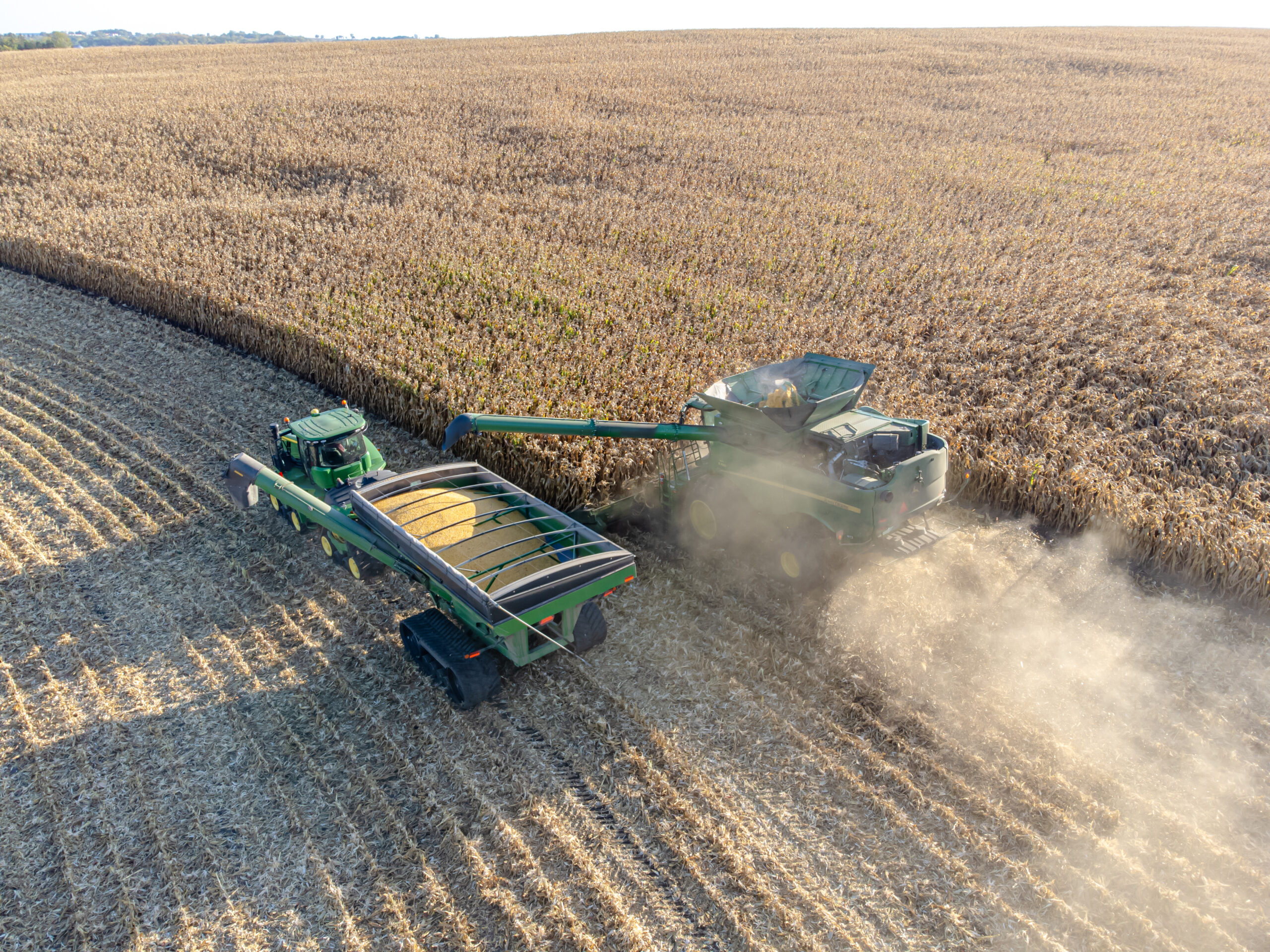
Thin news from the US-China trade meeting and American harvest delays set the tone for grain prices on Friday, September 25, 2026. Soybean futures edged up, corn ticked higher, and wheat drifted lower, although soybeans and corn both finished the week with gains.
The SOYB tracker fund, which follows soybean prices, closed at US$27.72, down 0.72%. The corn-tracking CORN fund settled at US$19.73, up 0.25%, and the wheat-tracking WEAT fund ended at US$25.50, down 0.27%.
Soybeans ended the week higher, but Friday showed how much of that rests on expectations: the US-China trade truce was extended without immediate purchase details, and prices only recovered after early weakness. Tight nearby supply in areas where the harvest is running late offers support that may fade once combines catch up. Corn’s fractional gain sits against Argentine planting running ahead of average, which could cap rallies if weather holds. Wheat has the clearest downside: fund selling and ample global supply outweigh Black Sea risk for now. The variable to watch is whether concrete Chinese purchase commitments emerge early this week.
02 The board
November Chicago soybeans settled at US$13.19 a bushel, up 1½ cents, after early losses. Harvest delays have left parts of the US short of beans, with reports of more movement from well-supplied areas to those shortfall regions.
December corn settled at US$5.28¼ a bushel, up ¾ cent, a modest advance after corn initially reacted negatively to the lack of trade specifics. December Chicago wheat settled at US$7.03¼ a bushel, down 3¾ cents, as fund and technical selling weighed on the market, leaving wheat lower week on week.
| Asset | Level | Change |
|---|---|---|
| Soybeans (SOYB) | US$27.72 | -0.72% |
| Corn (CORN) | US$19.73 | +0.25% |
| Wheat (WEAT) | US$25.50 | -0.27% |
Source: NYSE Arca close, 2026-09-25. Where a commodity has no spot feed, an exchange-traded tracker or leading producer is shown as a labelled proxy.
Live Market IntelligenceThe live market board
Rio Times · Live Market Intelligence
Latin America — Cross-Market Board
| Instrument | Last | Change | YoY | Prev. | High | Low | Volume |
|---|---|---|---|---|---|---|---|
| IBOV | 183,476.86 | -0.27% | +21.85% | 183,965.91 | 168,310 | 167,142 | — |
| IPSA | 11,256.80 | -0.38% | — | 11,299.82 | 11,210 | 10,984 | 1,513,213,483 |
| IPC MEX | 64,992.23 | +1.13% | +12.17% | 64,264.16 | 66,121 | 65,405 | 108,886,187 |
| MERVAL | 2,893,751 | -1.57% | +30.51% | 3,022,485 | 3,042,365 | 2,991,150 | — |
| COLCAP | 2,584.72 | -0.95% | — | 9.04 | 9.05 | 9.02 | 4,133 |
| BVL PERÚ | 59,934.37 | +1.27% | — | — | — | — | — |
| USD/BRL | 5.16 | +0.01% | -5.13% | 5.16 | 5.18 | 5.14 | — |
| EUR/BRL | 5.95 | +1.01% | -5.83% | 5.89 | 5.98 | 5.94 | — |
| USD/MXN | 17.06 | -0.24% | -8.58% | 17.10 | 17.08 | 17.01 | — |
| USD/CLP | 913.98 | +0.04% | -5.67% | 913.65 | 915.11 | 906.68 | — |
| USD/COP | 3,140 | +0.03% | -22.04% | 3,139 | 3,141 | 3,105 | — |
| USD/PEN | 3.36 | -0.66% | -4.82% | 3.38 | 3.38 | 3.35 | — |
| USD/ARS | 1,493 | +0.10% | +12.96% | 1,491 | 1,494 | 1,480 | — |
| USD/UYU | 40.27 | +1.24% | +1.80% | 39.77 | 40.27 | 40.23 | — |
| USD/PYG | 5,939 | +1.68% | -19.54% | 5,841 | 5,939 | 5,925 | — |
| USD/BOB | 11.64 | -0.76% | +72.04% | 11.73 | 11.72 | 11.64 | — |
| USD/DOP | 58.34 | +1.25% | -3.44% | 57.62 | 58.34 | 58.04 | — |
| USD/CRC | 445.92 | +0.89% | -9.71% | 441.97 | 448.50 | 445.92 | — |
03 What moved it
China remained the key demand hinge for soybeans. The trade truce was extended, but the absence of immediate purchase details put early pressure on prices; China had passed the halfway mark of its annual US soybean purchase pledge by mid-September.
The US dollar index eased on Friday, so currency was not the session’s driver. Wheat instead weighed talk of fewer attacks on Black Sea port infrastructure against continued strikes. The dollar still matters for Brazil and Argentina, whose exporters compete globally while selling in dollars and paying many local costs in reais or pesos.
04 The Latin American read
The Buenos Aires Grain Exchange reported that 17.1% of Argentina’s corn crop had been planted, ahead of the average pace. This early progress adds to expectations of ample South American supply for the coming season.
Brazil and Argentina remain central to the global export outlook. Traders are monitoring early planting conditions in Brazil and Argentina alongside US harvest progress. CONAB’s updated Brazilian crop estimate is due on October 15.
05 The names to watch
The SOYB, CORN, and WEAT exchange-traded funds are the most accessible proxies for foreign investors tracking American grain prices. Because they hold a basket of later-dated contracts, their daily moves can differ from the front-month futures, as SOYB’s Friday dip showed.
South American producers with overseas listings, such as Brazilian agribusiness exporters and Argentine farming groups, remain exposed to the currency. A strong dollar helps their dollar-denominated sales but raises the local-currency cost of inputs.
06 The outlook
Soybean strength hinges on how quickly the US harvest backlog clears and whether concrete Chinese purchases follow the truce. If nearby tightness eases as the harvest catches up, the soybean rally could stall.
Corn faces a tug-of-war between US harvest delays and rapid Argentine planting. Wheat remains the most vulnerable to fund selling and ample global supply.
07 What to watch
- US harvest and crop progress: The USDA’s weekly crop progress report on Monday afternoon and Quarterly Grain Stocks on Wednesday, September 30, will show how far the harvest has caught up.
- Chinese soybean purchases: Traders are still waiting for purchase details; confirmation would underpin soybean prices, while a delay would expose the market to harvest pressure.
- Argentine corn planting pace: Faster-than-expected progress from the Buenos Aires Grain Exchange could cap corn rallies and pressure the CORN tracker.
- USDA and CONAB estimates: The USDA’s supply and demand report on October 9 and CONAB’s Brazil update on October 15 will reset balance-sheet expectations.
Frequently Asked Questions
Why did soybeans rise on Friday, September 25, 2026?
Soybeans recovered from early weakness after the US-China trade truce was extended, and harvest delays tightened nearby supply, leaving November Chicago soybeans at US$13.19 a bushel, up 1½ cents.
What does the SOYB price tell investors?
SOYB is an exchange-traded fund that tracks soybean prices. It closed at US$27.72, down 0.72%, because the fund holds later-dated contracts that can move differently from the November future.
How does the stronger dollar affect Latin American grain exporters?
A stronger US dollar makes American grain more expensive for overseas buyers, while Brazilian and Argentine exporters sell in dollars but pay many local costs in reais or pesos, which improves their competitive position.
What is the significance of Argentina’s 17.1% corn planting figure?
The Buenos Aires Grain Exchange figure is ahead of average and signals early progress on South American supply, which could weigh on global corn prices if weather remains favourable.
Market data: NYSE Arca (tracker funds); CBOT settlements via USDA AMS.
This article was produced by The Rio Times’ automated newsroom system. How we use AI · Report an error
In depth
LatAm Markets: Live Signals → — real-time movers, turnover leaders and FX across Latin America.
Read More from The Rio Times