Wheat Leads Grain Rally; Brazil, Argentina Exports in Focus

Key Facts
- Wheat led gains the wheat tracker WEAT closed at US$28.00, up 2.87 percent on Black Sea supply disruption.
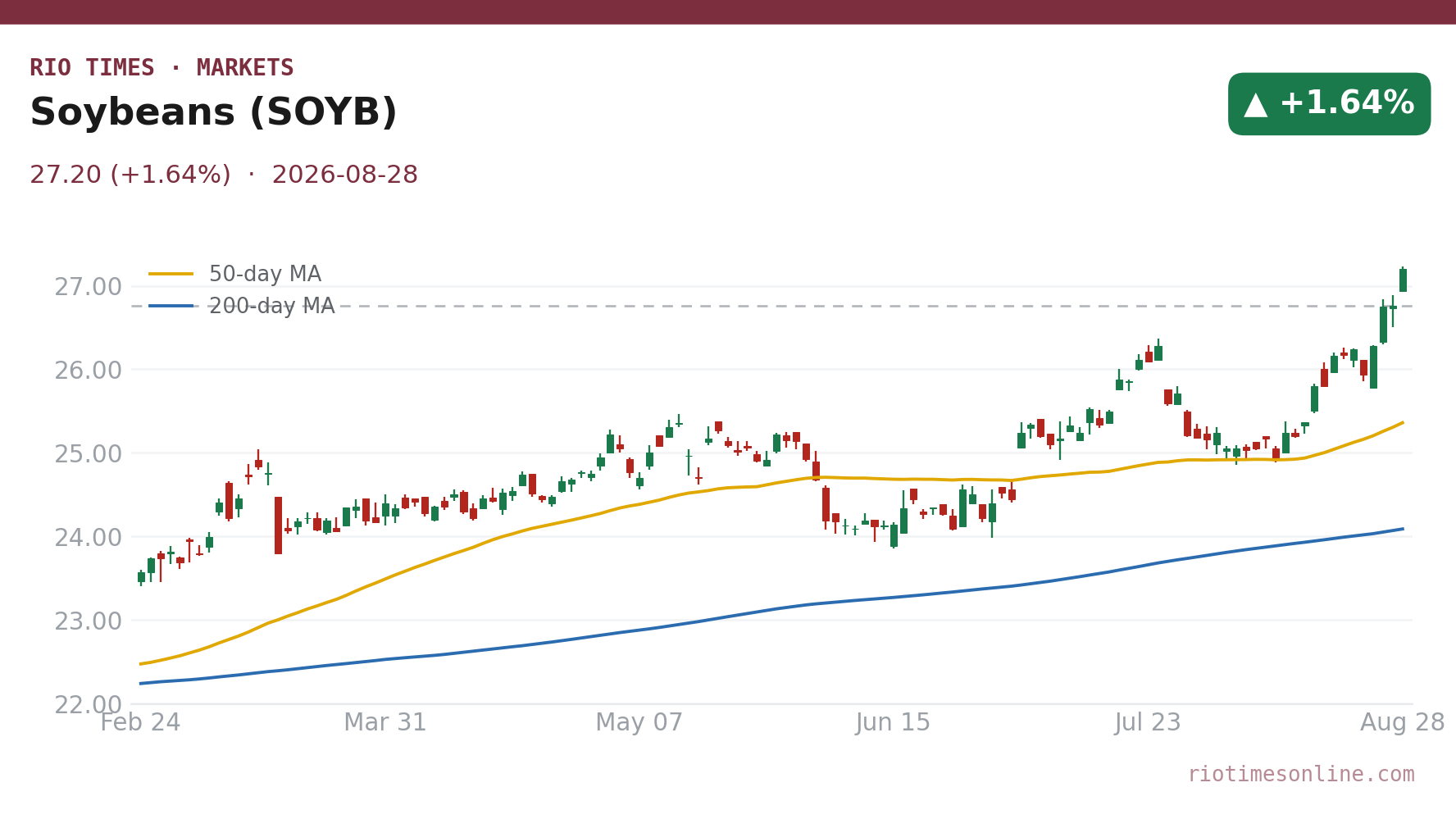
- Soybeans followed firmer the soybean tracker SOYB settled at US$27.20, a gain of 1.64 percent supported by steady Chinese oilseed demand.
- Corn posted the quietest advance the corn tracker CORN finished at US$19.95, up 0.76 percent as traders digested the prior rally.
- Chicago wheat hit a three-year high with the December contract at 784.00 cents per bushel amid a global shortage narrative tied to war.
- The real weakened slightly Brazil’s currency closed at R$5.1959 per US dollar, keeping South American exports competitive.
- The Argentine peso was quoted at 1,512 per US dollar wholesale, reinforcing the southern-hemisphere export engine framing.
Today’s Focus
Wheat was the standout in Friday’s grain session, with the WEAT tracker climbing 2.87 percent to US$28.00 as Black Sea supply worries pushed Chicago futures to a three-year high. The December wheat contract settled at 784.00 cents per bushel.
Soybeans also gained, with SOYB up 1.64 percent to US$27.20 on continued Chinese buying of oilseeds. November soybeans closed at 1,288.00 cents per bushel.
Corn was the laggard, adding just 0.76 percent to US$19.95 as speculative buying slowed. December corn settled at 536.50 cents per bushel.
For Latin America, the currency backdrop matters as much as the futures board. Brazil’s real at R$5.1959 and Argentina’s peso at 1,512 per dollar keep both countries firmly positioned as the world’s grain export engine.
What matters today. Wheat is the volatility leader on supply fears, while steady Chinese demand underpins soybeans and leaves Brazil and Argentina with strong export economics.
01 The session in one read
Friday’s grain trade was a wheat story first. The WEAT tracker jumped 2.87 percent to US$28.00, the strongest single move across the complex.
Behind the move, Chicago wheat futures extended to a three-year high, with December delivery at 784.00 cents per bushel.
Soybeans were firmer but less dramatic, with SOYB up 1.64 percent at US$27.20. Corn brought up the rear, adding 0.76 percent to US$19.95.
The grain complex is being driven by two distinct forces: a genuine supply shock in wheat from Black Sea disruption, and a more demand-led, steadier bid in soybeans from Chinese buying. Corn looks caught between the two, having already priced much of its earlier rally. The variable to watch is any diplomatic progress on reopening the Black Sea grain corridor, which could unwind wheat’s war premium quickly.
02 The board
The three grain trackers closed uniformly higher, but the gaps between them tell the story. Wheat’s 2.87 percent gain dwarfed soybeans’ 1.64 percent and corn’s 0.76 percent.
On the futures side, November soybeans settled at 1,288.00 cents per bushel and December corn at 536.50 cents per bushel, both reflecting a steadier, less panicked tone than wheat.
| Asset | Level | Change |
|---|---|---|
| Soybeans (SOYB) | US$27.20 | +1.64% |
| Corn (CORN) | US$19.95 | +0.76% |
| Wheat (WEAT) | US$28.00 | +2.87% |
Source: RT close, 2026-08-28. Where a commodity has no spot feed, an exchange-traded tracker or leading producer is shown as a labelled proxy.
Live Market IntelligenceThe live market board
Rio Times · Live Market Intelligence
Latin America — Cross-Market Board
| Instrument | Last | Change | YoY | Prev. | High | Low | Volume |
|---|---|---|---|---|---|---|---|
| IBOV | 206,505.98 | -0.18% | +21.85% | 206,887.52 | 168,310 | 167,142 | — |
| IPSA | 10,966.21 | -0.49% | — | 11,020.01 | 11,210 | 10,984 | 1,513,213,483 |
| IPC MEX | 66,790.35 | -0.26% | +12.17% | 66,965.15 | 66,121 | 65,405 | 108,886,187 |
| MERVAL | 2,835,843 | +0.00% | +30.51% | 3,022,485 | 3,042,365 | 2,991,150 | — |
| COLCAP | 2,582.29 | +0.46% | — | 9.04 | 9.05 | 9.02 | 4,133 |
| BVL PERÚ | 60,511.74 | -1.60% | — | — | — | — | — |
| USD/BRL | 5.16 | +0.01% | -5.13% | 5.16 | 5.18 | 5.14 | — |
| EUR/BRL | 5.95 | +1.01% | -5.83% | 5.89 | 5.98 | 5.94 | — |
| USD/MXN | 17.06 | -0.24% | -8.58% | 17.10 | 17.08 | 17.01 | — |
| USD/CLP | 913.98 | +0.04% | -5.67% | 913.65 | 915.11 | 906.68 | — |
| USD/COP | 3,140 | +0.03% | -22.04% | 3,139 | 3,141 | 3,105 | — |
| USD/PEN | 3.36 | -0.66% | -4.82% | 3.38 | 3.38 | 3.35 | — |
| USD/ARS | 1,493 | +0.10% | +12.96% | 1,491 | 1,494 | 1,480 | — |
| USD/UYU | 40.27 | +1.24% | +1.80% | 39.77 | 40.27 | 40.23 | — |
| USD/PYG | 5,939 | +1.68% | -19.54% | 5,841 | 5,939 | 5,925 | — |
| USD/BOB | 11.64 | -0.76% | +72.04% | 11.73 | 11.72 | 11.64 | — |
| USD/DOP | 58.34 | +1.25% | -3.44% | 57.62 | 58.34 | 58.04 | — |
| USD/CRC | 445.92 | +0.89% | -9.71% | 441.97 | 448.50 | 445.92 | — |
03 What moved it
Wheat’s surge is tied directly to war. Black Sea supply disruptions have produced what market notes describe as a global wheat shortage, and Türkiye is ramping up diplomacy to reopen the grain corridor.
Soybeans drew support from steady Chinese buying of oilseeds, a demand story that has not wavered. Corn’s smaller gain reflected speculative buying and spillover from the stronger wheat and soybean markets.
One report noted corn and wheat prices have reached their highest levels in three years, with wheat up 12.1 percent in a single week on Black Sea disruption.
04 The Latin American read
Brazil and Argentina remain the southern-hemisphere export engine, a position reinforced by the currency board. Brazil’s real traded at R$5.2005 per US dollar and Argentina’s wholesale peso at 1,512 per dollar.
A weaker real and a heavily managed peso make both countries’ grain more competitive in dollar terms at a moment when global buyers are anxious about supply. That anxiety is an export opportunity for South American shippers.
05 The names to watch
The three trackers themselves, SOYB, CORN and WEAT, are the cleanest way for foreign investors to follow the complex without direct futures exposure.
In Brazil and Argentina, the relevant watch points are the real’s path against the dollar and any Argentine policy shift on export taxes or the peso. The Brazilian currency at R$5.2005 is a competitiveness gauge.
Chicago futures remain the global benchmark: December wheat at 784.00 cents, November soybeans at 1,288.00 cents, and December corn at 536.50 cents per bushel.
06 The outlook
The path forward depends on Black Sea diplomacy and Beijing’s willingness to keep buying oilseeds at these levels. Wheat holds the most downside risk if the corridor reopens, while soybeans look supported by demand. Corn may consolidate.
07 What to watch
- Black Sea corridor diplomacy: Any concrete reopening talks led by Türkiye could unwind wheat’s war premium and drag the whole complex lower.
- Chinese soybean purchases: Continued buying by Beijing is the quiet floor under SOYB and South American export margins.
- Brazilian real movement: The real at R$5.2005 keeps exports competitive; a sharp appreciation would dent forward selling.
- Argentine export policy: Any change to peso management or export taxes would shift the competitive balance for South American corn and wheat.
Background: our usd brl outlook real focus guide.
Frequently Asked Questions
Why did wheat rise so sharply on Friday?
Black Sea supply disruption tied to the Russia-Ukraine conflict created a global shortage narrative, pushing WEAT up 2.87 percent to US$28.00.
Are these prices the actual commodity spot prices?
No. SOYB, CORN and WEAT are exchange-traded trackers; the underlying futures closed at 1,288.00 cents for soybeans, 536.50 cents for corn and 784.00 cents for wheat.
How do Brazil and Argentina benefit?
Both countries are the southern-hemisphere export engine, and their currencies, the real at R$5.2005 and the peso at 1,512 per dollar, keep their grain competitive in global markets.
What is the biggest risk to this rally?
A diplomatic reopening of the Black Sea grain corridor could remove wheat’s supply scare premium and drag the complex lower.
Market data: RT
This article was produced by The Rio Times’ automated newsroom system. How we use AI · Report an error · Editorial responsibility: Matthias Camenzind, Editor-in-Chief
LatAm Markets: Live Signals → — real-time movers, turnover leaders and FX across Latin America.