El Salvador Adds 38 Bitcoin as Donor Questions Grow

FINANCE · EL SALVADOR
Key Facts
- —The country El Salvador, a dollarised Central American nation of about 6 million people, made bitcoin legal tender in 2021 under President Nayib Bukele.
- —Why it matters The state’s bitcoin buying is a condition in a roughly US$1.4 billion IMF loan, so it affects US bondholders and the country’s credit standing.
- —Why now Cristosal, a human rights group, is demanding the names of the private donors the government says supplied the new coins, Diario Co Latino reported on Saturday.
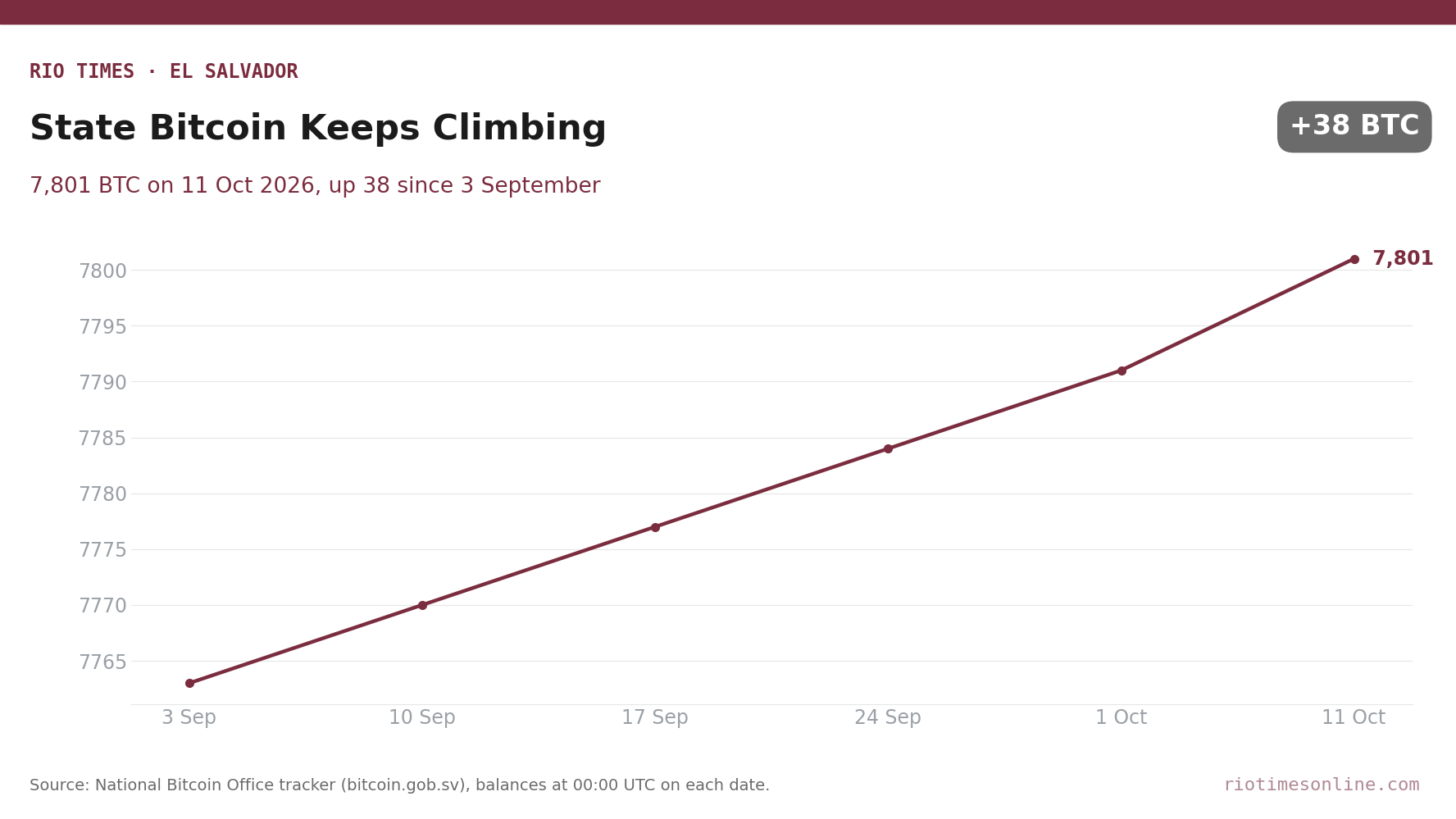
- —What happened The National Bitcoin Office tracker shows 38 bitcoin added since 3 September, the latest on Saturday 10 October, for 7,801 in total.
- —The numbers At US$82,958 per coin early on Sunday, the reserve is worth about US$647 million. The 38 new coins are worth about US$3.2 million.
- —What it means for you Nothing changes for visitors or remittance senders. Investors should watch whether the IMF treats the steady inflows as documented donations.
- —Still open Who the donors are, how much each gave, and whether the coins added since 1 October are covered by the IMF’s documentation.
- —Prediction markets Polymarket gives El Salvador a 14% chance of holding US$1 billion or more in bitcoin by 31 December (11 October, 2:31 a.m. ET).
El Salvador’s government added another bitcoin to its reserve on Saturday 10 October, its 38th since the IMF staff-level agreement of 3 September. The country now holds 7,801 coins, according to the official National Bitcoin Office tracker. For US investors, the El Salvador bitcoin question is whether a reserve the IMF says should stop growing keeps quietly expanding.
The government says the new coins come from private donors, not public money, and the IMF has accepted documentation to that effect. Cristosal, a human rights organisation, now wants those donors named. Its analysis, dated 30 September, was reported by the Salvadoran daily Diario Co Latino on Friday and Saturday.
El Salvador has used the US dollar as its currency since 2001, so all amounts here are in US$.
One Coin at a Time
The National Bitcoin Office is the government unit that runs the state’s bitcoin policy and publishes its wallet addresses online. Its tracker, built on public blockchain data, listed 20 addresses holding 7,801.37 bitcoin early on Sunday 11 October.
Inflows arrive almost daily in single-coin amounts. The tracker shows 38 deposits of exactly one bitcoin each since 3 September. Ten of them arrived on or after Thursday 1 October, the day the IMF executive board completed the programme’s second and third reviews.
The same data show no net outflows beyond small network fees, so El Salvador bitcoin holdings have only grown. At the tracker’s own price of US$82,958 early on Sunday, the reserve was worth about US$647 million.
What the IMF Agreed
El Salvador signed a roughly US$1.4 billion Extended Fund Facility with the International Monetary Fund, approved in early 2025. A core condition was that the public sector would keep its bitcoin holdings unchanged.
That did not happen. In its 3 September press release, the IMF said documentation had been provided “verifying that Bitcoin accumulation since the first review reflects private donations” and that “no public resources were used.”
The Fund added: “Going forward, no further Bitcoin accumulation beyond the documented donations is expected.” When the board approved the reviews on 1 October and released about US$138 million, it said again that “no further Bitcoin accumulation is envisaged beyond the documented donations.”
The board also said waivers were granted “for certain unmet performance criteria on Bitcoin accumulation”, based on corrective measures and renewed commitments. It asked the government to improve disclosure of public crypto holdings.
Live Market IntelligenceCrypto — Live Market Board
Rio Times · Live Market Intelligence
Crypto — Live Market Board
-0.26%
| Instrument | Last | Change | YoY | Prev. | High | Low | Volume |
|---|---|---|---|---|---|---|---|
| BTC | 63,384 | -0.26% | -47.24% | 63,552 | 64,346 | 63,305 | 22,774,743,040 |
| ETH | 1,886 | +0.26% | -58.90% | 1,881 | 1,920 | 1,879 | 7,916,475,392 |
| SOL | 75.89 | -0.40% | -60.44% | 76.20 | 76.99 | 75.39 | 1,473,821,056 |
| XRP | 1.01 | -1.15% | -69.07% | 1.02 | 1.02 | 1.01 | 1,144,044,416 |
| BNB | 609.60 | -1.12% | -26.81% | 616.50 | 619.30 | 609.23 | 1,266,706,432 |
| ADA | 0.18 | -1.98% | -78.22% | 0.19 | 0.19 | 0.18 | 238,085,632 |
| DOGE | 0.07 | -1.56% | -70.00% | 0.07 | 0.07 | 0.07 | 553,256,192 |
| AVAX | 6.38 | +1.04% | -74.11% | 6.32 | 6.42 | 6.21 | 248,470,560 |
| LINK | 8.77 | -0.06% | -62.73% | 8.77 | 8.87 | 8.68 | 317,054,880 |
| DOT | 0.78 | -0.75% | -81.11% | 0.79 | 0.80 | 0.78 | 43,490,492 |
| LTC | 45.08 | -0.85% | -65.45% | 45.47 | 45.59 | 44.98 | 143,727,712 |
| BCH | 213.85 | +0.10% | -65.44% | 213.64 | 215.69 | 212.54 | 137,956,688 |
| TRX | 0.34 | +0.28% | -4.73% | 0.33 | 0.34 | 0.33 | 436,576,064 |
| XLM | 0.16 | -1.33% | -64.46% | 0.16 | 0.16 | 0.16 | 89,559,864 |
| HBAR | 0.07 | -0.53% | -74.67% | 0.07 | 0.07 | 0.07 | 22,546,186 |
| NEAR | 1.65 | +2.42% | -40.55% | 1.62 | 1.68 | 1.61 | 187,591,264 |
| ATOM | 1.40 | -2.36% | -70.15% | 1.44 | 1.44 | 1.40 | 18,626,964 |
| AAVE | 89.06 | +0.93% | -72.33% | 88.24 | 90.20 | 88.19 | 129,099,704 |
What Cristosal Wants
Cristosal is a human rights group founded in El Salvador that works across Central America. It has long been critical of the Bukele government.
Its 11-page analysis says state bitcoin reserves have grown by about 1,090 coins, roughly US$100 million, since the IMF’s first review in June 2025. It asks the government to publish the donation contracts, the donors’ identities, the amounts and the dates.
It also calls for forensic tracing of the coins on the blockchain. The aim, it says, is to rule out funds linked to hacks, mixing services or illicit markets.
The group warns that undisclosed donations could carry the risk of an “upfront bribe” if donors later won contracts or concessions. It offers no evidence that this has happened, and the claim remains a warning, not an allegation against any person.
Cristosal adds that current law sets no specific procedure for the state to receive bitcoin as a donation. It also points to gaps on crypto funding of political campaigns, ahead of the 2027 elections.
What It Means for You
For travellers and Salvadorans sending money home from the United States, nothing changes. The dollar remains the everyday currency, and businesses may refuse bitcoin since the 2025 reforms.
For holders of Salvadoran bonds, the El Salvador bitcoin issue is about programme credibility. The IMF has already granted waivers once. Steady inflows that cannot be matched to named donors could complicate future reviews and disbursements.
There is a stabiliser. The IMF has accepted the government’s documentation and the board released the money. The new coins are also small against an economy the IMF puts at about US$39 billion this year.
For background, see El Salvador IMF Board Releases US$138 Million and El Salvador Holds 7,762 Bitcoin as IMF Ends Mandatory Use.
What Is Not Known
The donors behind the El Salvador bitcoin inflows, the size of each gift and the dates are not public. It is not clear whether the IMF’s documentation covers the ten coins added since 1 October or only earlier inflows.
The government and the National Bitcoin Office had not publicly answered Cristosal’s analysis by early Sunday. The tracker does not show who sent each coin, only that it arrived.
What Prediction Markets Say
Bets on Polymarket give El Salvador a 14% chance of holding US$1 billion or more in bitcoin by 31 December, as of 2:31 a.m. ET on Sunday 11 October. That price has fallen about 28 points over the past month.
About US$10,800 has been traded on that contract. Reaching the mark at today’s holdings would need bitcoin near US$128,000, so the bet is mostly on the coin’s price, not on new donations.
Why we show this: prediction markets turn real-money bets into a live probability that moves within minutes of the news, which is why investors, campaigns and newsrooms in the United States now follow them closely. We show them next to polls and official results, never instead of them.
Frequently Asked Questions
How much bitcoin does El Salvador hold?
The National Bitcoin Office tracker showed 7,801 bitcoin on Sunday 11 October, worth about US$647 million at early-morning prices.
Is El Salvador still buying bitcoin?
Its holdings keep rising by about one coin a day. The government and the IMF say the coins added since mid-2025 are private donations, not purchases with public money.
What is Cristosal asking for?
The rights group wants the government to publish the donors’ names, the amounts, the dates and the donation contracts, and to trace the coins on the blockchain.
Sources: National Bitcoin Office tracker, 11 October 2026; IMF Press Release 26/285, 3 September 2026; IMF Press Release 26/316, 1 October 2026; Cristosal analysis, 30 September 2026; Diario Co Latino, 10 October 2026; Diario Co Latino, 9 October 2026; Polymarket market data, 11 October 2026.
Editorial responsibility: Matthias Camenzind, Editor-in-Chief · Editorial standards · Report an error