Ecuador Remittances Hit Record US$2.04 Billion in Q2

ECONOMY · ECUADOR
Key Facts
- —The country Ecuador has used the US dollar as its currency since 2000. It lives on oil, shrimp and mining exports, and on money sent home by migrants.
- —What happened Remittances hit a record US$2.04 billion in April–June 2026, up 9.9% on the quarter and 2.0% on the year (Central Bank of Ecuador, 1 October).
- —The numbers First-half remittances totalled US$3.90 billion, 4.6% more than in 2025 (El Universo). Foreign direct investment over the same six months was US$715.5 million (central bank).
- —What it means for you Household spending in many Ecuadorian provinces leans on these transfers. Consumer businesses gain, but a downturn in the US job market would be felt quickly.
- —Still open The bank’s 1 October release gave no province or channel detail for the second quarter, and July–September figures are not yet out.
Ecuador remittances reached US$2.04 billion in the second quarter of 2026, the largest quarterly sum on record. Migrants’ transfers rose 9.9% on the quarter and 2.0% on the year, the Central Bank of Ecuador said on 1 October.
El Comercio reported on 2 October that the transfers are helping to hold up the economy alongside record exports. Because Ecuador uses the US dollar, every remitted dollar adds directly to the cash circulating at home.
A Record Quarter After a Softer Start
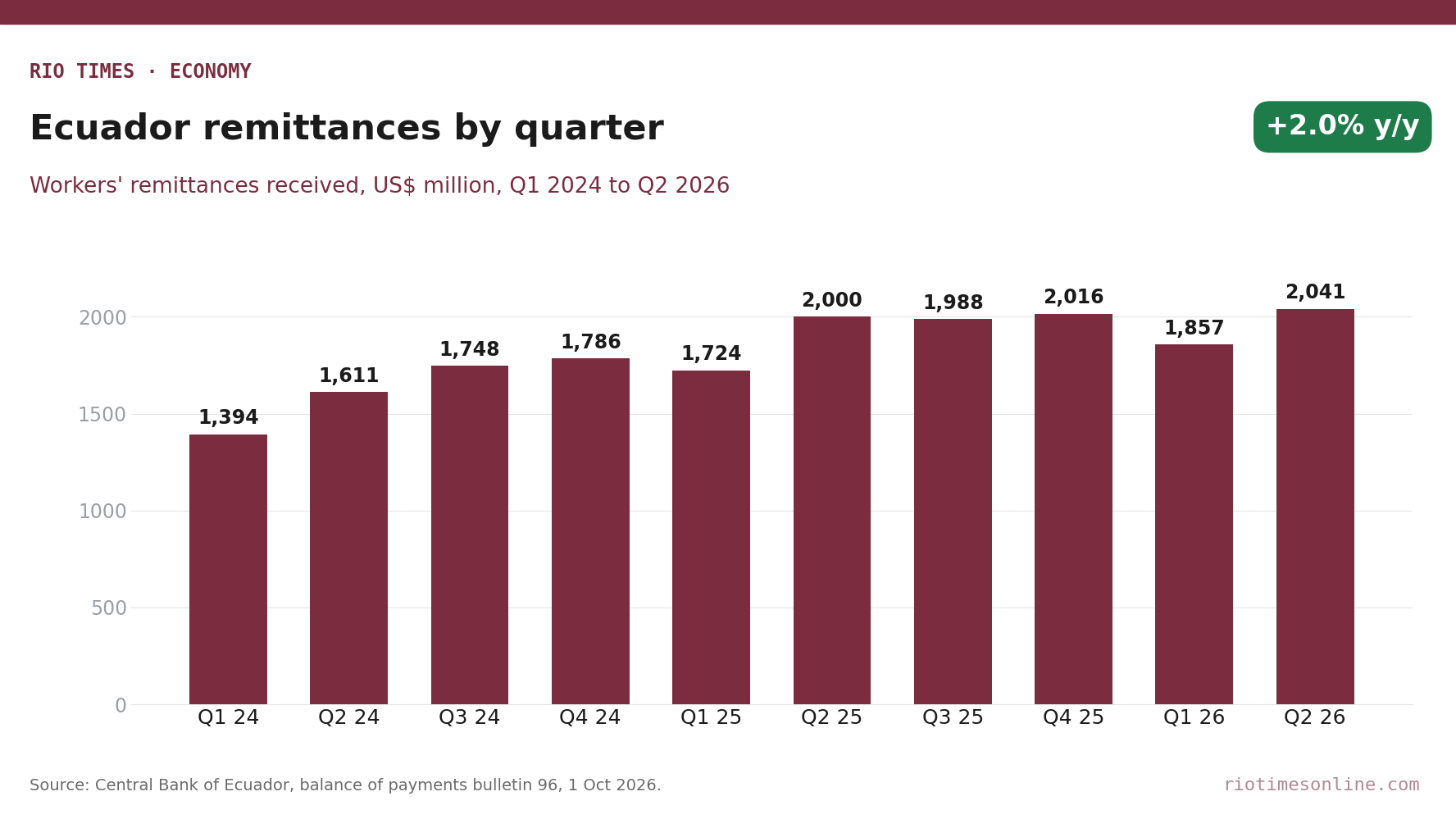
The April–June total of US$2.04 billion followed US$1.86 billion in January–March. Teleamazonas described it on 1 October as the largest quarterly amount ever recorded, and the central bank’s own series bears that out.
Over the first half, remittances came to US$3.90 billion, El Universo reported. That is 4.6% more than the US$3.72 billion received in January–June 2025.
The longer trend is steeper still. Central bank balance of payments data show annual remittances rising from US$2.60 billion in 2016 to US$7.73 billion in 2025.
Where the Money Comes From
The United States sent US$1.60 billion in the second quarter, or 78.5% of the total, El Universo and El Diario reported. Spain followed with US$278.8 million, a 13.7% share.
In the first quarter, the bank said in July, the United States, Spain and Italy together supplied 93.7% of the money. Remittances from the United States went mainly to Pichincha, Guayas, Azuay, Cañar and Chimborazo provinces.
Most of the money now arrives through the formal banking system. In January–March, 63.1% came in through private banks, and 77.8% of that was credited straight into accounts.
More Than Five Times Foreign Investment
Foreign direct investment, the capital foreign firms put into Ecuadorian companies, reached US$715.5 million in the first half. Ecuador remittances were therefore more than five times larger over the same months.
Investment is not shrinking, though. Second-quarter inflows of US$237.9 million more than doubled from a year earlier, with business services and mining prominent.
Exports also hit a record US$10.26 billion in the quarter, helped by oil averaging US$87.0 a barrel. The current account, which tracks trade, income and transfers with the world, showed a US$1.43 billion surplus.
Output rose 2.1% in the second quarter, as reported in Ecuador Economy Grew 2.1% in the Second Quarter, Central Bank Says. The bank has since raised its 2026 growth forecast to 2.7%.
Strength With a Single Point of Exposure
Annual growth slowed to 2.0% in the second quarter from 7.7% in the first. Flows also tend to dip at the start of each year, as the chart shows.
Reliance on one country is high. With nearly four in five dollars coming from the United States, Ecuador remittances depend on US jobs and migration policy.
The offsetting strength is breadth. The money reaches households in many provinces, and the central bank says it supports family income and local banks.
What Is Not Yet Known
The 1 October release did not break down second-quarter remittances by province or by channel. That detail appeared only for the first quarter, in a separate release on 9 July.
Figures for July–September are not yet out. It is also unclear whether the slower annual growth seen in the second quarter will persist into the second half.
Sources: Central Bank of Ecuador, second-quarter 2026 balance of payments release (1 October 2026), first-quarter 2026 remittances release (9 July 2026) and balance of payments bulletin 96; El Comercio (2 October 2026); El Universo; Primicias; Teleamazonas (1 October 2026); El Diario (2 October 2026).
This article was produced by The Rio Times’ automated newsroom system. How we use AI · Report an error · Editorial responsibility: Matthias Camenzind, Editor-in-Chief
LatAm Markets: Live Signals → — real-time movers, turnover leaders and FX across Latin America.