Ecuador Doubles Guayaquil Power Substation Capacity With a US$12.9 Million Upgrade

ENERGY · ECUADOR
Key Facts
- —The country Ecuador, a dollarised economy, has been rationing power to 185 large industrial users since 22 September 2026 during its dry season.
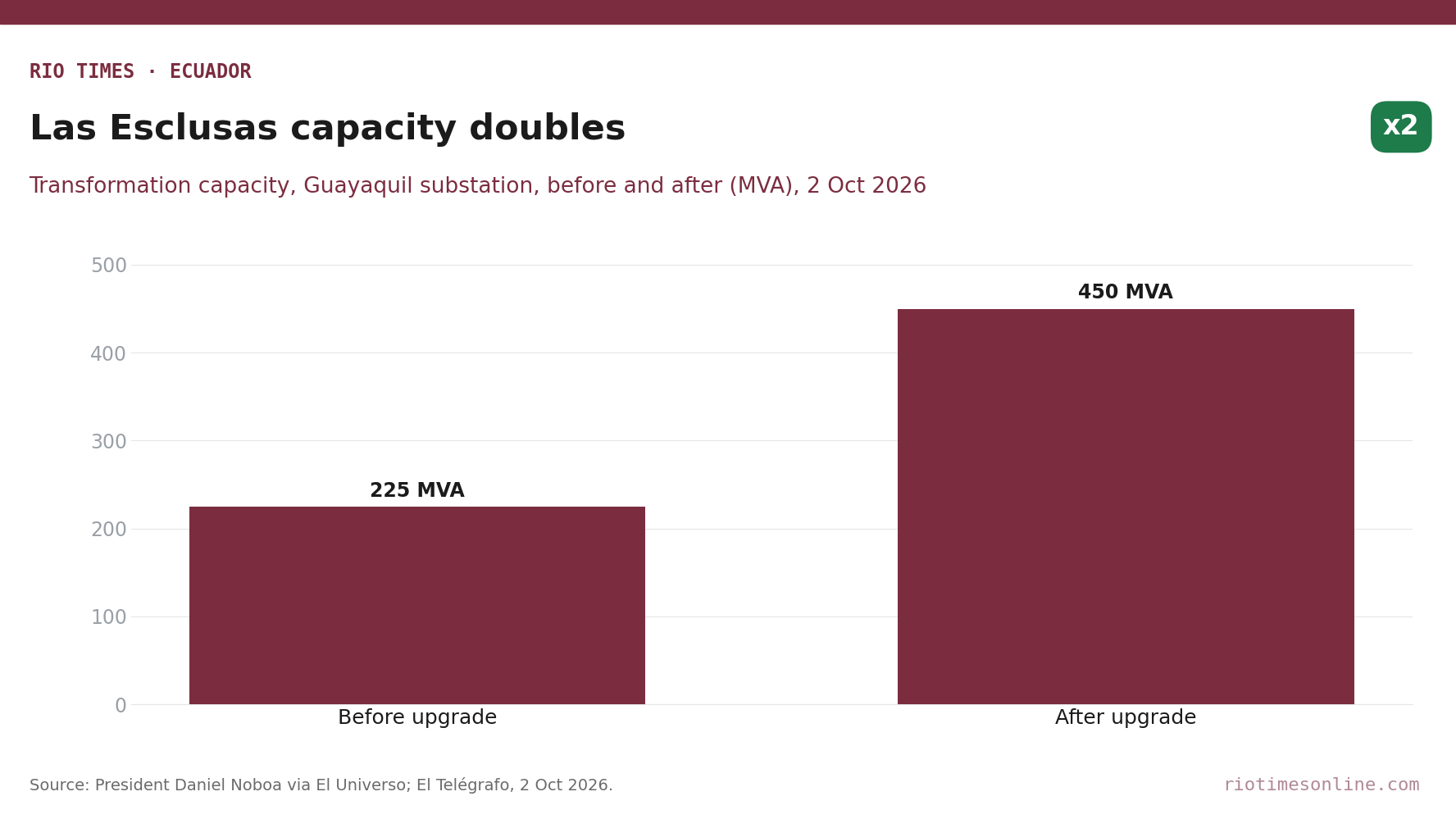
- —What happened The Las Esclusas substation in south Guayaquil now has 450 MVA of transformation capacity, up from 225 MVA, President Daniel Noboa said on 2 October 2026.
- —The numbers US$12,967,941 invested, 982,252 residents served and 112 direct jobs created during the works, according to government figures reported by El Telégrafo on 2 October 2026.
- —What it means for you Homes and businesses in south Guayaquil may see steadier supply. The upgrade moves more power through the local grid but does not generate new electricity.
- —Still open No construction dates, contractor or before-and-after outage data have been published. How far it eases rationing is unclear.
Ecuador says the Las Esclusas electricity substation in south Guayaquil has doubled its capacity after an investment of almost US$13 million. President Daniel Noboa announced the result in a video on social media, El Universo reported on 2 October.
Capacity rose from 225 to 450 megavolt-amperes (MVA), the unit used to rate transformers. The upgrade arrives while the country rations electricity to large industrial users during a dry season that has cut hydropower output.
What the government says changed
The project installed a new 225 MVA power transformer, El Telégrafo reported, citing the government. That single unit doubles the transformation capacity of the whole substation.
A new 69-kilovolt yard was also built to connect the national transmission grid with CNEL EP, the state electricity distributor. Transformers, supervision panels and control, protection and metering boards were modernised.
The government put the total cost at US$12,967,941. El Universo quoted Noboa as saying the plant is “operating at 100%” and created 112 direct jobs.
Who benefits in Guayaquil
According to the government, the work directly serves 982,252 people in the south of Guayaquil, Ecuador’s largest city and main port. It is also meant to take load off the nearby Caraguay substation.
A resident of Guasmo Sur, a large southern district, told El Telégrafo that steadier supply would protect household appliances. She said it would also help small businesses keep running.
Grid relief, not new power
A substation steps high-voltage power down so it can be distributed to homes and firms. Greater capacity reduces bottlenecks and overloads, but it does not add a single megawatt of generation.
Ecuador’s current shortage stems mainly from low reservoir levels at its hydropower plants. Since late September, 185 large companies have been asked to cut consumption, and two Guayaquil ports were affected, as covered in Ecuador Power Rationing Reaches Two Guayaquil Ports as Exporters Warn of Delays.
The government is also trying to add generation. A recent decree aims to speed up new plants of up to 100 MW, as reported in Ecuador Decree Fast-Tracks New Power Plants to 100 MW.
Part of a longer plan
El Telégrafo said the Las Esclusas expansion belongs to the national electricity master plan for 2023–2032. Staff of Celec EP, the state power corporation, explained the new transformer in Noboa’s video.
“Ecuador needs certainty. We respond with work and results,” Noboa said, according to El Universo. Ecuador holds local elections on 29 November.
What Is Not Yet Known
The government has not published when construction at the substation started or finished, or which company carried out the work. Neither source gave figures on how often south Guayaquil lost power before the upgrade.
It is also unclear whether the extra capacity will shorten any scheduled cuts. That depends on generation and rainfall, which a substation cannot change.
Sources: El Universo (2 October 2026, Noboa announcement); El Telégrafo (2 October 2026, government figures); earlier Rio Times reporting on Ecuador’s power rationing.
This article was produced by The Rio Times’ automated newsroom system. How we use AI · Report an error · Editorial responsibility: Matthias Camenzind, Editor-in-Chief