Ecuador Youth Jobs Plan Adds 700,000 Paid Places

POLITICS · ECUADOR
Key Facts
- —The country Ecuador, which uses the US dollar, elects local authorities on Sunday 29 November 2026. About 13.8 million voters are registered (Teleamazonas, 3 October).
- —What happened On 1 October President Daniel Noboa announced 700,000 new places in the Jóvenes en Acción youth programme. Each pays US$400 a month for two months (El Universo, Primicias).
- —The numbers If all places are filled the stage costs US$560 million, the Cordes think tank estimates (Expreso, 2 October). The 2026 budget draft set aside US$1 million; 2026 spending would reach US$740 million (Ecuavisa, 2 October).
- —What it means for you People aged 18 to 29 who receive no other state aid and have not taken part before can apply online. Payments are due on 30 October and 27 November.
- —Still open The government has not said how the US$560 million will be financed. It has not answered critics who link the payment dates to the November vote.
Ecuador will pay 700,000 young people US$400 a month for two months in a new stage of Jóvenes en Acción. The state programme pays young adults for training and internships in public bodies.
The stage would cost about US$560 million if every place is filled, the Cordes think tank estimates, and its last payment falls two days before local elections. Critics call the timing electoral, while the government says it helps young people into first jobs.
What Noboa announced
Daniel Noboa unveiled the stage in a video on his social media accounts on 1 October. He said he had seen videos from young people who were left out of earlier rounds.
The places are open to people aged 18 to 29, El Universo and Primicias report. Each participant receives training and a paid internship of US$400 a month for two months.
Both payments will be made in advance, on 30 October and 27 November. Applicants must not receive any other state bonus and must not have joined the programme before, Primicias reports.
Interns will serve in the ministries of Public Health, Infrastructure and Transport, and Education, Sport and Culture. Others go to the National Risk Management Secretariat, the disaster agency.
How fast the programme has grown
The first edition, launched in November 2024, offered 80,000 places at a cost of US$96 million, according to Ecuavisa. The 2025 edition matched both figures.
The third stage, from July to September 2026, rose to 150,000 places and US$180 million. The new stage reaches almost nine times as many people as the first.
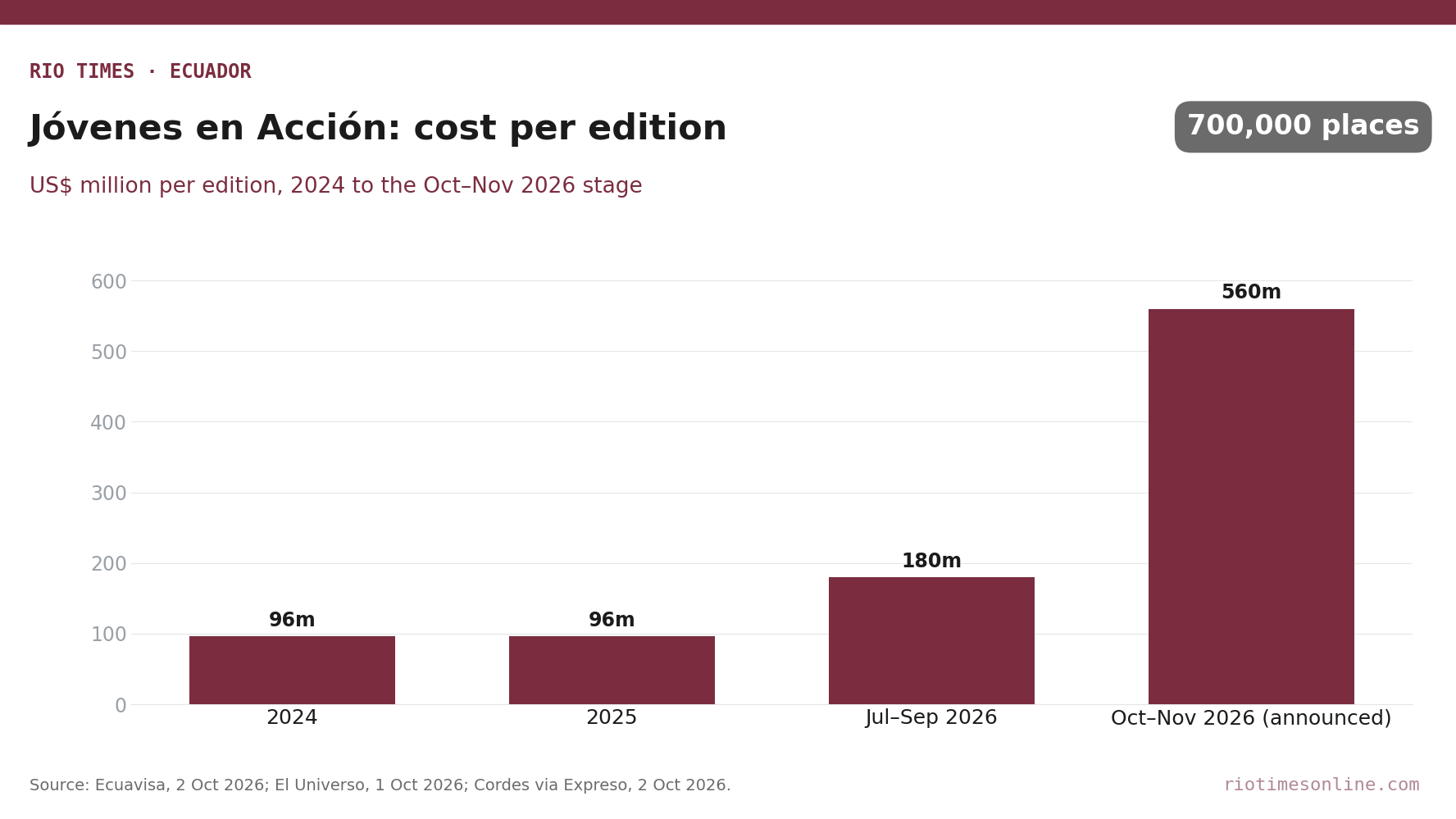
Across the four editions, Ecuavisa counts US$932 million paid or committed. Government figures cited by El Universo put actual 2024 participation at 75,467 people.
The budget question
The 2026 budget draft held only US$1 million for the programme, both Ecuavisa and Expreso report. With the July and October stages, 2026 spending would reach US$740 million, Ecuavisa calculates.
José Hidalgo Pallares, director of the economic research group Cordes, said this “implies finding additional resources”, Ecuavisa reports. The government has not said where the money will come from.
Expreso columnist Martín Pallares, in an opinion piece, calls the plan “clientelism, pure and simple”. It counts 550,000 more places than in the previous 150,000-place stage.
The electoral calendar
Ecuador holds its November local elections on Sunday 29 November. Voters also choose the CPCCS, the citizen participation council that selects senior oversight officials.
The CNE, the national electoral council, has confirmed that date and is renting generators against power cuts, Teleamazonas reports. About 13.8 million people are registered to vote.
The government has also moved the public sector’s 13th-month salary forward to 16 November. It has suspended the working day on 20 November, nine days before the vote, Expreso notes.
Ecuavisa points out that the first call, in November 2024, came months before the February 2025 general election. Hidalgo, quoted by Ecuavisa, said it is “difficult not to find the electoral tint” in the new announcement.
The government says paying in advance aims to stimulate the economy, Primicias reports. Former participants quoted by Ecuavisa are split: one attended only three talks, another said the money paid for her degree.
What Is Not Yet Known
The government has not published a financing source for the US$560 million. Nor has it explained how four public bodies will absorb 700,000 interns within weeks.
It is also unclear how many applicants will meet the rule barring other state aid. Whether all 700,000 places will be filled before the first payment is still open.
Sources: Expreso, 3 October 2026; Expreso, 2 October 2026; Ecuavisa, 2 October 2026; El Universo, 1 October 2026; Primicias, 1 October 2026; Teleamazonas, 3 October 2026.
Editorial responsibility: Matthias Camenzind, Editor-in-Chief · Editorial standards · Report an error