Ecuador Cuts Gasoline and Diesel by 4 Cents a Gallon

ECONOMY · ECUADOR
Key Facts
- —The country Ecuador uses the US dollar and sets the price of its two cheapest gasolines and diesel through a monthly band system.
- —Why it matters The government is cutting pump prices while world oil prices stay high because of the war involving the United States and Iran.
- —Why now Prices are reset on the 12th of each month. The new values apply from Monday 12 October to Wednesday 11 November.
- —What happened Extra and Ecopaís gasoline fell from US$3.21 to US$3.17 a gallon on 12 October. Diesel Premium fell from US$3.15 to US$3.11.
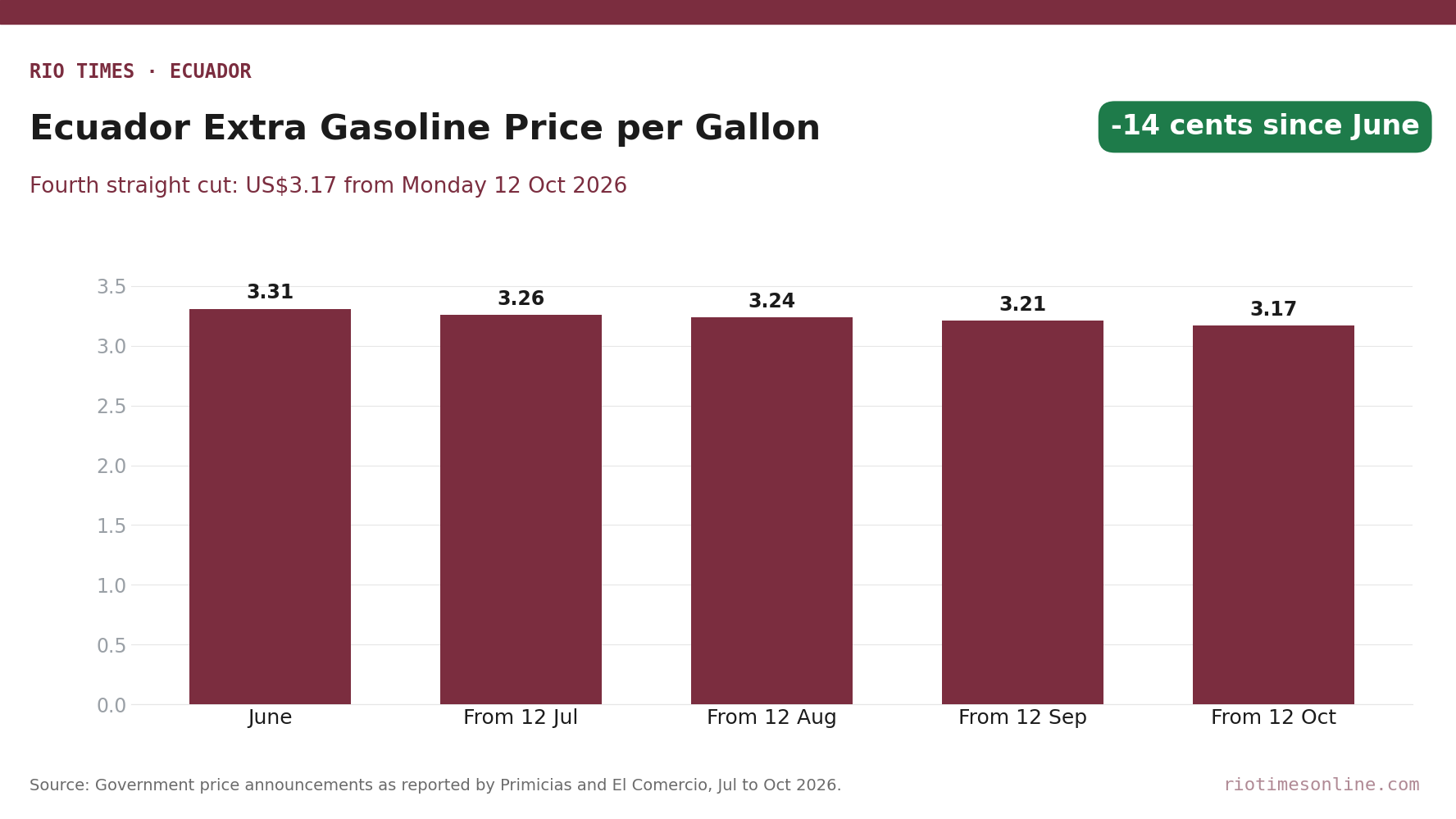
- —The numbers This is the fourth cut in a row since July. The total reduction now stands at 14 cents a gallon.
- —What it means for you Drivers and renters of ordinary cars pay slightly less. Premium Súper gasoline is not covered and may cost more.
- —Still open What the cuts cost the state, the new Súper reference price, and whether November brings another reduction.
Ecuador fuel prices fell again on Monday 12 October. The government cut Extra and Ecopaís gasoline and Diesel Premium by four cents a gallon. The cheapest gasolines now cost US$3.17 a gallon nationwide, and diesel costs US$3.11. For US readers, it shows a dollarised economy shielding drivers from an oil shock. That shock is tied to the war involving the United States and Iran.
President Daniel Noboa announced the cut on Wednesday 7 October. Noboa is a centre-right businessman who has led Ecuador since November 2023 and won a full term in 2025.
Fourth Cut in a Row Since July
Under the new schedule, Extra and Ecopaís drop from US$3.21 to US$3.17 a gallon. Diesel Premium drops from US$3.15 to US$3.11, El Comercio and Primicias reported on Sunday. Both are Quito-based news outlets.
The prices stay in force until Wednesday 11 November, when the next monthly update is due. Extra and Ecopaís are 85-octane fuels and the ones most ordinary cars in Ecuador use.
This is the fourth reduction in a row since July, according to El Comercio. The cumulative cut over the period is 14 cents a gallon.
The steps were uneven. Extra and Ecopaís cost US$3.31 a gallon in June, Primicias reported in July. They fell to US$3.26 in July, to US$3.24 in August and to US$3.21 in September.
On his X account, Noboa wrote that “the world is going through difficult times”. He said oil prices and fuel supply were affected worldwide. “Even so, Ecuador cannot stop,” he added, according to Primicias. He said the state would cut Ecopaís, Extra and diesel by four cents “for the benefit of citizens”.
How the Price Formula Changed
Ecuador has used a price band for Extra and Ecopaís since 2024. Before that, the price was frozen at US$2.46 a gallon, Primicias reported. Diesel joined the band system in December 2025.
Under the standard band, prices can rise by up to 5% or fall by up to 10% in a month. The aim is to follow world oil prices while smoothing sharp jumps.
In July and August, Noboa reformed the system through Executive Decrees 444 and 468. The decrees kept the bands but added an exceptional mechanism for periods of high international volatility.
Noboa had argued that local prices did not react fast enough to world markets. He cited a lag of 45 to 60 days between crude extraction, refining and distribution, Primicias reported in August.
The first cut under the new formula came in July. Each month since then has brought a further small reduction.
Cuts Despite Higher Oil
The latest reduction comes as crude has climbed again. West Texas Intermediate (WTI), the US benchmark Ecuador uses, averaged US$96.18 a barrel between 12 September and 8 October. That compares with US$87.80 a month earlier, Primicias reported.
Primicias noted that the cut was announced despite higher international fuel prices. The gap suggests the state is absorbing part of the cost, though the government has not published a figure.
There is a stabiliser in that picture. Ecuador is an oil exporter, so higher crude prices also lift state revenue from sales abroad. The balance between the two has not been disclosed.
Energy remains a pressure point. Large factories had power cut over the 9 October holiday as a key reservoir ran low.
What It Means for You
For visitors and residents who drive or rent ordinary cars, the saving is small. On a 12-gallon tank of Extra, four cents a gallon is less than 50 cents per fill.
Because Ecuador uses the US dollar, there is no exchange-rate risk at the pump. Extra, Ecopaís and Diesel Premium carry one national price set by the state.
Súper, the 95-octane premium gasoline, is different. Its price is liberalised and not part of the band system. State oil company Petroecuador issues a reference price each month, and private stations can set their own.
The fuel distributors’ association, Camddepe, said Súper could rise from 12 October. Its reference is linked to US East Coast fuel prices. Some stations expect an increase of about 50 cents a gallon, Primicias reported.
Drivers of cars that need Súper should compare stations before filling up. For investors, the cuts signal that the government is prioritising household costs over a faster end to fuel support.
What Is Not Known
The government has not said how much the four monthly cuts cost the state. No official subsidy figure for October was available on Monday morning.
The new Súper reference price for 12 October to 11 November had not been confirmed in the sources reviewed. Reported figures for the previous Súper reference price also differ between reports.
It is not known whether November will bring a fifth cut. That depends on oil prices and on how long the exceptional mechanism stays in force.
Frequently Asked Questions
What are Ecuador fuel prices from 12 October 2026?
Extra and Ecopaís gasoline cost US$3.17 a gallon and Diesel Premium costs US$3.11 a gallon. The prices apply until 11 November 2026.
How much have prices fallen since July?
This is the fourth cut in a row since July, with a cumulative reduction of 14 cents a gallon. Extra cost US$3.31 a gallon in June.
Is Súper gasoline cheaper too?
No. Súper is not part of the band system. Its price is liberalised, follows international markets and can differ between stations.
Sources: President Daniel Noboa’s announcement of 7 October as reported by Primicias; El Comercio; Primicias (12 October prices); Primicias (Súper and oil prices); Primicias (August prices, Decree 468); Primicias (June price, band system).
This article was produced by The Rio Times’ automated newsroom system. How we use AI · Report an error · Editorial responsibility: Matthias Camenzind, Editor-in-Chief
LatAm Markets: Live Signals → — real-time movers, turnover leaders and FX across Latin America.