Dollar Dips for Sixth Day Amid Interest Rate Cuts Speculation in the U.S.
On Tuesday, the US dollar saw its value decrease against the Brazilian real for the sixth consecutive day, marking a trend of weakness shared among several emerging market currencies.
This shift follows US inflation data falling below expectations, bolstering the likelihood of an interest rate reduction by the Federal Reserve in September, which weakened the dollar globally.
Matheus Spiess, an analyst at Empiricus Research, noted that “the potential for a 50 basis-point cut is increasingly likely.” He added that this would ensure the Fed stays proactive rather than reactive.
The commercial dollar ended Tuesday down by 0.84%, trading at 5.449 Brazilian reais for both buying and selling. On the B3 futures market, the nearest dollar futures (DOLc1) dropped by 0.88% to 5.459 points.
Just the day before, the spot dollar had closed at 5.4984 reais, reflecting a 0.30% decline. Over the past six trading days, the currency has cumulatively dropped by 5.09% against the real.
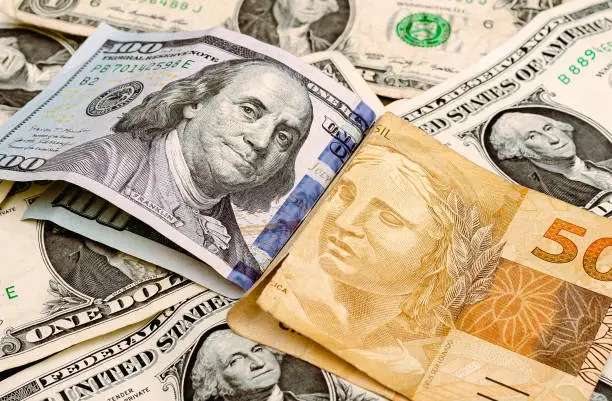
Global markets exuded optimism, contributing to the dollar’s consecutive declines, culminating in a closing below 5.45 reais.
This trend coincided with a broader pullback of the US dollar against other currencies following positive US Producer Price Index (PPI) figures for July.
Global Financial Dynamics
The PPI rose only 0.1% year-on-year, compared to the 0.2% increase in June and below the anticipated 0.2% increase. These figures fueled expectations for a Fed rate cut in September.
Concurrently, Brazil is poised to maintain or even raise its benchmark interest rates in the same month. This action fosters a favorable interest rate differential, which attracts investment into Brazil and further drives the dollar down.
Another contributing factor was the stabilization of the yen, which eased the unwinding of carry trade operations.
In these transactions, investors borrow in countries with low interest rates, like Japan, and invest in countries with higher rates, such as Brazil. The unwinding of these trades had previously hurt the real.
By late afternoon, the dollar’s decline was nearly universal against its major counterparts. This included the Mexican peso and the Chilean peso.
At 5:26 PM, the Dollar Index (DXY), which tracks the US dollar against a basket of six major currencies, fell by 0.54% to 102.58 points.
The continued weakening of the US dollar underscores significant shifts in global financial dynamics. This trend is influenced by economic indicators and central bank policies, with implications for both traders and the broader economic landscape.
This article was produced by The Rio Times’ automated newsroom system. How we use AI · Report an error
LatAm Markets: Live Signals → — real-time movers, turnover leaders and FX across Latin America.
Read More from The Rio Times