Crypto Wrap Aug 5: Bitcoin Holds $64k as LatAm Stablecoin Use Swells
Key Facts
- Bitcoin settled at US$64,056, rising 0.94% on the day as Federal Reserve hawkishness redirected flows into non-sovereign assets. Spot Bitcoin exchange-traded products in the US and Europe attracted net inflows over the past week, per market commentary.
- Ethereum was largely stagnant at US$1,868, gaining just 0.55% amid low volumes, reflecting uncertainty over the timing of US spot ETF approvals. On-chain data showed a steady decline in ETH held on exchanges, which analysts read as long-term holders moving coins into self-custody.
- Solana lost momentum, trading at US$73.72, while XRP dipped 0.13% to US$1.0732 as traders took profits on alternative layer-1 tokens. Regulatory scrutiny of staking reward programs in the United States dampened appetite for more experimental protocols.
- Dollar-linked stablecoins USDT and USDC traded tightly around their one-dollar pegs, serving as de-facto digital dollars for inflation-hedging Argentines. Tether’s reserve reports show a heavy concentration in US Treasuries, reinforcing the peg but tying its stability directly to US interest rate policy.
- In Brazil, millions of retail users access crypto via listed ETFs on the B3 exchange, while fintechs integrate stablecoin rails for instant cross-border transfers. The Central Bank of Brazil is simultaneously developing Drex, a wholesale digital real token aimed at improving settlement efficiency.
- El Salvador’s Bitcoin legal tender experiment continues to see most day-to-day retail transactions bypass the Chivo wallet in favour of physical US dollars. However, crypto-based remittance channels are being promoted by the government to reduce fees on flows sent by Salvadoran migrants abroad.
Today’s Focus
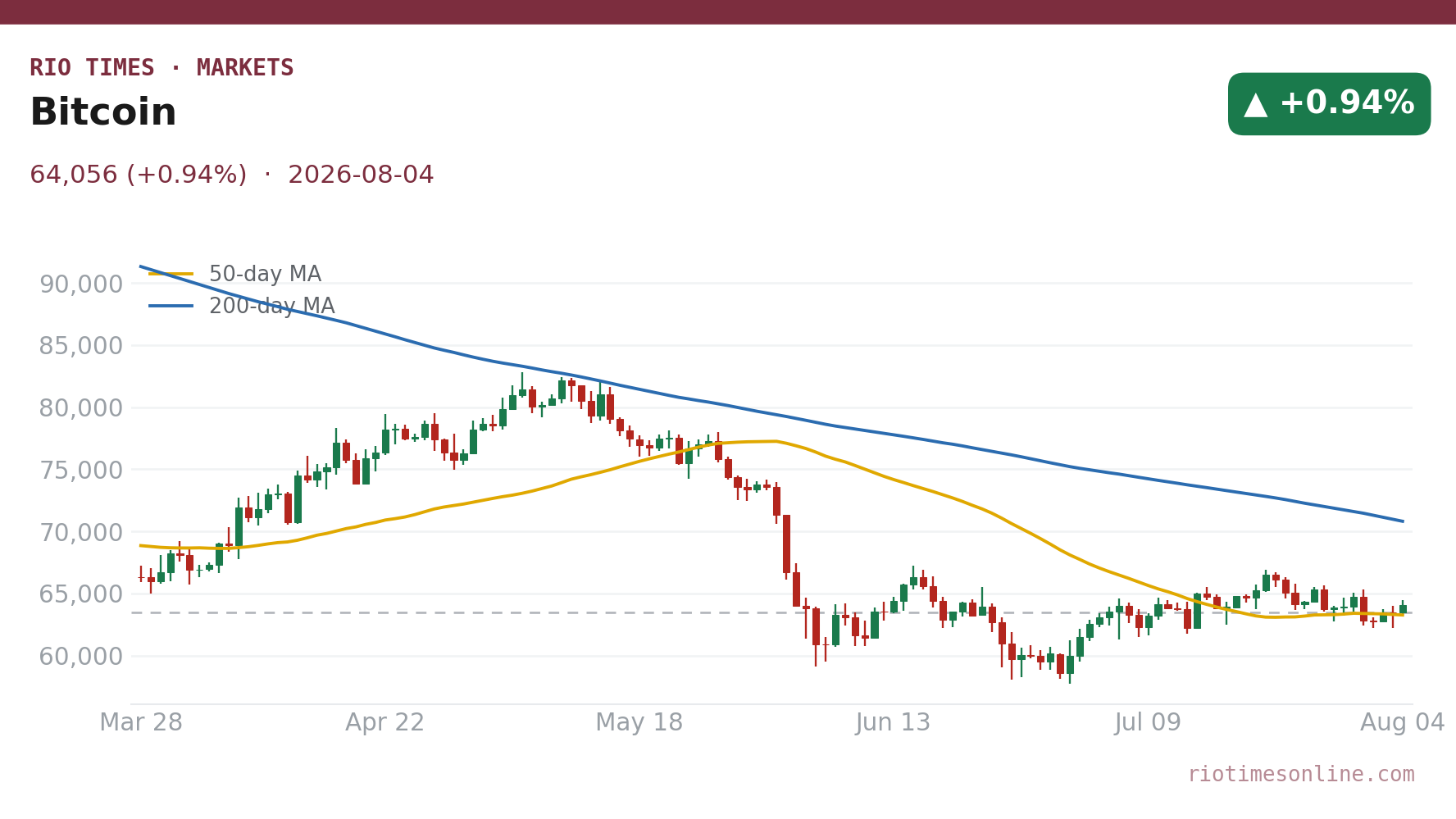
Bitcoin climbed to US$64,056—a 0.94% daily gain—while Ethereum barely moved, rising 0.55% to US$1,868. The divergence was driven by strong institutional inflows into spot Bitcoin exchange-traded products, contrasting with lingering regulatory delays for a US spot Ether ETF.
Doggedly high US interest rates are cementing the view that Bitcoin acts as a non-sovereign hedge, yet investors shunned riskier altcoins. Solana edged up to US$73.72, while XRP slipped to US$1.0732 as profit-taking and staking-regulation fears in Washington soured the mood for smaller protocols.
Across Latin America, the stability of the USDT and USDC pegs matters more than Bitcoin’s price. Argentines bought “crypto dollars” en masse to bypass capital controls while Brazilians routed remittances through stablecoin rails buried inside popular fintech apps. Regulated Bitcoin funds on Brazil’s B3 exchange continue to slip into multi-asset portfolios.
What matters today. Bitcoin’s rise is a chance for Latin American savers to retain purchasing-power hedges, but stablecoin stability is the region’s most immediate financial tool.
01 The session in one read
Renewed conviction that the US Federal Reserve will not cut rates soon pushed Bitcoin up 0.94% to US$64,056 on Tuesday. The move left larger-cap crypto in the green despite a retreat among smaller tokens, with Ethereum managing a scant 0.55% gain to US$1,868 on volumes well below the 30-day average.
The climb was powered by fresh net inflows into US and European spot Bitcoin exchange-traded products, not a speculative altcoin frenzy. That separation matters for Latin American holders who increasingly treat Bitcoin as a macro hedge while using dollar-linked stablecoins for daily financial survival.
The climb above the US$64,000 mark aligns with institutional buying prompted by sticky US rates, yet thin Ethereum volumes and Solana’s retreat signal that speculation is not back in force. For Latin America, the mechanics of dollar-pegged stablecoins have become far more transformative than token prices themselves. The variable to watch is the US Federal Reserve’s next policy signal, because a sudden hawkish shift could quickly reverse Bitcoin’s inflows and drive a stampede into the safer dollar proxies already flooding the region.
02 The board
Bitcoin’s US$64,056 close reclaimed the psychologically important US$64,000 floor that had wobbled earlier in the week. Ether’s US$1,868 level pointed to hesitation; traders appear unwilling to bid aggressively without a definitive sign that Washington will approve a spot Ether ETF.
Solana’s US$73.72 print marked a modest gain, while XRP dipped to US$1.0732. The underperformance of these alternative base-layer networks reflects profit-taking after a strong first half as well as growing regulatory headaches around staking yields. Stablecoins USDT and USDC barely budged off their one-dollar pegs, anchoring the ledger for cross-border flows.
| Asset | Level | Change |
|---|---|---|
| Bitcoin | US$64,056 | +0.94% |
| Ethereum | US$1,868 | +0.55% |
| Solana | US$73.72 | +0.33% |
| XRP | US$1.0732 | -0.13% |
Source: RT close, 2026-08-04. Where a commodity has no spot feed, an exchange-traded tracker or leading producer is shown as a labelled proxy.
Live Market IntelligenceThe live market board
Rio Times · Live Market Intelligence
Latin America — Cross-Market Board
| Instrument | Last | Change | YoY | Prev. | High | Low | Volume |
|---|---|---|---|---|---|---|---|
| IBOV | 183,476.86 | -0.27% | +21.85% | 183,965.91 | 168,310 | 167,142 | — |
| IPSA | 11,255.90 | -0.39% | — | 11,299.82 | 11,210 | 10,984 | 1,513,213,483 |
| IPC MEX | 64,651.92 | +0.60% | +12.17% | 64,264.16 | 66,121 | 65,405 | 108,886,187 |
| MERVAL | 2,893,751 | -1.57% | +30.51% | 3,022,485 | 3,042,365 | 2,991,150 | — |
| COLCAP | 2,584.72 | -0.95% | — | 9.04 | 9.05 | 9.02 | 4,133 |
| BVL PERÚ | 59,934.37 | +1.27% | — | — | — | — | — |
| USD/BRL | 5.16 | +0.01% | -5.13% | 5.16 | 5.18 | 5.14 | — |
| EUR/BRL | 5.95 | +1.01% | -5.83% | 5.89 | 5.98 | 5.94 | — |
| USD/MXN | 17.06 | -0.24% | -8.58% | 17.10 | 17.08 | 17.01 | — |
| USD/CLP | 913.98 | +0.04% | -5.67% | 913.65 | 915.11 | 906.68 | — |
| USD/COP | 3,140 | +0.03% | -22.04% | 3,139 | 3,141 | 3,105 | — |
| USD/PEN | 3.36 | -0.66% | -4.82% | 3.38 | 3.38 | 3.35 | — |
| USD/ARS | 1,493 | +0.10% | +12.96% | 1,491 | 1,494 | 1,480 | — |
| USD/UYU | 40.27 | +1.24% | +1.80% | 39.77 | 40.27 | 40.23 | — |
| USD/PYG | 5,939 | +1.68% | -19.54% | 5,841 | 5,939 | 5,925 | — |
| USD/BOB | 11.64 | -0.76% | +72.04% | 11.73 | 11.72 | 11.64 | — |
| USD/DOP | 58.34 | +1.25% | -3.44% | 57.62 | 58.34 | 58.04 | — |
| USD/CRC | 445.92 | +0.89% | -9.71% | 441.97 | 448.50 | 445.92 | — |
03 What moved it
Federal Reserve commentary kept the US 10-year Treasury yield above 4%, making fixed income competitive yet simultaneously burnishing Bitcoin’s appeal as a non-sovereign asset for those worried about sticky inflation. Spot Bitcoin ETFs listed in America, already holding tens of billions of dollars, attracted further net inflows over the past week, while open interest on Bitcoin futures rose across major venues.
Ethereum was held back by a regulatory vacuum. Several issuers have filed for spot Ether ETFs, but full approval is not granted, leaving the token in limbo. Meanwhile, scrutiny of staking rewards by US agencies prompted caution on Solana and Avalanche. On-chain data underscored the mood shift: the proportion of Ethereum transactions tied to DeFi and NFTs has fallen, while ETH held on exchanges declined steadily as holders chose self-custody.
04 The Latin American read
Bitcoin’s ability to stick above US$64,000 reinforces its role in multi-asset strategies run by wealth managers in Brazil and Mexico, who access it through regulated ETFs listed on Brazil’s B3 exchange. Simultaneously, stablecoins have become plumbing. Brazilian fintechs embed USDT and USDC rails into mobile apps to settle remittances in seconds, bypassing slow wire transfers.
In Argentina, triple-digit inflation and capital controls pushed households into ‘digital dollar’ markets operated by local exchanges and peer-to-peer platforms. Tether’s reserves, heavily weighted in US Treasuries, give that de-facto dollarisation a tie to US rate policy. El Salvador’s legal-tender project remains a separate reality: official statistics show most remittances still arrive via conventional operators, despite government promotion of the Chivo wallet and Bitcoin-linked channels.
05 The names to watch
The largest US-listed spot Bitcoin ETF providers—BlackRock and Fidelity—continue absorbing coins on behalf of traditional investors, making their weekly flow figures a real-time sentiment gauge. Circle and Tether are equally pivotal for Latin America because any deviation of USDC or USDT from their one-dollar pegs would immediately rupture the region’s favourite hedging mechanism.
Within Brazil, the Central Bank’s Drex pilot represents a state-led alternative to private stablecoins. Should Drex offer seamless, regulated wholesale settlement without the volatility of unbacked crypto, it could reshape how institutional money moves through the regional financial system.
06 The outlook
With Bitcoin buoyed by institutional ETF inflows and Ethereum stalled by regulatory fog, the path of US monetary policy will govern the next leg. Further hawkishness could quickly cool Bitcoin’s recent bid, whereas a softer tone might lift beaten-down altcoins. For Latin America, the main event is not price action but the quiet expansion of stablecoin plumbing that turns smartphones into cross-border dollar accounts.
07 What to watch
- US Federal Reserve speeches: Fresh hawkishness could reverse spot Bitcoin ETF inflows and tighten dollar liquidity, directly affecting stablecoin demand in Argentina and Brazil.
- Spot Ether ETF approval signals: An approval timeline from Washington would likely re-rate Ethereum and could pull capital away from smaller layer-1 tokens popular among regional retail traders.
- Tether and Circle reserve attestations: Any sign of weakening US Treasury backing would threaten the one-dollar peg that makes USDT and USDC the primary store of value for millions of Latin Americans.
- Brazil’s Drex pilot milestones: Progress on the wholesale digital real will show whether a sovereign token can compete with privately issued stablecoins for cross-border settlement flows.
Frequently Asked Questions
Why did Bitcoin rise on Tuesday?
Bitcoin gained 0.94% to US$64,056 as spot ETF inflows picked up and Federal Reserve policy expectations drove investors toward assets perceived as hedges against persistent inflation.
Why did Ethereum barely move?
Ethereum added just 0.55% to trade at US$1,868 because traders remain uncertain about the timing of a US spot Ether ETF approval and on-chain speculative activity is subdued.
How are Latin Americans using crypto right now?
Argentines buy dollar-linked stablecoins such as USDT to hedge inflation and bypass capital controls, while Brazilians use stablecoin rails inside fintech apps for cross-border transfers and also hold regulated Bitcoin ETFs.
Is Bitcoin used for everyday payments in El Salvador?
Usage is limited. Most retail transactions still use physical US dollars rather than the government’s Chivo wallet, though Bitcoin is promoted in tourism and as a remittance corridor.
This article was produced by The Rio Times’ automated newsroom system. How we use AI · Report an error
LatAm Markets: Live Signals → — real-time movers, turnover leaders and FX across Latin America.
Read More from The Rio Times