
Key Facts
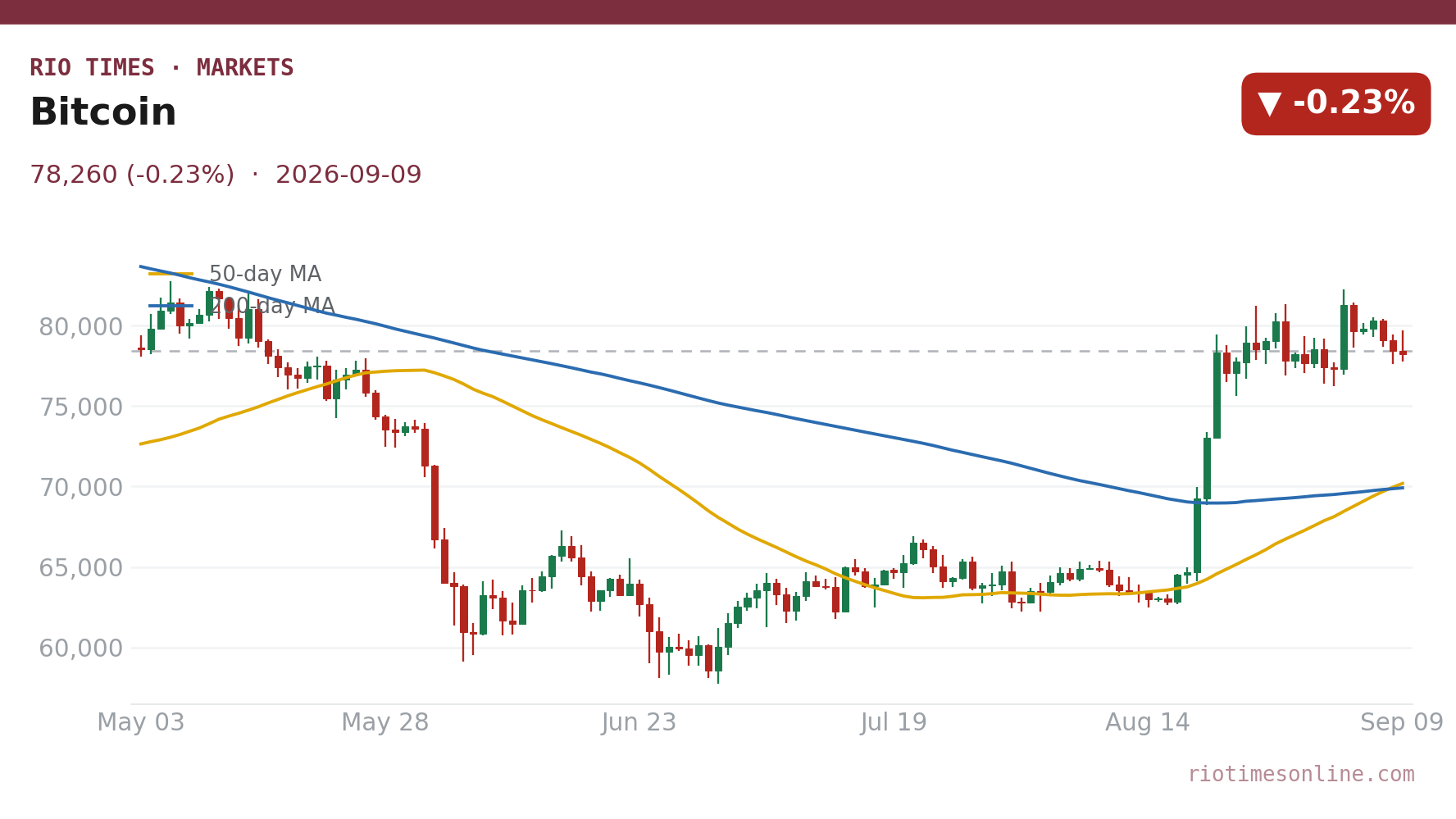
- Bitcoin settled at US$78,260 down 0.23% on Wednesday, September 9, 2026, holding a narrow band rather than breaking direction.
- Ethereum closed at US$2,467 off 0.73%, while Solana fell 1.66% to US$101.61 and XRP slipped 1.54% to US$1.3944.
- Bitcoin dominance sat at 56.9% with roughly 71% of supply in profit, a configuration analysts read as a sideways, low-volatility market.
- Brazil reported 98% of Q1 2026 crypto turnover in stablecoins or US$6.9 billion of a US$6.9 billion volume, anchored by PIX rails and new central-bank rules.
- Argentina saw 11.2 million people hold crypto in 2025 with more than 70% of purchases in USDT and USDC as an informal dollar hedge against high inflation.
- El Salvador’s sovereign treasury held over 7,600 BTC worth just over US$500 million, as the state continued its policy of ongoing purchases.
Today’s Focus
Bitcoin traded in a tight range on Wednesday, September 9, 2026, settling at US$78,260, down 0.23%, as uncertainty over US interest-rate policy kept the market anchored. Ethereum fell 0.73% to US$2,467, while Solana dropped 1.66% to US$101.61 and XRP lost 1.54% to US$1.3944.
The flat session masked a deeper story: institutional flows into Bitcoin funds and corporate treasuries stabilised prices, while tokenized real-world assets posted some of the day’s strongest gains. Stablecoin capitalisation held near US$291.3 billion, underlining dollar-linked tokens as crypto’s main transactional rail.
For Latin America, that stablecoin dominance is the real market. Brazil reported 98% of Q1 2026 crypto turnover in stablecoins, Argentina saw 11.2 million people holding crypto with more than 70% of purchases in USDT and USDC, and El Salvador’s sovereign treasury held over 7,600 BTC.
Regulatory tightening in Brazil and Argentina is formalising those flows, turning informal dollarisation into supervised infrastructure that foreign investors can more easily underwrite.
What matters today. The flat Bitcoin price is a sideshow; LatAm stablecoin volume is where the durable, institution-ready crypto demand lives.
01 The session in one read
Bitcoin closed Wednesday, September 9, 2026, at US$78,260, down 0.23%, failing to reclaim the US$80,000 level that has become a psychological anchor. Ethereum settled at US$2,467, off 0.73%, while Solana dropped 1.66% to US$101.61 and XRP lost 1.54% to US$1.3944.
The moves were contained, not directional. Analysts tied the drift to uncertainty over future US Federal Reserve rate decisions, which typically weigh on risk assets when hikes are priced in. Yet institutional flows into Bitcoin exchange-traded funds and corporate treasuries kept the market from a sharper pullback.
The session’s 0.23% Bitcoin decline tells you almost nothing about where allocable capital is moving in Latin America. Brazil’s 98% stablecoin share of reported crypto turnover, Argentina’s 11.2 million holders and El Salvador’s continuing treasury purchases point to a region using crypto as payments infrastructure and a dollar substitute, not as a speculative asset. The variable to watch is whether Brazil’s February 2026 capital-buffer rules and Argentina’s expected lifting of the bank-services ban accelerate regulated custody flows beyond the current US$27 billion regional transaction base.
02 The board
The price board shows a market in low-volatility consolidation. Bitcoin’s 0.23% decline to US$78,260 was mirrored by Ethereum’s 0.73% slip to US$2,467, a spread that suggests broad, shallow profit-taking rather than a sector-specific shock.
Altcoins softened selectively. Solana fell the most among the majors, down 1.66% to US$101.61, while XRP lost 1.54% to US$1.3944. Tokenized real-world assets were cited among the day’s relative gainers, indicating investors rotated into on-chain versions of traditional instruments while headline coins idled.
| Asset | Level | Change |
|---|---|---|
| Bitcoin | US$78,260 | -0.23% |
| Ethereum | US$2,467 | -0.73% |
| Solana | US$101.61 | -1.66% |
| XRP | US$1.3944 | -1.54% |
Trade date: Wednesday 9 September 2026. Source: RT close, 2026-09-09. Where a commodity has no spot feed, an exchange-traded tracker or leading producer is shown as a labelled proxy.
Live Market IntelligenceThe live market board
Rio Times · Live Market Intelligence
Latin America — Cross-Market Board
| Instrument | Last | Change | YoY | Prev. | High | Low | Volume |
|---|---|---|---|---|---|---|---|
| IBOV | 205,082.56 | +0.47% | +21.85% | 204,120.12 | 168,310 | 167,142 | — |
| IPSA | 10,746.36 | -0.31% | — | 10,780.31 | 11,210 | 10,984 | 1,513,213,483 |
| IPC MEX | 69,879.62 | -0.01% | +12.17% | 69,889.73 | 66,121 | 65,405 | 108,886,187 |
| MERVAL | 3,017,221 | — | +30.51% | 3,022,485 | 3,042,365 | 2,991,150 | — |
| COLCAP | 2,540.10 | +0.46% | — | 9.04 | 9.05 | 9.02 | 4,133 |
| BVL PERÚ | 57,021.19 | +0.13% | — | — | — | — | — |
| USD/BRL | 5.16 | +0.01% | -5.13% | 5.16 | 5.18 | 5.14 | — |
| EUR/BRL | 5.95 | +1.01% | -5.83% | 5.89 | 5.98 | 5.94 | — |
| USD/MXN | 17.06 | -0.24% | -8.58% | 17.10 | 17.08 | 17.01 | — |
| USD/CLP | 913.98 | +0.04% | -5.67% | 913.65 | 915.11 | 906.68 | — |
| USD/COP | 3,140 | +0.03% | -22.04% | 3,139 | 3,141 | 3,105 | — |
| USD/PEN | 3.36 | -0.66% | -4.82% | 3.38 | 3.38 | 3.35 | — |
| USD/ARS | 1,493 | +0.10% | +12.96% | 1,491 | 1,494 | 1,480 | — |
| USD/UYU | 40.27 | +1.24% | +1.80% | 39.77 | 40.27 | 40.23 | — |
| USD/PYG | 5,939 | +1.68% | -19.54% | 5,841 | 5,939 | 5,925 | — |
| USD/BOB | 11.64 | -0.76% | +72.04% | 11.73 | 11.72 | 11.64 | — |
| USD/DOP | 58.34 | +1.25% | -3.44% | 57.62 | 58.34 | 58.04 | — |
| USD/CRC | 445.92 | +0.89% | -9.71% | 441.97 | 448.50 | 445.92 | — |
03 What moved it
Macro rate anxiety was the dominant drag. US Treasury Secretary Scott Bessent’s comments around yen strength contributed to fears of renewed carry-trade unwinding, which pushed Bitcoin and US equities lower in tandem as Iran-related headlines added risk-off pressure.
Countering that, structural demand remained intact. Bitcoin’s realised volatility sat at historically low levels, with roughly 71% of supply in profit, a setup where long-term holders stay comfortable and short-term traders find fewer trends to chase. Stablecoin capitalisation of about US$291.3 billion reinforced dollar-linked tokens as the market’s settlement layer.
04 The Latin American read
Latin America’s crypto story is now a stablecoin story. Regional digital-asset transaction volume surpassed US$27 billion in 2025 with more than 90% in stablecoins, and the pattern held into 2026.
Brazil shows the sharpest concentration: around 90% of reported crypto turnover is stablecoin-denominated, rising to 98% of a US$6.9 billion Q1 2026 volume. The central bank’s virtual-asset provider rules, in force since February 2, 2026, now require capital buffers between BRL 10.8 million and BRL 37.2 million and the FATF travel rule, formalising what was once informal infrastructure.
Argentina tells a dollarisation story. About 11.2 million people held crypto in 2025, with USDT and USDC making up more than 70% of purchases and roughly 75% of crypto-paid workers choosing stablecoins as an inflation hedge. Remittance flows are the connective tissue: Latin America received about US$142 billion in 2025 remittances, with stablecoins’ share rising from 3% in 2023 to 11% in 2025.
05 The names to watch
Consensys, the firm behind MetaMask, announced a split into a consumer-facing MetaMask business and a separate institutional blockchain entity. The restructuring matters for Ethereum’s developer ecosystem, which underpins much of Latin America’s on-chain stablecoin activity.
US Bank began testing a proprietary stablecoin, USBDC, on the public Stellar network for cross-border transfers between its North American and European entities. The pilot is a signal that regulated banks may soon compete with Tether and Circle in dollar-settlement rails.
Germany’s finance ministry proposed a 25% crypto tax starting in 2028, a sharp departure from current rules that make gains tax-free after one year. The proposal, along with an Illinois effort to block a 0.2% crypto tax, marks a global regulatory tightening that could push more activity toward clearer LatAm frameworks.
06 The outlook
The most consequential variable for Latin America is regulatory, not price. Brazil’s capital-buffer regime and Argentina’s expected lifting of a bank-services ban in 2026 could shift stablecoin custody from unregulated wallets into supervised institutions, deepening the region’s position as a global adoption laboratory. Bitcoin’s tight US$78,000–US$79,000 band may persist until US rate expectations clarify, but the LatAm trade remains stablecoins and remittance rails, not headline-coin momentum.
07 What to watch
- Brazil capital-buffer compliance: Watch whether licensed exchanges hit the BRL 10.8 million to BRL 37.2 million capital requirements; non-compliance could consolidate volume among fewer, better-capitalised providers.
- Argentina bank-custody ruling: The central bank’s expected 2026 lifting of the ban on banks offering crypto services would open regulated custody to 11.2 million crypto holders and shift stablecoin demand towards supervised rails.
- El Salvador treasury purchases: With over 7,600 BTC held and a policy of ongoing buying, any sovereign sale or pause would move both price and regional sentiment.
- US Federal Reserve path: Rising rate-hike odds weigh on Bitcoin and risk assets broadly; a dovish repricing could break the US$78,000–US$79,000 range and lift altcoins off Wednesday’s soft close.
Frequently Asked Questions
Why did Bitcoin barely move on Wednesday?
Uncertainty over US Federal Reserve interest-rate policy and yen-carry-trade fears held Bitcoin in a tight US$78,000–US$79,000 band, with institutional ETF and treasury flows providing a floor.
What is driving crypto adoption in Brazil?
Stablecoins account for about 90% of reported crypto turnover, hitting 98% of a US$6.9 billion Q1 2026 volume, supported by PIX rails and new central-bank rules requiring capital buffers and travel-rule compliance.
How big are stablecoin remittances in Latin America?
Latin America received about US$142 billion in 2025 remittances, with stablecoins’ share rising from 3% to 11% over two years, a US$15.6 billion flow that is projected to keep growing.
Which institutional names are moving this market?
Consensys is splitting MetaMask from its institutional blockchain business, US Bank is testing a proprietary stablecoin on Stellar, and Germany has proposed a 25% crypto tax starting 2028.
Market data: RT
This article was produced by The Rio Times’ automated newsroom system. How we use AI · Report an error · Editorial responsibility: Matthias Camenzind, Editor-in-Chief
LatAm Markets: Live Signals → — real-time movers, turnover leaders and FX across Latin America.