Key Facts
- Vale shares slipped 0.77% to US$15.44 in New York on Wednesday, September 9, 2026, acting as the main iron ore proxy.
- CSN Mineração jumped 3.57% to R$6.96 (US$1.36) in São Paulo, outperforming global peers amid local bargain hunting.
- Rio Tinto edged lower with its US-listed shares closing at US$103.74, down 0.09% on the session.
- The 62% Fe benchmark held above US$100 having settled at US$100.02 per tonne on Tuesday, September 8, keeping iron ore near that level into Wednesday.
- Vale reaffirmed 2026 production guidance of 335 to 345 million tonnes of iron ore, a range investors previously saw as supportive of prices.
- China steel output is tracking 3–5% lower year-on-year in the first quarter of 2026, reflecting a deep property downturn and capping demand growth.
Today’s Focus
Iron ore proxies diverged on Wednesday, September 9, 2026. Vale, the world’s second-largest exporter, fell 0.77% to US$15.44 in New York, while Brazil’s CSN Mineração rose 3.57% to R$6.96 (US$1.36) in São Paulo.
The move came as the benchmark 62% Fe price stayed just above US$100 per tonne after a flat close at US$100.02 on Tuesday. Chinese steel mills are in their traditional ‘Golden September’ demand window, yet domestic Dalian futures in yuan were quoted down 0.87% at 738 CNY per tonne on September 9.
Vale’s disciplined supply stance, reaffirmed at 335 to 345 million tonnes for 2026, continues to underpin the market against structurally softer Chinese steel output. Analysts expect 2026 average prices around US$95 to US$99 per tonne.
What matters today. Vale’s proxy dip aside, iron ore is holding above US$100 because China’s seasonal steel demand and Vale’s capped production are offsetting a long-term decline in Chinese property-led steel consumption.
01 The session in one read
Iron ore had a mixed session on Wednesday, September 9, 2026, with the main producer proxies pointing in different directions. Vale, Brazil’s mining champion and the number two iron ore exporter globally, saw its New York shares ease 0.77% to US$15.44.
CSN Mineração, the Brazilian pure-play iron ore miner, rose 3.57% to R$6.96 (US$1.36) in São Paulo. Anglo-Australian giant Rio Tinto slipped just 0.09% to US$103.74 in New York.
The market is balanced between a seasonal uptick in Chinese steel buying and a structural slide in China’s crude steel output, now tracking 3–5% lower year-on-year. Vale’s decision to keep production growth moderate at 335 to 345 million tonnes gives investors a reason to stay, but the seaborne surplus of 30 to 75 million tonnes caps upside. The variable to watch is whether Dalian iron ore futures can climb back above 750 yuan per tonne (about US$112), confirming that mill restocking has real momentum.
02 The board
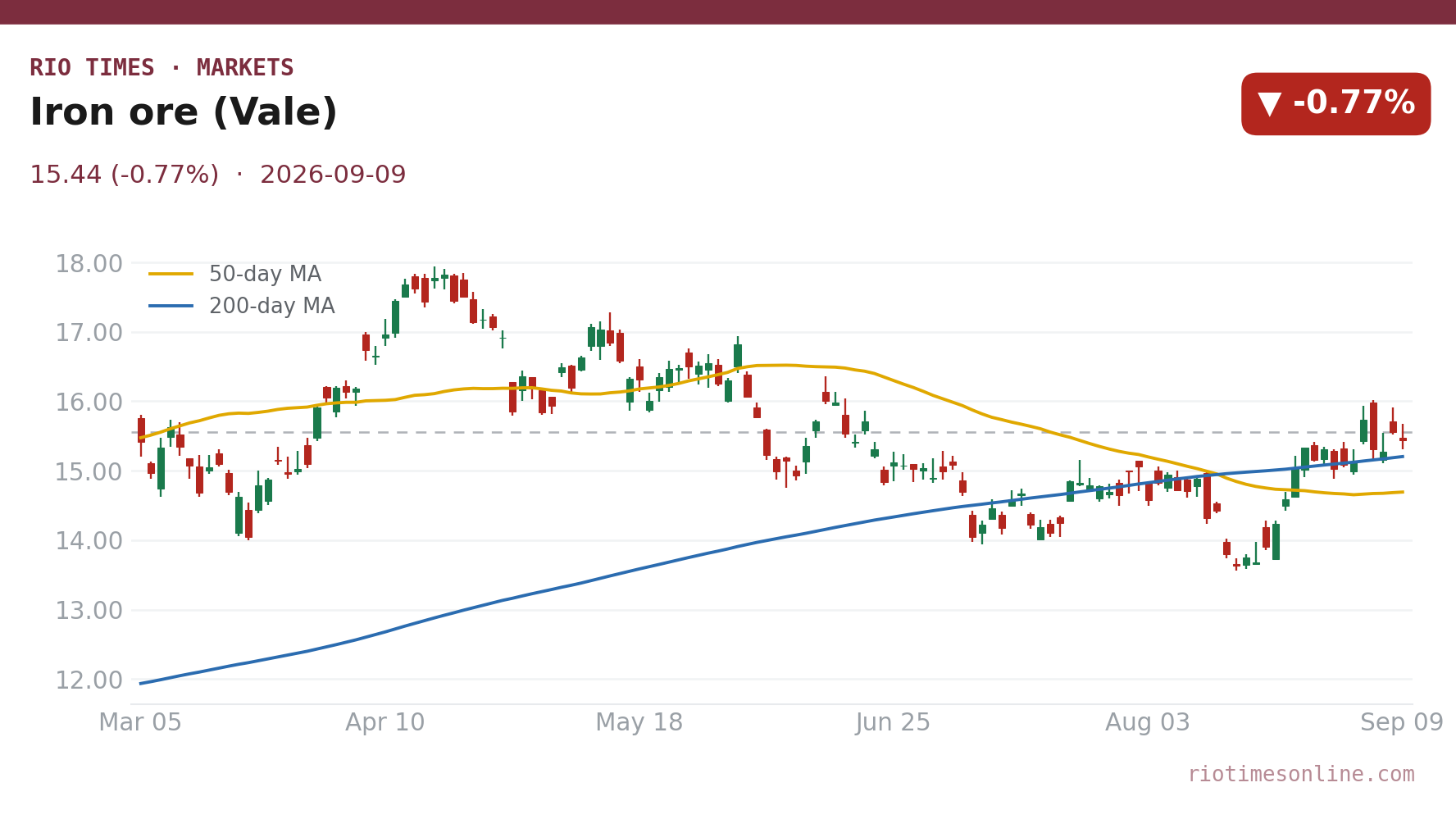
Vale’s US$15.44 close marked a pause after Tuesday’s 1.9% gain, which had been driven by a 1.36% rise in most-traded Dalian iron ore futures to 744.5 yuan per tonne (about US$111). That rebound had pushed the company’s shares to US$15.56 the previous day.
The divergence on Wednesday shows investors are differentiating between global producers. CSN Mineração’s 3.57% jump to R$6.96 (US$1.36) suggests domestic buyers see value in the Brazilian miner after recent weakness, while Rio Tinto’s near-flat US$103.74 finish reflects its broader diversification beyond iron ore.
| Asset | Level | Change |
|---|---|---|
| Iron ore (Vale) | US$15.44 | -0.77% |
| CSN Mineração | R$6.96 (US$1.36) | +3.57% |
| Rio Tinto | US$103.74 | -0.09% |
Trade date: Wednesday 9 September 2026. Source: RT close, 2026-09-09. Where a commodity has no spot feed, an exchange-traded tracker or leading producer is shown as a labelled proxy.
Live Market IntelligenceThe live market board
Rio Times · Live Market Intelligence
Latin America — Cross-Market Board
| Instrument | Last | Change | YoY | Prev. | High | Low | Volume |
|---|---|---|---|---|---|---|---|
| IBOV | 176,608.23 | -13.88% | +21.85% | 205,082.56 | 168,310 | 167,142 | — |
| IPSA | 10,575.59 | -1.59% | — | 10,746.36 | 11,210 | 10,984 | 1,513,213,483 |
| IPC MEX | 69,647.80 | -0.33% | +12.17% | 69,879.62 | 66,121 | 65,405 | 108,886,187 |
| MERVAL | 3,017,221 | — | +30.51% | 3,022,485 | 3,042,365 | 2,991,150 | — |
| COLCAP | 2,505.04 | -1.38% | — | 9.04 | 9.05 | 9.02 | 4,133 |
| BVL PERÚ | 57,093.72 | +0.04% | — | — | — | — | — |
| USD/BRL | 5.16 | +0.01% | -5.13% | 5.16 | 5.18 | 5.14 | — |
| EUR/BRL | 5.95 | +1.01% | -5.83% | 5.89 | 5.98 | 5.94 | — |
| USD/MXN | 17.06 | -0.24% | -8.58% | 17.10 | 17.08 | 17.01 | — |
| USD/CLP | 913.98 | +0.04% | -5.67% | 913.65 | 915.11 | 906.68 | — |
| USD/COP | 3,140 | +0.03% | -22.04% | 3,139 | 3,141 | 3,105 | — |
| USD/PEN | 3.36 | -0.66% | -4.82% | 3.38 | 3.38 | 3.35 | — |
| USD/ARS | 1,493 | +0.10% | +12.96% | 1,491 | 1,494 | 1,480 | — |
| USD/UYU | 40.27 | +1.24% | +1.80% | 39.77 | 40.27 | 40.23 | — |
| USD/PYG | 5,939 | +1.68% | -19.54% | 5,841 | 5,939 | 5,925 | — |
| USD/BOB | 11.64 | -0.76% | +72.04% | 11.73 | 11.72 | 11.64 | — |
| USD/DOP | 58.34 | +1.25% | -3.44% | 57.62 | 58.34 | 58.04 | — |
| USD/CRC | 445.92 | +0.89% | -9.71% | 441.97 | 448.50 | 445.92 | — |
Live Company IntelligenceVale SA ADR — the full investor dossier
Wall Street view
Valuation & profitability
Price & risk
$10.5952-wk high
$17.44
Revenue trend · 6y
Ownership
Dividend
03 What moved it
China’s ‘Golden September’ steel demand is the traditional autumn driver, as mills restock raw materials for construction and manufacturing orders. The 62% Fe benchmark held above US$100 per tonne, settling at US$100.02 on Tuesday, September 8.
Yet the onshore Chinese futures contract priced in yuan showed a 0.87% drop to 738 CNY per tonne on September 9, a mild pullback from the prior day. Higher coke costs at Chinese mills were also cited as a supportive factor for iron ore, squeezing margins but keeping buying interest alive.
Supply discipline remains the other pillar. Vale has reaffirmed its 2026 iron ore production target of 335 to 345 million tonnes, resisting the temptation to flood a softer market. Combined Big Three output is running near 970 million tonnes annualized, against seaborne demand estimated at 1.5 to 1.55 billion tonnes.
04 The Latin American read
For Brazil, Vale’s measured output strategy is the key signal. The company is choosing to protect price levels rather than chase volume, a stance that matters for export revenues and the real.
CSN Mineração’s 3.57% São Paulo gain to R$6.96 (US$1.36) stands out because it suggests local investors are more optimistic than New York traders. The Brazilian market often reacts faster to domestic steel and construction data, which have shown pockets of resilience even as China’s property sector drags.
Latin American producers also benefit from seaborne freight dynamics as Chinese buyers seek security of supply. With the market modestly oversupplied by 30 to 75 million tonnes, every tonne Vale withholds helps defend the US$100 floor.
05 The names to watch
Vale remains the central proxy for iron ore in Latin America. Its US$15.44 New York close reflects global investor sentiment, but the company’s guidance discipline is the structural story.
CSN Mineração’s R$6.96 (US$1.36) level after a 3.57% jump makes it the most volatile of the major Brazilian iron ore names. Rio Tinto, at US$103.74, offers a lower-beta play for investors wanting diversified mining exposure with less direct iron ore sensitivity.
Analysts are forecasting average iron ore prices around US$95 to US$99 per tonne in 2026, with BMI revising its call to US$99 per tonne. That range keeps Vale profitable but demands continued cost control.
06 The outlook
Iron ore looks set to hold above US$100 into the autumn as long as Chinese mill restocking continues and Vale maintains its 335 to 345 million tonne production ceiling. The seaborne surplus and China’s structural steel downturn argue against a sustained rally.
The immediate variable is Dalian futures, which fell 0.87% in yuan terms on September 9. A recovery above 750 yuan per tonne (about US$112) would confirm that physical demand is genuinely firm, while a deeper slide could drag the dollar benchmark back toward the mid-US$90s that most analysts see as fair value for 2026.
07 What to watch
- Dalian iron ore futures: A move back above 750 yuan per tonne (about US$112) would confirm sustained Chinese mill restocking and support the US$100 benchmark.
- China crude steel output: Tracking 3–5% lower year-on-year in Q1 2026, any improvement or deterioration shifts the demand outlook quickly.
- Vale production comments: Any signal on the 335–345 million tonne 2026 range would move the share price and the broader iron ore complex.
- Coke and steel margins: Higher coke costs squeeze Chinese mills; if margins compress too far, iron ore buying could stall despite seasonal demand.
Frequently Asked Questions
Why did Vale slip while CSN Mineração rose?
Vale’s New York shares fell 0.77% to US$15.44 after a 1.9% gain the prior day, while CSN Mineração jumped 3.57% to R$6.96 (US$1.36) as São Paulo investors saw value in the Brazilian pure-play miner.
Is iron ore still above US$100?
Yes. The benchmark 62% Fe price settled at US$100.02 per tonne on Tuesday, September 8, and held just above US$100 into Wednesday’s session.
What is Vale’s production outlook?
Vale has reaffirmed guidance for 335 to 345 million tonnes of iron ore in 2026, a disciplined range that investors view as supportive of prices.
Is China’s steel demand recovering?
Seasonal ‘Golden September’ buying is helping, but China’s crude steel output is tracking 3–5% lower year-on-year in early 2026 due to the property downturn.
Market data: RT
This article was produced by The Rio Times’ automated newsroom system. How we use AI · Report an error · Editorial responsibility: Matthias Camenzind, Editor-in-Chief
LatAm Markets: Live Signals → — real-time movers, turnover leaders and FX across Latin America.