Costa Rica Gota a Gota Loans: 2,050 Cases and Rising

EXPLAINER · COSTA RICA
Key Facts
- —The country Costa Rica is a Central American democracy of about five million people and a top destination for US tourists and retirees.
- —Why it matters Informal “gota a gota” lenders charge 20% to 100% interest and collect with threats. Police say organised crime uses the loans to launder drug money.
- —Why now National team defender Carlos Barahona was arrested on Wednesday 14 October in a gota a gota extortion case. He is presumed innocent.
- —What happened Judicial police logged 2,050 gota a gota cases in 2026 by early August, after about 2,930 in all of 2025.
- —The numbers Complaints rose 21% in January to July from a year earlier. San José province leads, followed by Cartago.
- —What it means for you Tourists are not the target, but residents, employers and their staff can be drawn in. Victims are urged to report threats, whatever the amount.
- —Still open How much money the networks move, how many borrowers never report, and whether the legal cap on interest rates will change.
- —Power Index Costa Rica ranks 9th of 14 in The Rio Times Latin America Power Index, with 36.5 points (October 2026 edition).
Gota a gota loans, informal cash loans repaid in small daily instalments, are a growing police problem in Costa Rica. The Judicial Investigation Agency (OIJ), the country’s criminal police, logged 2,050 related cases in 2026 by early August.
On Wednesday 14 October, police arrested national team footballer Carlos Barahona in a gota a gota extortion case. For foreigners, it shows how organised crime reaches ordinary households in a country many Americans visit or call home.
How Gota a Gota Loans Work
The name means “drop by drop” and refers to the small, frequent payments the lender collects. Lenders advertise on social media, on flyers taped to lamp posts and by word of mouth, an OIJ investigator said.
Borrowers usually need little more than an identity card. Amounts start at about ¢50,000 (about US$110) and can reach several million colones, according to the OIJ.
Lenders charge interest of 20% to 100%, with payments due daily, weekly, fortnightly or monthly, the OIJ said. A borrower may have to hand over ¢5,000 to ¢15,000 (about US$11 to US$33) every day.
Because the terms are informal, lenders can change them at will. In one investigation, a debt of ¢200,000 (about US$440) grew to ¢400,000 (about US$880) and then to ¢1 million (about US$2,200).
Conversions use the Central Bank of Costa Rica (BCCR) reference selling rate of ¢454.56 per US dollar on 14 October. The BCCR is the country’s central bank and also sets the legal cap on interest rates.
When Lending Becomes a Crime
“Lending money in Costa Rica is not a crime,” OIJ investigator José Eduardo Rojas Valerio said on 11 August, Semanario Universidad reported. He said collection becomes extortion once lenders use intimidation, serious threats or violence.
Rojas Valerio, of the OIJ’s miscellaneous crimes section, said 95% of cases end in aggression against victims, El Observador reported. Collectors visit homes, kick gates, make threatening calls and pressure relatives to pay.
The networks have a clear division of labour, according to the OIJ. Some members put up the capital, others place the loans, and the most visible ones collect, sometimes with violent criminal records.
Investigators also say collectors trawl borrowers’ social media for photos of relatives, workplaces and homes. That information is then used in threatening messages when payments stop.
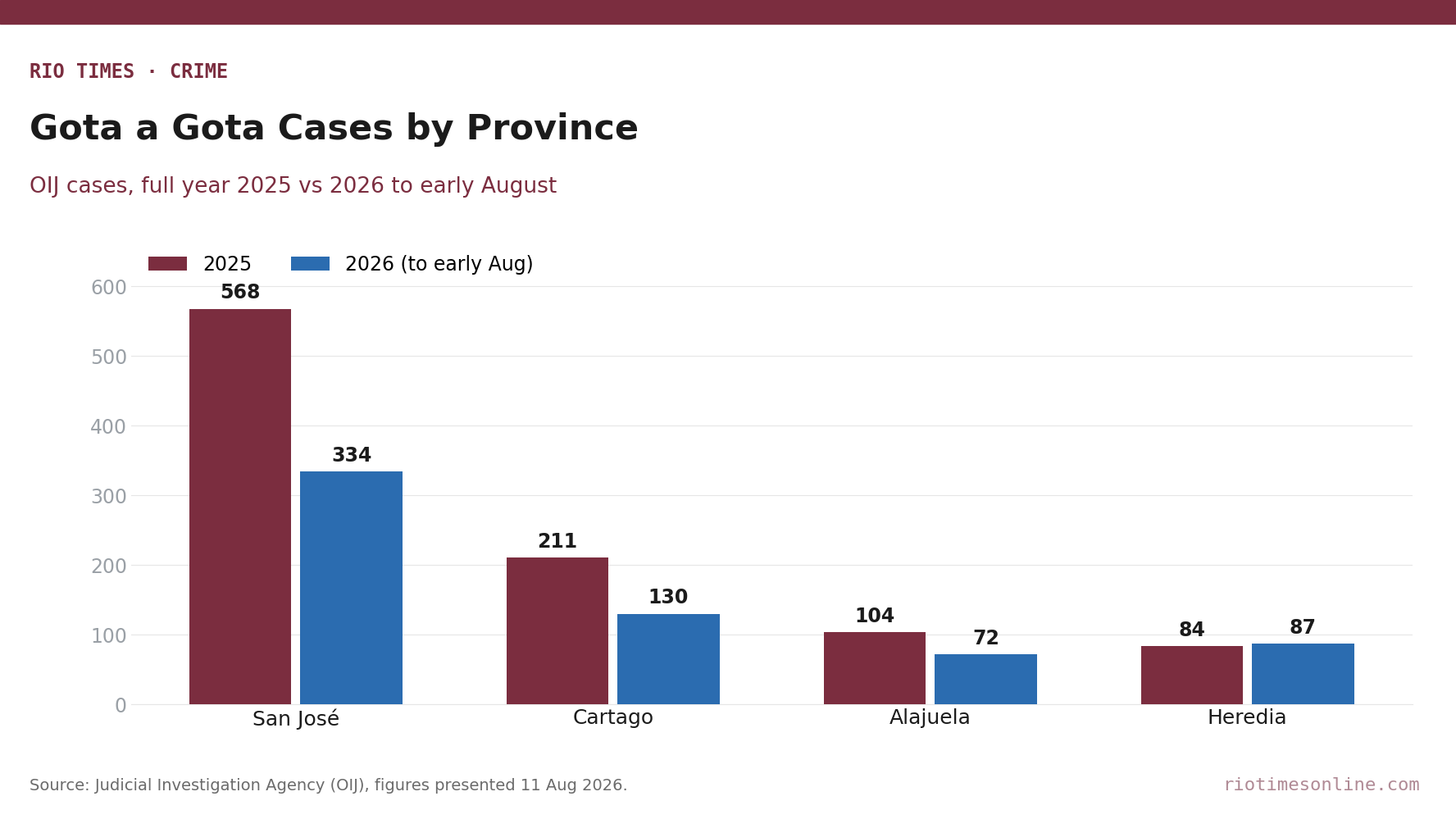
San José province recorded 568 cases in 2025 and 334 in 2026 by early August, the OIJ said. Cartago followed with 211 and 130, while Heredia already had 87 cases this year against 84 in all of 2025.
Officials attribute San José’s lead mainly to its larger population rather than any special weakness. Victims include Costa Ricans as well as Nicaraguan, Venezuelan and Colombian nationals, the OIJ said.
Why Borrowers Turn to Informal Lenders
Most borrowers are people shut out of the formal financial system, either because they work informally or already carry too much debt. Rojas Valerio said bank loans can be harder to obtain and applications are sometimes refused.
A 2024 study by CINPE, an economic policy centre at the National University, estimated that about 225,000 people had used such credit. Some 42% said they needed money quickly for an emergency, Semanario Universidad reported.
Formal lenders face a legal ceiling known as the usury rate, set by Law 9859, which took effect in June 2020. The BCCR recalculates it every January and July from average lending rates.
For the second half of 2026, the cap is 36.48% a year on colón loans and 30.11% on dollar loans. Microcredit carries higher caps of 51.51% in colones and 42.65% in dollars.
The Costa Rican Chamber of Commerce argues the cap shuts riskier borrowers out of banks and pushes some towards informal lenders. On 19 August the government filed a reform letting the bank regulator, Sugef, set separate caps by type of credit.
The Link to Organised Crime
Police say some drug gangs use gota a gota lending to put illicit cash into circulation and launder it. The OIJ has linked the scheme to groups led by men known by the aliases “Diablo” and “Tan”.
In the Barahona case, investigators allege the collectors were tied to Los Gery, a Cartago gang linked to drugs and killings. The allegations are detailed in Carlos Barahona Arrested With 3 in Loan Case, and all four suspects are presumed innocent.
What It Means for You
Gota a gota lenders target local borrowers, not tourists, so short-term visitors face little direct risk. Residents, landlords and employers can still be drawn in when a tenant, a worker or household staff fall behind.
The OIJ advises against using these loans at all and says there is no minimum amount for filing a complaint. Even a loan below ¢500,000 (about US$1,100) will be investigated, and the agency takes reports around the clock.
Victims are asked to keep evidence such as photos, licence plates, tattoos and descriptions of collectors and their vehicles. Foreign residents should borrow only from regulated banks and keep social media profiles private.
The wider security picture is set out in Safety in Costa Rica 2026: What the Numbers Say and What Foreigners Actually Face. For the economy and politics, see Costa Rica Explained: The Country, Its Politics, Its Economy and What to Watch and the San José city page.
What Is Not Known
The OIJ has not said how much money gota a gota networks move each year or how many borrowers never report threats. It also did not say over what period the 20% to 100% interest is charged.
It is unclear whether lawmakers will pass the government’s reform of the usury cap, and how that would affect informal lending. The court outcome of the Barahona case is also pending, and no charges have been proven.
Frequently Asked Questions
What is a gota a gota loan?
It is an informal cash loan repaid in small, frequent instalments, often daily, at very high interest. Lenders operate outside the regulated financial system and collect through visits, calls and messages.
Are gota a gota loans illegal in Costa Rica?
Lending money is not a crime in itself, according to the OIJ. Collecting with threats, intimidation or violence can amount to extortion and other offences.
How common are gota a gota loans in Costa Rica?
The OIJ logged 2,050 related cases in 2026 by early August and about 2,930 in 2025. Complaints rose 21% in January to July compared with the same months of 2025.
What interest do gota a gota lenders charge?
The OIJ has seen interest of 20% to 100%, with daily, weekly or monthly payments. Formal lenders are capped at 36.48% a year on colón loans in the second half of 2026.
What should a victim do?
The OIJ urges victims to file a complaint and keep evidence such as messages, photos and licence plates. There is no minimum amount, and the agency takes reports 24 hours a day.
Sources: Semanario Universidad, OIJ figures (11 August 2026) · El Observador, complaints up 21% · El Observador, OIJ on aggression · El Observador, BCCR interest caps · Diario Extra, BCCR caps · El Observador, usury law reform · El Observador, Chamber of Commerce · Semanario Universidad, CINPE study · Ministry of Finance, BCCR reference rate (14 October 2026) · CR Hoy, Barahona case
This article was produced by The Rio Times’ automated newsroom system. How we use AI · Report an error · Editorial responsibility: Matthias Camenzind, Editor-in-Chief