Colombia Markets: COLCAP and the Peso, September 18, 2026
Key Facts
- The MSCI COLCAP rose 0.40% to 2,521.85 points, recovering part of Wednesday’s 2.16% fall to 2,511.76.
- The peso was the weakest major Latin American currency on the day, with the reference close at 3,132.01 to the dollar and local prints as high as 3,159.
- The official reference rate rose 28.01 pesos to 3,128.46, reflecting the Federal Reserve’s increase earlier in the week.
- The central bank’s monthly survey lifted December inflation expectations to 6.81%, from 6.60%, against August inflation of 6.33% and a target of 3%.
- The policy rate stands at 12.00%, the highest since 2024, after a three-quarter-point increase in June, and there was no meeting this week.
- The statistics agency publishes the July activity index at noon, with a consensus of 2.9% against June’s 3.5% and forecasts ranging from 0.2% to 2.3%.
Today’s Focus
The story in Colombia on Thursday was the currency, not the index. The peso weakened while every major regional equity market rose.
The MSCI COLCAP itself had a reasonable day, gaining 0.40% to 2,521.85 points. That recovered part of Wednesday’s 2.16% fall, the fourth consecutive decline at the time.
The reference close on the peso was 3,132.01 to the dollar, and local sources quoted prints as high as 3,159. Either way it was the sharpest regional move of the session.
The official rate used for contracts rose 28.01 pesos to 3,128.46. That is the number Colombian businesses actually settle against.
Behind it sits an inflation problem that is not improving. The central bank’s monthly analyst survey lifted the median December forecast to 6.81% from 6.60%.
What matters today. The July activity index at noon lands with forecasts spread from 0.2% to 2.3%. A range that wide is itself a statement about how little anyone knows.

| Instrument | Level | Session |
|---|---|---|
| Ibovespa (Brazil) | 185,992.03 | +0.24% |
| S&P 500 (US) | 7,637.76 | +1.14% |
| Nasdaq Composite (US) | 26,418 | +1.69% |
| VIX (US volatility) | 15.44 | -12.82% |
| USD/BRL | 5.1289 | -0.48% |
| Gold (per ounce) | US$4,346.42 | +1.74% |
| Silver (per ounce) | US$65.43 | +3.44% |
| Oil fund (USO) | US$155.31 | -0.55% |
Thursday, 17 September 2026 close. Gold, silver and the oil fund in US dollars.
01 The session in one read
A rising index and a falling currency is a familiar Colombian combination. It usually means local buyers are supporting shares while foreign money steps back.
The COLCAP had fallen for four consecutive sessions before Thursday. A gain of 0.40% stops the run without reversing it.
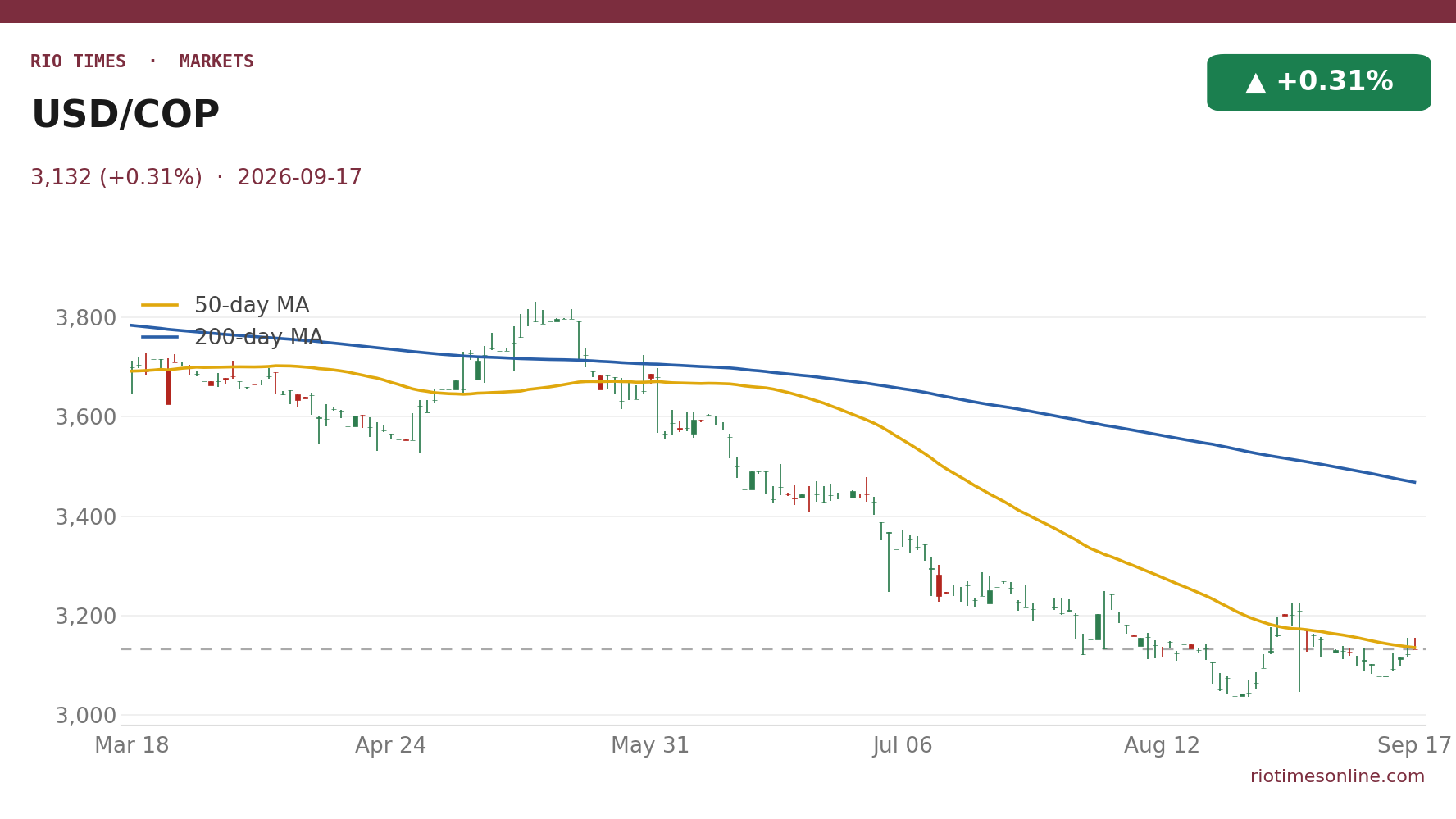
The currency chart is the clearer picture of the week. The dollar has climbed steadily against the peso since the start of September.
The Federal Reserve’s increase on Wednesday added to that trend rather than starting it. A policy rate of 12.00% in Bogotá has not been enough to hold the line.
02 The day’s numbers
| Measure | Level | Change | Read |
|---|---|---|---|
| MSCI COLCAP | 2,521.85 | +0.40% | Ends a four-session losing run |
| Previous close | 2,511.76 | -2.16% | Wednesday’s fall was the steepest of the week |
| USD/COP (reference) | 3,132.01 | +0.31% | Local prints ranged as high as 3,159 |
| Official reference rate | 3,128.46 | +28.01 | The rate Colombian contracts settle against |
| Policy rate | 12.00% | — | Highest since 2024, no meeting this week |
| August inflation | 6.33% | — | Against a central bank target of 3% |
The two peso lines disagree because they are measured at different moments. The reference feed closes later than the Bogotá market, and local quotes ran higher still.
What both agree on is direction. The peso lost ground on Thursday while the Brazilian and Mexican currencies gained.
Live Market IntelligenceColombia — Live Market Board
Rio Times · Live Market Intelligence
Colombia — Live Market Board
+0.40%
185,992.03
+0.24%
63,873.32
+0.58%
11,381.18
+1.30%
3,061,512
+1.08%
2,521.85
+0.40%
58,965.05
+1.80%
| Instrument | Last | Change | YoY | Prev. | High | Low | Volume |
|---|---|---|---|---|---|---|---|
| COLCAP | 2,521.85 | +0.40% | — | 9.04 | 9.05 | 9.02 | 4,133 |
| USD/COP | 3,140 | +0.03% | -22.04% | 3,139 | 3,141 | 3,105 | — |
| BRENT | 88.88 | -0.03% | +34.42% | 88.91 | 90.07 | 88.12 | 29,713 |
| WTI | 83.11 | -0.11% | +31.57% | 83.20 | 84.35 | 82.40 | 166,848 |
| ECOPETROL | 16.92 | -0.53% | +98.01% | 17.01 | 17.05 | 16.79 | 737,591 |
| BANCOLOMBIA | 95.87 | -2.18% | +96.15% | 98.01 | 100.36 | 95.73 | 188,740 |
| GRUPO AVAL | 5.40 | +2.66% | +76.89% | 5.26 | 5.49 | 5.32 | 146,447 |
| TECNOGLASS | 42.30 | -1.10% | -48.04% | 42.77 | 42.73 | 42.05 | 60,908 |
| CREDICORP | 375.17 | -0.49% | +49.60% | 377.00 | 384.43 | 372.27 | 88,375 |
| BUENAVENTURA | 34.45 | -1.02% | +88.07% | 34.80 | 35.62 | 34.33 | 275,831 |
| SOUTHERN COPPER | 193.97 | -0.26% | +104.01% | 194.48 | 199.36 | 192.59 | 367,102 |
03 Why it moved — expectations, not decisions
There was no central bank meeting this week. What the bank published was its monthly survey of what analysts expect.
The median December inflation forecast rose to 6.81% from 6.60%. That is more than double the 3% target and above August’s actual reading of 6.33%.
It matters because it is the market talking rather than the bank. When forecasters revise upwards while the policy rate is already at 12.00%, they are saying the rate is not yet doing its work.
The Federal Reserve’s increase compounds the problem. A higher American rate reduces the reward for holding pesos at any given Colombian rate.
04 What the index is made of
Ecopetrol is the heaviest name in the Colombian market and the hardest to read this week. Live quote pages showed it near 2,730 pesos, down about 3.7% from a previous close of 2,835.
That figure is carried by a single indicator page and we could not corroborate it against a dated session report. The New York listing is firmer ground, closing at US$17.38, down 0.46%.
Bancolombia now trades through Grupo Cibest, at levels around 90,940 pesos. Any quote in the single or double digits for either name is a unit error rather than a price.
That caution matters more than usual here. Colombian session reports were thin on Thursday, and no outlet we could reach published a full list of gainers and losers.
05 The regional scoreboard
| Market | Close | Session | Note |
|---|---|---|---|
| Ibovespa (Brazil) | 185,992.03 | +0.24% | Recovered from an intraday fall of 1.24% |
| S&P/BMV IPC (Mexico) | 63,873 | +0.58% | First session after Independence Day |
| S&P Merval (Argentina) | 3,061,512 | +1.08% | Rose while country risk climbed to 515 points |
| S&P IPSA (Chile) | 11,381 | +1.30% | Shortened session, closing at one in the afternoon |
| MSCI COLCAP (Colombia) | 2,521.85 | +0.40% | Index up while the peso weakened |
Colombia’s 0.40% gain was the smallest in the region. It was also the only market where the currency moved sharply against the local investor.
The contrast with Chile is instructive. Both are commodity economies, but copper rose on Thursday while oil fell for a second session.
Colombia’s index has had a strong year despite this week. It was trading near record levels in early September, which makes the last five sessions a correction rather than a slide.
06 The wider Colombian picture
Washington kept Colombia on its list of countries judged to be failing on drug control this week. It also redirected about US$52 million of assistance towards Colombia, Panama, Peru and Ecuador.
On trade, the head of the exporters’ association Analdex said the additional 12.5% United States tariff could fall to zero. That tariff has been in force since 24 July 2026.
Financial technology firms pledged 4.3 billion Colombian pesos, roughly US$1.1 to 1.4 billion, over the next year at an industry event in Barranquilla. The figure is often misread as dollars.
The government also sent 300,000 million pesos, about US$96 million, to the electricity sector’s emergency fund. That followed August’s magnitude-7.4 earthquake and a dry spell.
07 What to watch
- The July activity index at noon: Consensus is 2.9% against June’s 3.5%, but forecasts run from 0.2% to 2.3%.
- The peso above 3,150: Local prints already reached 3,159, and a close there would be a fresh low for the month.
- Inflation expectations: The survey median at 6.81% is the constraint on any rate cut this year.
- Ecopetrol: The New York listing is the reliable read while Bogotá session reporting stays thin.
- The United States tariff: Analdex expects the additional 12.5% duty to fall, with a Colombian decree already prepared.
Frequently Asked Questions
Where did the COLCAP close on 17 September 2026?
The MSCI COLCAP closed at 2,521.85 points, up 0.40%. It had fallen 2.16% to 2,511.76 the previous day.
What is the Colombian peso worth?
The reference close was 3,132.01 to the dollar and local sources quoted prints as high as 3,159. The official reference rate rose 28.01 pesos to 3,128.46.
What is Colombia’s policy interest rate?
The rate is 12.00%, the highest since 2024, after a three-quarter-point increase in June 2026. There was no monetary policy meeting this week.
What did the central bank’s survey show?
The median forecast for December 2026 inflation rose to 6.81% from 6.60%. August inflation was 6.33% against a target of 3%.
What Colombian data is due today?
The statistics agency publishes the July economic activity index at noon. Consensus is 2.9% against June’s 3.5%, with individual forecasts from 0.2% to 2.3%.
How did Ecopetrol trade?
Its New York listing closed at US$17.38, down 0.46%. Bogotá quote pages showed the local share near 2,730 pesos, a figure we could not corroborate against a dated session report.
Sources: Trading Economics and Valora Analitik for COLCAP levels; Infobae and Portafolio for the peso and the official reference rate; Banco de la República monthly expectations survey; La República indicator pages for Ecopetrol; El Tiempo on the Analdex tariff comments; El Colombiano and Valora Analitik on the electricity fund; RT end-of-day series and economic calendar.
This article was produced by The Rio Times’ automated newsroom system. How we use AI · Report an error
In depth
LatAm Markets: Live Signals → — real-time movers, turnover leaders and FX across Latin America.
Read More from The Rio Times