Brazil’s Financial Morning Call for Monday, July 27, 2026
Key Facts
- The mid-month inflation gauge, IPCA-15, is due at midday, landing after the Ibovespa fell sharply on Friday, the data will harden or soften the current Selic wager.
- Consumer confidence is forecast to edge down, with the FGV index seen at 88.5 against 88.7 previously, a print that would keep mild pressure on consumption-linked shares.
- Education stock YDUQ3 rose 3% on Friday with R$48m in volume, a bright spot in a risk-off session that saw the benchmark index decline more than 1.5%.
- Power utility ISAE4 tumbled 7.2% on Friday on heavy R$292m turnover, signalling a specific corporate concern that may carry into the new week.
- The real was nearly flat against the dollar at 5.0873, holding near the strong end of its 52-week band just above 4.89, a supportive backdrop before the inflation release.
Today’s Focus
The first number traders will scan on Monday is the IPCA-15 mid-month consumer price index, set for noon Brasília time. The consensus expects a 0.4% monthly rise, which would nudge the annual rate to 4.9%. A print at or below that figure would embolden the view that the Copom — Brazil’s monetary policy committee — can keep easing the Selic benchmark rate at its August meeting without stoking fresh price pressure.
At the same time, foreign investors are digesting a current-account reading and foreign-direct-investment data half an hour before the inflation release. The FGV consumer confidence gauge, forecast at 88.5 against 88.7 previously, would hint that household sentiment is cooling gently — a dynamic that rate-sensitive builders and retailers will feel at the open.
Those two forces — inflation and activity — will set the tone for the Ibovespa, Brazil’s main stock index, which enters the session nursing a steep Friday loss. Friday’s standout movers, from education name YDUQ3 up 3% to insurer ISAE4 down more than 7%, show that company-level stories are already stirring alongside the macro debate. With the real holding firm near 5.09 to the dollar, the currency is not fighting the equity story, leaving the inflation print as the day’s genuine pivot.
What matters today. Whether the IPCA-15 inflation print lands at or below the 0.4% consensus, giving the Copom room to signal another Selic cut in August.

Today’s Economic Events
01 The setup in one read
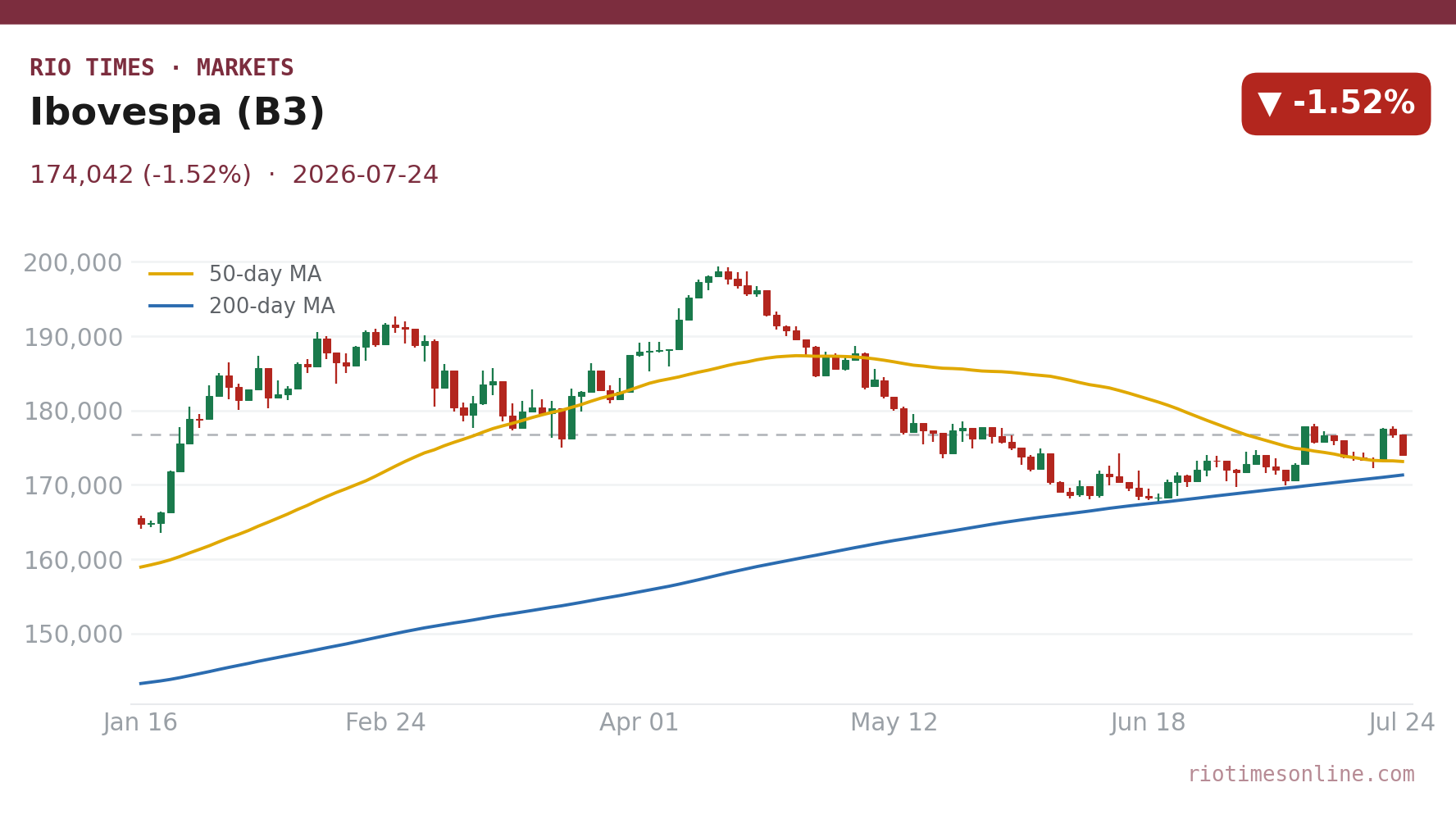
Monday’s session on B3, the São Paulo stock exchange, will revolve around a single piece of domestic data: the IPCA-15 mid-month consumer price index, due at noon. The consensus forecast of 0.4% on the month would keep the annual pace just below the 5% psychological mark at 4.9%, a level that has allowed the Copom — the central bank’s rate-setting committee — to gently lower the Selic, Brazil’s benchmark interest rate. The August Copom meeting is now the market’s central wager, and today’s inflation print is the clearest clue yet on whether another cut is truly coming.
Before the CPI lands, traders will also work through the FGV consumer confidence index, forecast to soften to 88.5 from 88.7, a whisper that Brazilian households are becoming slightly more cautious. That matters for the consumption and real-estate names that dominate the Ibovespa’s most cyclical pockets. Half an hour before the inflation release, the current account and foreign-direct-investment numbers will also arrive, offering a quick health check on Brazil’s external finances and the appetite of foreign firms to put money to work.
The real, Brazil’s currency, starts the day near the strong end of its recent range at 5.0873 to the dollar, remarkably close to the 4.89 level that marks the 52-week top. A stable or strengthening real tends to give the central bank more freedom to cut rates without worrying about imported inflation — a factor that ties today’s FX open directly to the rate story. Friday’s broad market retreat, which sent the Ibovespa more than 1.5% lower, has left the index at 174,042 points and created a potential springboard for a bounce if the inflation data cooperates.
Everything rests on a straightforward test: can Brazilian inflation stay tame enough to keep the central bank in easing mode? The consensus points to a mild 0.4% monthly figure, and a cooler consumer-confidence reading already weakens the case for demand-driven price pressures. If the IPCA-15 surprises to the downside, rate-sensitive sectors — homebuilders, banks, and consumption names — are likely to lead a relief rally; a hotter number would quickly repriced DI futures and hit the same stocks. Watch the headline and the core services component at noon.
02 Where Brazil is set to open
| Instrument | Last close | Indicated | Watch today |
|---|---|---|---|
| Ibovespa (IBOV) | 174,042 | — | Close above 170,367, the last recorded open, on an IPCA-15 relief rally |
| USD/BRL | 5.0873 | — | Test of the 5.20 area if the inflation data surprises higher; otherwise holding below 5.10 |
| DI Futures (Jan 27) | — | — | Pricing of the August Copom decision — watch for a repricing on the CPI print |
The table sets out the three instruments that will frame the opening auction, which runs from 09:45 to 10:00 Brasília time. The Ibovespa enters the session at 174,042 points and the direction of the first trade depends almost entirely on how futures and the real behave ahead of the noon inflation release. The USD/BRL pair at 5.0873 is a quiet pillar — it has barely budged from the prior close and sits well below the 2026 average, which various sources place between 5.21 and 5.31. That stability removes one layer of anxiety, letting local traders focus squarely on the rate outlook.
The DI futures curve, which prices expectations for the Selic, is the unspoken driver here. A soft IPCA-15 would flatten the front end, pulling bank and real-estate stocks higher; a hot number would steepen the curve and punish those same names. Pre-market indications are thin in Brazil before the auction, so the first real signal will come from the futures open and the currency’s first ticks. Rio Times · Live Market Intelligence
Live Market IntelligenceBrazil Morning Call — Live Board
Brazil Morning Call — Live Board
Instrument Last Change YoY Prev. High Low Volume
IBOV
183,827.59
+0.46%
+21.85%
182,991.13
168,310
167,142
—
USD/BRL
5.16
+0.01%
-5.13%
5.16
5.18
5.14
—
EUR/BRL
5.95
+1.01%
-5.83%
5.89
5.98
5.94
—
SELIC
14.00%
—
—
—
—
—
BRENT
88.88
-0.03%
+34.42%
88.91
90.07
88.12
29,713
WTI
83.11
-0.11%
+31.57%
83.20
84.35
82.40
166,848
IRON ORE
161.91
—
+58.10%
161.91
161.91
1
GOLD
4,461
+1.78%
+33.20%
4,383
4,503
4,421
139,824
SILVER
65.59
+1.26%
+73.05%
64.77
66.98
64.81
46,406
LITHIUM
75.20
+1.47%
+62.95%
74.11
75.80
75.08
89,275
SOY
1,184
+3.20%
+17.05%
1,148
1,199
1,168
163,179
CORN
480.50
+10.02%
+29.34%
436.75
480.75
459.50
341,248
WHEAT
655.00
+3.93%
+29.70%
630.25
657.75
631.50
128,793
COFFEE
317.25
-5.51%
+0.67%
335.75
321.20
313.55
21,747
SUGAR
16.43
-1.79%
-3.01%
16.73
17.11
16.22
171,992
ORANGE JUICE
138.55
-0.47%
-45.38%
139.20
141.05
137.50
703
COTTON
85.03
+2.33%
+26.78%
83.09
82.90
81.96
16,546
BEEF
223.60
-3.93%
-5.18%
232.75
226.40
223.00
16,126
CATTLE
339.10
-3.16%
-1.82%
350.17
345.50
338.60
10,164
COCOA
5,719
+3.18%
-34.96%
5,543
5,779
5,574
26,773
PETR4
41.64
-0.05%
+35.19%
41.66
41.97
41.15
41,499,400
VALE3
72.97
+0.83%
+30.75%
72.37
73.54
72.66
17,658,000
SUZB3
41.33
+2.35%
-23.55%
40.38
41.48
40.35
3,914,900
KLABIN
17.69
+0.80%
-2.95%
17.55
17.74
17.48
2,057,400
SLCE3
13.34
+0.30%
-12.25%
13.30
13.42
13.20
1,454,200
ABEV3
14.89
-0.80%
+21.91%
15.01
15.07
14.81
16,453,100
ITUB4
38.60
-1.03%
+4.57%
39.00
39.34
38.39
29,487,800
BBDC4
16.85
+0.36%
+3.50%
16.79
16.90
16.67
19,416,900
BBAS3
19.37
+0.47%
+0.73%
19.28
19.44
19.16
11,069,200
B3SA3
14.26
-0.21%
+12.73%
14.29
14.47
14.11
33,037,800
WEGE3
47.59
+0.49%
+29.99%
47.36
48.08
47.36
3,364,600
PRIO3
59.14
-0.19%
+50.67%
59.25
59.81
58.74
3,325,600
RENT3
34.68
-0.09%
+0.84%
34.71
34.96
34.35
7,979,100
AZZA3
15.89
-2.63%
-53.76%
16.32
16.42
15.82
1,330,300
CSNA3
4.30
+0.47%
-42.65%
4.28
4.41
4.26
10,076,100
GGBR4
24.69
+2.19%
+51.38%
24.16
24.85
24.18
7,047,600
ENEV3
24.21
-1.38%
+70.49%
24.55
24.64
23.99
9,297,000
LREN3
11.87
-1.33%
-28.65%
12.03
12.17
11.83
9,683,300
03 On the B3 radar today — IPCA-15 and consumer confidence
| Item | When | Why it matters |
|---|---|---|
| FGV Consumer Confidence | 08:00 BRT | Consensus 88.5 vs 88.7 — a soft print would weigh on retailers and homebuilders |
| Current Account | 11:30 BRT | A narrower deficit would signal a healthier external position, supporting the real |
| Foreign Direct Investment (FDI) | 11:30 BRT | A strong FDI print, above the $5.8bn forecast, would show foreign firms still backing Brazil |
| IPCA-15 (mid-month CPI) | 12:00 BRT | The main event — a read at 0.4% or lower would cement expectations of an August Selic cut |
Today’s calendar is back-loaded and entirely domestic. The FGV consumer confidence figure is due first at a forecast 88.5 against 88.7 previously, and a soft print may dampen enthusiasm for the consumption names that rallied late last week — including YDUQ3, the education provider, and CVCB3, the travel operator. Half an hour later, the current account and FDI data will give a quick read on Brazil’s external vulnerability; the FDI consensus of $5.8bn is well below the prior $7.97bn, so a beat there would be a welcome surprise for the real.
Everything builds toward the IPCA-15 release at noon. This is the broadest mid-month inflation snapshot available and the Copom watches it closely. If the core services component remains well-behaved and the headline matches the 0.4% estimate, the path to another Selic reduction at the August meeting widens — and stocks such as MRVE3, the homebuilder, and TOTS3, the software firm, would be first to respond.
There are no major corporate earnings or ex-dividend dates on the official Monday schedule, which makes the macro data the undisputed driver of the session. Turnover leaders from Friday — PETR4, the Petrobras preferred share, and VALE3, the iron-ore giant — will still dominate the tape, but their direction today will be steered by the rate and currency story rather than company-specific news.
04 Copom and the macro backdrop
The Copom’s August meeting is now the lodestar for Brazilian assets, and every domestic data point between now and then is being read through that single lens. The Selic rate, currently a double-digit yield that has long attracted foreign capital, is expected to edge lower as inflation cools — but the pace and the terminal rate remain fiercely debated. Friday’s sharp Ibovespa retreat, combined with a flat S&P 500, showed that Brazilian risk is being priced locally, not imported from Wall Street.
Today’s IPCA-15 holds extra weight because it arrives after a mixed run of activity data. The consumer confidence miss this morning suggests the economy is not overheating, which is what the central bank wants to see before easing further. The real’s strength — still less than 1% from its 52-week high against the dollar — provides a disinflationary tailwind that the Copom will note.
Foreign investors will also scan the current-account print for signs of strain. A deficit near the forecast $3bn would be manageable, but a wider gap could stir unease about Brazil’s reliance on portfolio flows to fund its external shortfall. The FDI number matters too: robust foreign direct investment signals long-term commitment, while a weak number would leave the real more exposed to a sudden shift in rate expectations. Together, these morning releases will either reinforce the August rate-cut narrative or introduce the first serious doubt.
05 Corporate stories to watch today
Even on a data-heavy day, several individual stocks will command attention because of sharp moves in the last session. YDUQ3, the education company formerly known as Estácio, rose 3% on Friday with R$48m in turnover — a standout gain in a falling market. The move suggests a fund or a large investor was building a position, and the stock could be volatile again if the macro backdrop improves.
At the other end of the spectrum, ISAE4, a smaller and less-liquid power-transmission utility, crashed 7.2% on R$292m in volume, a massive turnover for that name. That kind of price action usually signals a forced seller or a sudden reassessment of corporate risk; traders will watch whether the selling continues into Monday. CXSE3, another mid-cap that dropped more than 5%, showed similar stress.
Among the blue chips, PETR4 and VALE3 remain the volume kings, trading R$1.2bn and R$650m respectively on Friday. Neither had a company-specific catalyst, but a stabilisation in global oil and iron-ore prices overnight would help both names open flat to slightly higher. The banking trio of ITUB4, B3SA3 and the Bradesco-linked BRAP4 will instead move in lockstep with the Selic repricing after the CPI release — if the data is cool, expect the banks to lead any bounce.
06 The levels to watch at the open
For the Ibovespa, the first level that matters is 170,367 points, the last recorded open on Investing.com’s live feed. A gap above that number would signal that buyers stepped in early, likely on a constructive read of the morning data. The 174,000 area, where the index closed on Friday, is the immediate ceiling — a move back above it would erase the entire Friday loss and shift the short-term mood.
The USD/BRL pair is hugging the 5.08–5.09 zone, a tight band that has held through several sessions. A break above 5.10 would be the first sign of FX stress, but the real would need to weaken past 5.20 — the lower edge of the 2026 average — to cause genuine alarm. On the strong side, a push below 5.00 toward the 4.89 52-week high would light a fire under importers’ stocks and keep the rate-cut trade alive.
In the DI futures market, the contract that captures the August Copom meeting is the one to monitor. An IPCA-15 print of 0.35% or lower would likely send that contract sharply lower in yield, pulling bank and real-estate shares up with it. A 0.45% or higher print would reverse the trade — the yield would spike, and the Ibovespa would struggle to hold 170,000. Until noon, the market will drift, but the auction will already tell you who positioned for which outcome.
07 What to watch
- IPCA-15 print at noon: A 0.4% monthly rise or lower would green-light the August Selic cut trade; anything hotter reprices the whole curve.
- USD/BRL at the 5.10 barrier: A break above 5.10 on an inflation scare would hit importers and signal that the real’s strong run is pausing.
- YDUQ3 and the education names: Friday’s outlier gain of 3% may attract momentum traders if the macro backdrop stays supportive.
- Bank stocks after the CPI: ITUB4 and Bradesco-linked BRAP4 are the purest Selic plays — they will move first and fastest on the inflation number.
Background: Kenya’s Maisha Namba Digital ID Reaches 1.7 Million Cards.
Background: UN Chief Warns Libya Over Arms Embargo and Parallel Oil Networks.
More: Brazil news in English, every day from The Rio Times.
Frequently Asked Questions
What is the IPCA-15 and why does it matter today?
It is Brazil’s mid-month consumer price index, a preview of the full monthly inflation figure. The Copom watches it closely to decide whether to cut the Selic interest rate.
What is the Selic and how does it move stocks?
The Selic is Brazil’s benchmark interest rate set by the central bank. A lower Selic makes credit cheaper, which helps banks lend more and supports homebuilders and retailers — so those stocks rally when rate cuts are expected.
Why is the real’s level important for the stock market?
A stronger real makes imports cheaper and keeps inflation low, giving the central bank room to cut rates. A weaker real can push inflation up and force the Copom to pause, which hurts domestic stocks.
Which stocks are most sensitive to today’s inflation data?
Homebuilders such as MRVE3, retailers such as CVCB3, and banks such as ITUB4 are the most reactive. They borrow or lend money and feel the Selic’s impact directly.
This article was produced by The Rio Times’ automated newsroom system. How we use AI · Report an error
LatAm Markets: Live Signals → — real-time movers, turnover leaders and FX across Latin America.