Mexico Becomes Regional Progessive Leader with Evo Morales Asylum
RIO DE JANEIRO, BRAZIL – Political asylum for humanitarian grounds granted to Evo Morales has placed Mexico ahead of the progressive governments of Latin America, a position of leadership that Andrés Manuel López Obrador’s executive branch had refused to accept since he took office a year ago.

However, circumstances have led Mexico to take a step forward, in line with its tradition of welcoming both the Spanish Republican exile and Central American refugees.
Evo Morales‘ surprising request for help, to which Mexico replied with a broad mobilization of resources, placed the country in a new scenario in which it is raising its voice to denounce a “coup d’état” against the overwhelming silence of the rest of Latin America.
Until now, true to his political ideology, López Obrador had fulfilled his old slogan: “You cannot have light in the street and darkness in the home”. During the Venezuelan crisis, he remained on the sidelines for as long as he could.
Mexico was the only Latin American power that did not acknowledge Juan Guaidó as interim president and, although it did not support Nicolás Maduro, it always chose the path of dialogue to which the Venezuelan president is resorting. Everything has changed with Evo Morales.
Until now, López Obrador had dodged the international commitment and the recurring bids from the left-wing. Since coming to power a year ago, he has not traveled to any major international event – he was absent from the G20 summit in Osaka and the UN General Assembly – and in fact, he has not traveled abroad, not even to the United States, with which he had to deal with a migration crisis.
He continually ignored Nicolas Maduro’s friendly gestures and last week he vigorously declined to join the Puebla Group, promoted by Argentina’s President-elect Alberto Fernández. To the event held in Buenos Aires, which was attended by Fernández himself and former South American presidents José Mujica, Dilma Rousseff and Ernesto Samper – and which celebrated Lula’s release from prison – he sent his country’s undersecretary to Latin America.
Faced with the discrediting of the Bolivarian bloc, the sinking of Cuba as an ideological reference and awaiting the inauguration of Alberto Fernández, López Obrador stood alone in front of a leftist bloc that looks to the sides in search of references.
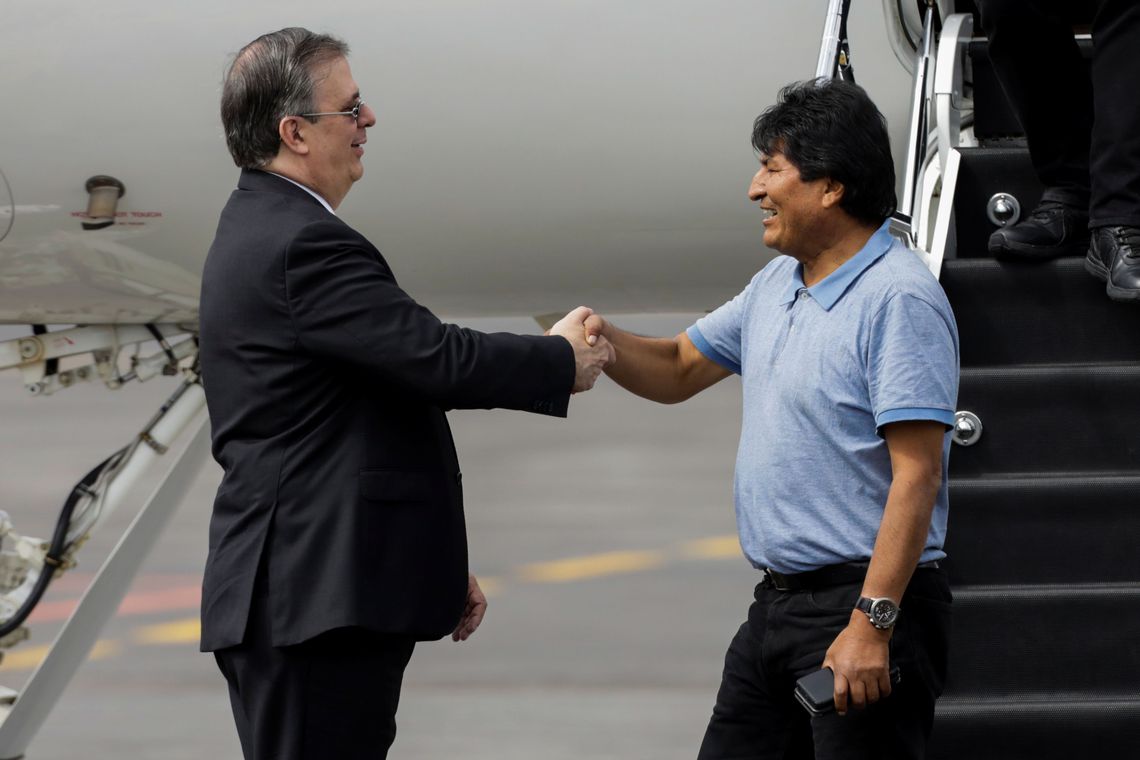
The Mexican president and his foreign minister, Marcelo Ebrard, one of the most effective and permanent ministers in his cabinet, emerge as protagonists of consensus when it comes to unifying a Latin American voice. Facing him is a right-wing bloc that is so antagonistic that it ranges from Bolsonaro to Piñera, where the only confluence is the hatred of Maduro.
Mexico’s step forward came just before the López Obrador administration took over the interim presidency of the Community of American and Caribbean States (CELAC), a body promoted by the late Hugo Chávez and former Brazilian president Lula. This could lead to a clash with the Organization of American States (OAS), which Mexico has harshly criticized for its actions in recent days in relation to the Bolivian crisis.
The Mexican Foreign Minister announced that he will make a complaint to the organization’s permanent council for what he considers the “silence of the OAS”. “We are going to put this on the table. That (the OAS) fulfill the role for which it was established.”
The possible repercussion of the decision to grant Morales asylum, in its relations with the United States, constitute another point of questioning. Ebrard said it should not affect the new free trade agreement that also includes Canada (TMEC) – which will come into force subject to approval by the US Congress – nor the relationship with the government of Donald Trump, because it is based on mutual respect. The relationship with the United States “is in its best moment,” he summarized.
Much of Mexico’s diplomatic success and its new leadership lies in the implementation of the notorious Estrada doctrine, which promotes non-intervention in other regions’ affairs. A philosophy that Ebrard reiterated in the case of Bolivia and the countries that prevented the use of their airspace.
Concomitantly, the arrival of Morales served to reaffirm the traditional welcoming role of Mexican diplomacy. “Many people are alive today thanks to the asylum that Mexico has provided. And it is a source of pride for Mexico, be it in the Spanish Republic or in other parts of the world, as in the case of Trotsky. It is ennobling and prestigious,” he said.
Evo Morales’ troubled trip made it clear that he was in tune with Argentina after Alberto Fernández’s intervention served to relieve the crisis and allow the Mexican armed forces plane to land in Paraguay, after Peru had refused to let the plane land in Lima to refuel.
As for the circumstances surrounding Evo Morales’s resignation from power in Bolivia, the Mexican government made it clear that this was a “coup d’état,” whose resignation was forced by pressure from the Armed Forces. “Evo Morales had been elected to serve until January 2020”.
Source: El País
More: Latin America news in English, every day from The Rio Times.
This article was produced by The Rio Times’ automated newsroom system. How we use AI · Report an error · Editorial responsibility: Matthias Camenzind, Editor-in-Chief