Bolivia’s Evo Morales, Increasingly Encircled, Is Unable to Find a Way Out
RIO DE JANEIRO, BRAZIL – “In Bolivia, the Army is not like in Venezuela. There is still a certain tradition and honor,” explains a veteran leader who opposes the current government of La Paz. “Nor do the security forces, in general, sympathize with them”.
“Them” is, in truth, “he”. He is referring to the unfinished achievements that Evo Morales failed to attract in the country, crippled by very serious suspicions of electoral fraud.

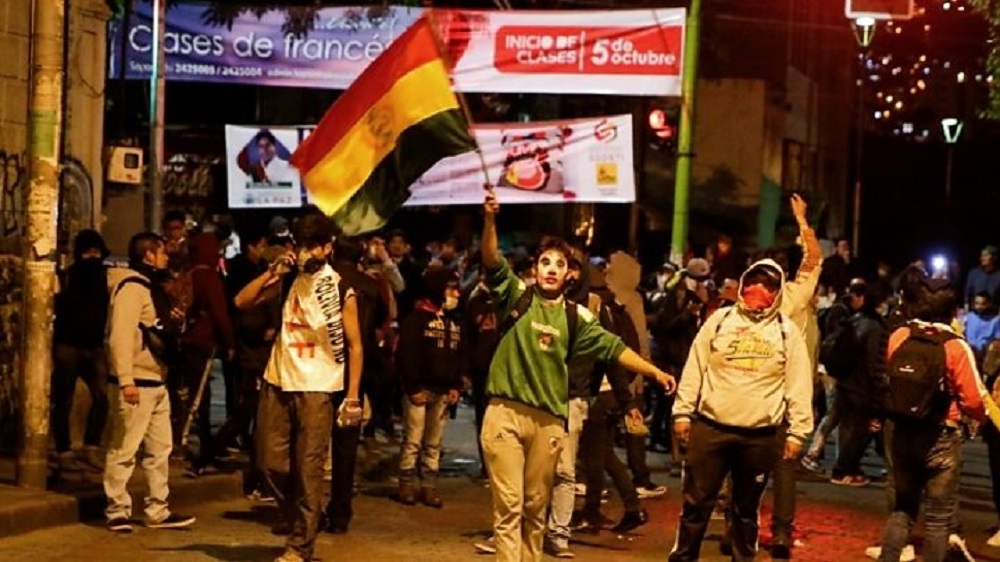
The images speak for themselves. Uniforms waving the Bolivian flag from the top of the police barracks responding to the only command they acknowledge: that of the people. An unexpected jolt for the would-be-eternal president who took office on January 22nd, 2006, and who intends to turn these protests into a racial issue in order to incite hatred.
A strange parable: complaints united all social classes over a rigged electoral accounting.
The wave of discontent does not cease despite the efforts of Quemado Palace to prevent them. The regime has tried every art and craft learned from its chief advisor. He is none other than the Cuban ambassador in Bolivia, Carlos Rafael Zamora Rodríguez. They call him El Gallo (The Rooster). But he doesn’t criow, he whispers.
Born in Las Tunas in 1943 and married to Maura Isabel Juampere Pérez, Zamora Rodríguez is a former officer of the General Intelligence Directorate (DGI) who began his diplomatic duties in New York between 1974 and 1977. He then toured the rest of the continent: Ecuador, Panama, Brazil and El Salvador. He landed in Bolivia last March.
For those familiar with his arts, he is the one who outlined the system of repression that Evo has been implementing since the week after the elections on October 20th. Guilds, social groups, and voluntary supporters go out to defend their leader with the sole purpose of silencing the voices that denounce the result – once again – of the people’s will at the polls. Chavista groups have become an interesting tool.
When Hugo Chavez first created them, after the uprising that almost stripped him of power in 2002, he was inspired by Fidel Castro’s repeated advice. He mirrored the Cuban Committee for the Defense of the Revolution. He called them Bolivarian Circles until they ultimately distorted into the vigilante groups they are today.
Perhaps Evo was late in recalling their use. Didn’t El Gallo crow in time?
But unlike Maduro, his mirror, Morales does not rely on a sufficiently loyal security force to trample over the rest of society. The Army still retains a spirit of strength that survived the attacks of its Commander-in-Chief. No general will dare to shoot at the crowds.
The police forces – as weary as the rest of the government’s arrogance – would also not seem willing to risk their lives for a President who pledged institutionality and turned a referendum upside down. “Democracy does not end with the vote,” Evo said four days ago when tensions started to become uncontrollable.
From his mouth, it seems consistent. However, academia will need to explain, in this context, whether what he expressed was a betrayal of his subconscious or an unknown quote from some liberal theorist.
La Paz, Oruro, Potosí, Sucre, Tarija, Cochabamba, and Santa Cruz are the places where rioting is most noticeable. They are tired. Now, they must be careful. If the central power is radicalized, their names will be the first to figure on lists ready to be purged — the specialty of Cuban counselors.
Mid-morning on Saturday, Evo picked up his cell phone and started tweeting. He wasn’t original. He spoke again of a “coup d’état”. It was unlikely that he would speak in those terms: he has not yet called Sebastián Piñera to express his solidarity with the violent protests in the neighboring country that put a democratically elected government on the brink of the abyss.
There, the “breeze” is welcoming, despite the imperfections and unpopularity of the people who are suffering from it.
“Sisters and brothers, our democracy is at risk due to the coup d’état that violent groups have started against the constitutional order. We denounce this attack against the rule of law before the international community,” said the Bolivian president.
He would seem to be underestimating his people, who are aware that the claims are related to the manipulation of an electoral result that would force him out of the La Paz seat of governance.
In the meantime, Carlos Mesa and Luis Fernando Camacho appear to be fighting over the table scraps of power. They must come to an agreement: divided is how La Paz, a city that suffers more and more from opposition protests, wants them to remain. Morales cannot cover the sun with one finger. From their midst, they fear that the “institutional rupture” will come to an end.
However, Evo decided to become a ‘chavista’ with an unseen pedigree and the situation is becoming more and more tense, more extreme: now the opposition – which at first only asked for a second round – is nowdemanding his resignation.
What will the Organization of American States (OAS) decide next week? Is there room for a Solomonic solution? The streets will tell him no. The prestige and credibility of its conductor, Luis Almagro, will be at stake. Yesterday he only spoke of Maduro’s “usurping dictatorship”. He is very close to having to say the same about Morales Ayma.
This Friday, the Superior Electoral Court (TSE) – the same one that allowed Evo to elude the Constitution and a referendum and run for the fourth time – publicly criticized the actions of the company he had hired to carry out an internal audit, for saying that irregularities had been detected. They did not use the word “fraud”. It was not necessary.
The TSE was desperate to clarify that it was a lie, according to the documentation they had received from the same company, Ethical Hacking.
The outcome of the audit, however, would undoubtedly be reviewed by the TSE, a body that could rule it out or minimize it, arguing that the irregularities identified by the OAS experts were insufficient to alter the final results that enshrined Evo Morales Ayma as President in the first round of voting.
The streets would seethe with anger again and the threat from Bolivia’s Defense Minister, Javier Zabatela, could become reality: “We are one step away from counting the dead by the dozens.”
Thus, Evo would rise to an altar known all too well to Latin Americans — that of rulers without any legitimacy. In other words, a dictator, no matter how much he searches for the supporting shoulders of his friends – new and historical – in the Latin American region, as El Gallo has been advising him.
Source: Infobae
More: Latin America news in English, every day from The Rio Times.
This article was produced by The Rio Times’ automated newsroom system. How we use AI · Report an error · Editorial responsibility: Matthias Camenzind, Editor-in-Chief