Brazil Markets: Ibovespa & the Real — August 1, 2026
Key Facts
- The Ibovespa gained 0.47% to 177,999 points, a session defined by a powerful rally in bank shares after Santander Spain announced its intention to launch an exchange offer for the free float of its Brazilian unit.
- Santander Brasil’s units (SANB11) soared 13.3%, their biggest single-day jump in years, leading both the turnover and the winners’ boards.
- The Brazilian real weakened 0.40% to 5.0793 per US dollar, a gentle pullback from recent strength driven by profit-taking as the month turned.
- Petrobras preferred shares (PETR4) added 1.4%, providing a steady lift for the main index alongside solid gains in heavyweight domestic banks.
- Trading volume was concentrated in Vale and the large financials, with SANB11 alone moving R$141 million (about US$27.8 million) in a session otherwise light on macro catalysts.
Today’s Focus
Brazil’s stock market closed higher to end the week, with the benchmark Ibovespa index adding 0.47% to settle at 177,999 points. The advance was not broad—it hinged on a singular, explosive move in Banco Santander Brasil after its Spanish parent moved to buy out the minority shareholders.
The lender’s units rocketed 13.3%, the session’s standout gainer. The rally was so sharp it accounted for a substantial share of the index’s points. The other titans of the B3 exchange—Petrobras, Vale, and the big retail banks—traded in much calmer ranges, with modest gains and small dips.
The currency, the real, edged 0.40% weaker to 5.0793 per US dollar. It was a mild retracement in a market where the real has been a favoured carry trade, still trading well off its 52-week low.
What matters today. A buyout offer for a single bank, not its earnings, drove the entire session’s gains, masking an otherwise quiet day for the broader market.

01 The session in one read
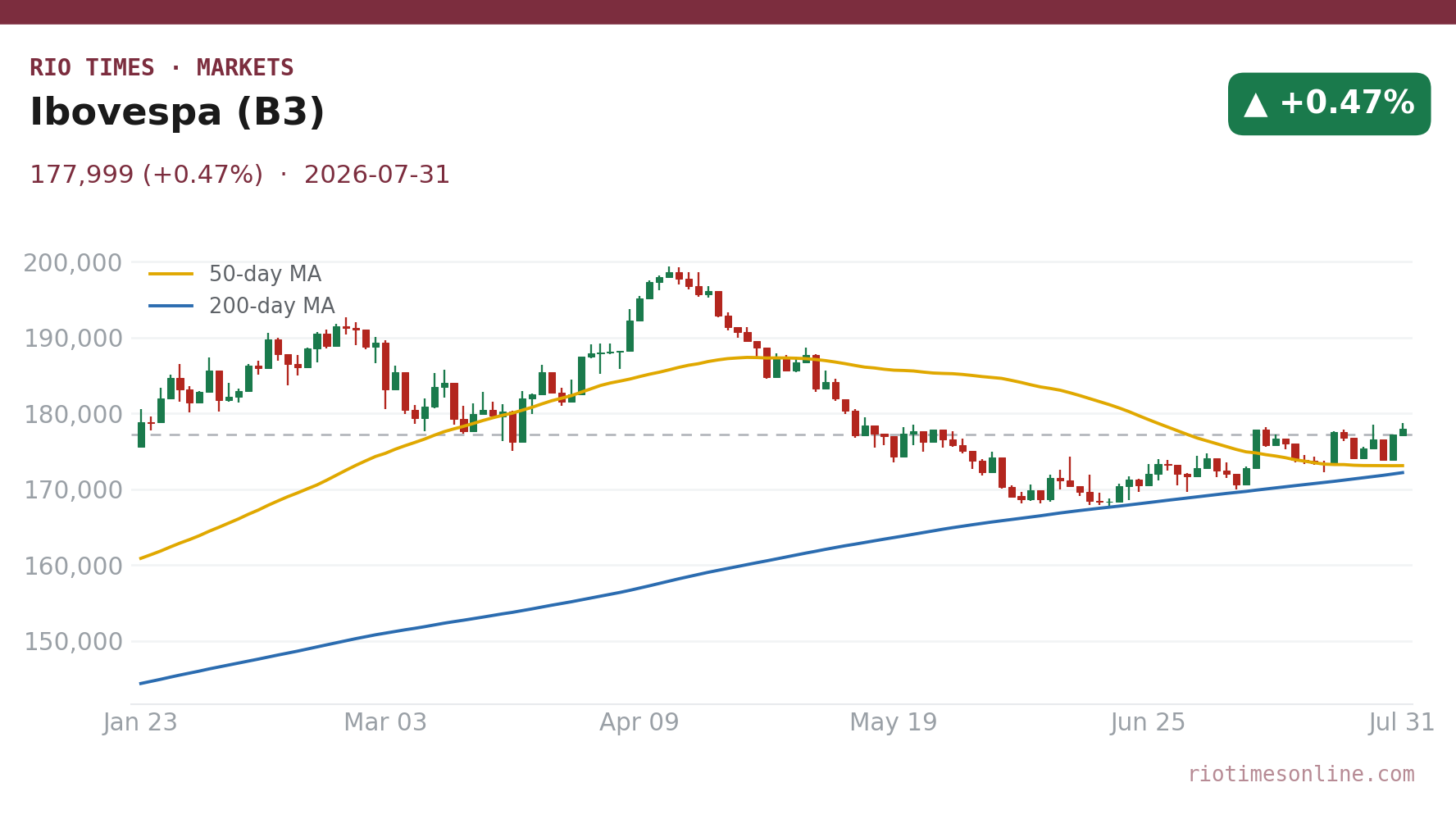
There was one story in São Paulo on Friday, and its name was Santander. The Spanish-owned giant’s Brazilian-listed units (SANB11) catapulted 13.3% higher, a move so emphatic it pulled the entire Ibovespa—Brazil’s main stock index—to a 0.47% gain, closing at 177,999 points, building on Thursday’s 1.88% jump to 177,159.
Without that single takeover-fuelled sprint, the session would have been remarkably flat. Heavyweight iron-ore exporter Vale (VALE3) inched up 0.2%. The index’s other pillar, state-controlled oil producer Petrobras (PETR4), delivered a useful 1.4% gain.
For a session devoid of dramatic global news, turnover was extraordinarily concentrated. SANB11 alone consumed R$141 million (about US$27.8 million) in trading, roughly 14% of the total volume in the most-traded names, as investors rushed to reprice the units against the offer terms.
The currency market told a different, quieter tale. The Brazilian real slipped 0.40% to 5.0793 per US dollar. It was a soft, unpanicked pullback—the kind of profit-taking that naturally follows a period of steady gains for the high-yielding real.
The spike in Santander is a takeover-premium repricing rather than a verdict on trading conditions, so it says little about the earnings power of the wider sector. However, the lack of follow-through in heavily-weighted miners and oil—Vale added just 0.2%, while USIM5 fell 2.5%—shows the rally lacks breadth. The real’s small decline seems consistent with portfolio adjustments rather than a shift in the macro story. Watch whether Monday brings fresh buying into other financials like Itaú and Bradesco, which posted only fractional gains today, or if the market’s attention pivots back to commodity prices and the central bank’s next Selic move.
02 The day’s numbers
| Measure | Level | Change | Read |
|---|---|---|---|
| Ibovespa | 177,999 | +0.47% | Gain led by a concentrated bank rally; 10.4% below its 52-week high |
| Session range (est.) | — | — | Intraday range unavailable in the settlement data |
| USD/BRL | 5.0793 | +0.40% | A mild weakening of the real; still 9.1% stronger than its weakest point of the past year (5.5901) |
| 52-week Ibovespa | 132,437 – 198,657 | — | Mid-range positioning, below the psychological 180,000 mark |
| 52-week USD/BRL | 4.8909 – 5.5901 | — | The real remains comfortably far from the weaker end of its yearly band |
The Ibovespa’s close at 177,999 leaves the index still looking up at its 52-week peak of 198,657, a level reached when rate-cut euphoria was at its loudest. Trading range data for the session itself is scarce, but the closing snapshot shows a market that advanced on low breadth.
The real’s session was a mirror image of local equities’ quiet confidence. At 5.0793 per dollar, it dialled back a fraction but held well inside the strong half of its annual range, a reflection of Brazil’s towering 14.25% Selic rate—the central bank’s benchmark—continuing to attract yield-seeking foreign capital, even as cooling inflation keeps Copom on an easing path. Rio Times · Live Market Intelligence
Live Market IntelligenceBrazil — Live Market Board
Brazil — Live Market Board
Instrument Last Change YoY Prev. High Low Volume
IBOV
185,547.66
-0.51%
+21.85%
186,502.64
168,310
167,142
—
USD/BRL
5.16
+0.01%
-5.13%
5.16
5.18
5.14
—
SELIC
14.00%
—
—
—
—
—
PETR4
41.64
-0.05%
+35.19%
41.66
41.97
41.15
41,499,400
VALE3
72.97
+0.83%
+30.75%
72.37
73.54
72.66
17,658,000
ITUB4
38.60
-1.03%
+4.57%
39.00
39.34
38.39
29,487,800
BBDC4
16.85
+0.36%
+3.50%
16.79
16.90
16.67
19,416,900
BBAS3
19.37
+0.47%
+0.73%
19.28
19.44
19.16
11,069,200
B3SA3
14.26
-0.21%
+12.73%
14.29
14.47
14.11
33,037,800
ABEV3
14.89
-0.80%
+21.91%
15.01
15.07
14.81
16,453,100
WEGE3
47.59
+0.49%
+29.99%
47.36
48.08
47.36
3,364,600
PRIO3
59.14
-0.19%
+50.67%
59.25
59.81
58.74
3,325,600
SUZB3
41.33
+2.35%
-23.55%
40.38
41.48
40.35
3,914,900
RENT3
34.68
-0.09%
+0.84%
34.71
34.96
34.35
7,979,100
AZZA3
15.89
-2.63%
-53.76%
16.32
16.42
15.82
1,330,300
CSNA3
4.30
+0.47%
-42.65%
4.28
4.41
4.26
10,076,100
GGBR4
24.69
+2.19%
+51.38%
24.16
24.85
24.18
7,047,600
ENEV3
24.21
-1.38%
+70.49%
24.55
24.64
23.99
9,297,000
03 Why it moved — Santander’s exchange offer reshapes the bank trade
The catalyst could not have been simpler. Banco Santander of Spain announced its intention to launch a voluntary exchange offer for the roughly 10% of Santander Brasil that it does not already own, paying in newly issued shares of the Spanish parent. The proposal was pitched at a premium of about 15% to the reference price of a SANB11 unit, valuing the minority stake at as much as 1.9 billion euros.
The market’s reaction was immediate. SANB11’s 13.3% surge is the kind of repricing that happens when a buyout premium lands on a stock that had lagged its peers for months, with the units racing to close the gap to the offer terms. Local pension funds and foreign desks scrambled to adjust positions. The offer is voluntary, does not seek a delisting from B3 and carries no minimum acceptance condition.
That exuberance, however, did not fully spill over. Itaú Unibanco (ITUB4) and Banco do Brasil (BBAS3) posted only polite, sub-1% gains, while Bradesco (BBDC4) was effectively flat, up 0.2%. The market made a clear distinction: Santander’s good news was Santander’s alone.
On the currency side, the real’s 0.40% dip was a gentle exhale. With no fresh economic data out of Brasília or Washington, and the US S&P 500 rising 0.70%, there was no panic. The move likely reflected dealers squaring positions at month-end, selling the real simply because it had rallied enough recently.
04 The day’s movers
| Driver | Level / Move | Change | Note |
|---|---|---|---|
| SANB11 (Santander Brasil) | Turnover R$141m (US$27.8m) | +13.3% | Session’s undisputed leader after the Spanish parent’s 15% premium buyout offer |
| PETR4 (Petrobras PN) | Turnover R$213m (US$41.9m) | +1.4% | The oil giant provided steady ballast; second-heaviest turnover of the day |
| VALE3 (Vale ON) | Turnover R$260m (US$51.2m) | +0.2% | Highest turnover name, yet barely moved as iron ore markets stayed calm |
| USIM5 (Usiminas PNA) | — | −2.5% | The steelmaker was the biggest domestic loser outside of cross-listed BDRs |
| BRAV3 (Brava Energia) | — | −2.9% | The oil junior fell sharply, underperforming larger rival Petrobras |
The scoreboard above tells the session’s story clearly: financials, not commodities, drove the bus. SANB11’s R$141 million (US$27.8 million) in turnover was the third-highest on the day, astonishing for a stock that usually trades in a quieter corner. The surge dwarfs all other percentage moves among the genuinely domestic, non-BDR names.
Beyond Santander, the list of big movers requires careful reading. AMZO34 and NVDC34, up 8.6% and 3.1%, are Brazilian Depositary Receipts tracking Amazon and Nvidia—their moves are echoes of a strong US tech session, not a domestic Brazilian story. The real domestic laggards were in steel and oil, with Usiminas and Brava Energia retreating.
05 The regional scoreboard
| Index | Country | Change |
|---|---|---|
| Ibovespa | Brazil | +0.47% |
| IPC | Mexico | −0.58% |
| IPSA | Chile | −0.13% |
| Merval | Argentina | −0.41% |
| COLCAP | Colombia | +2.12% |
Friday’s session across Latin America showed no common thread. Colombia’s COLCAP stole the regional show with a robust 2.12% gain, though the exact domestic catalysts remain opaque in the data scan. Mexico’s IPC and Argentina’s Merval both lost ground, slipping 0.58% and 0.41% respectively, reminding us that each market is currently dancing to its own local tune.
The live market board embedded above carries the official closing prices for all regional indices. The moves suggest that Brazil’s mild gain, anchored by a single bank, was far from a coordinated regional rally.
06 The technical picture
The Ibovespa’s settlement at 177,999 just shy of 178,000, leaves it in a technical no-man’s land. It sits comfortably above its 52-week nadir of 132,437, yet remains 10.4% below the high of 198,657. That gap matters because previous attempts to pierce the 190,000 ceiling this year have quickly run out of steam.
Buying interest in big banks is a constructive signal for the broader index. If the Santander spark reignites sustained appetite for Itaú and Bradesco shares, the Ibovespa could finally test the heavy resistance it has been coddling for months. Conversely, the real at 5.0793 per US dollar offers little drama—its 52-week floor of 4.89 remains a distant but plausible target if the current yield advantage holds.
07 What to watch
- Itaú and Bradesco follow-through: If Monday brings 1-2% gains in ITUB4 and BBDC4, it signals the Santander spark has ignited a broader bank rally rather than a one-day pop.
- US jobs data: The Brazilian real’s direction hinges heavily on the interest-rate gap with the US; any data point shifting Federal Reserve expectations will ripple through USD/BRL instantly.
- OPEC Meeting (Saturday): Oil markets will digest OPEC’s decisions over the weekend; Petrobras, whose preferred shares rose 1.4% today, could open Monday with a jolt.
- Commodity prices in Asia: Vale’s flat 0.2% move reflects a holding pattern; a shift in iron ore futures during Asian hours will determine whether the miner supports or drags the Ibovespa next week.
Background: Petrobras Energy Transition Chief Named in Brazil Oil Clash.
Background: Vports Espirito Santo Posts Record First Half.
Background: Brazil Markets: Ibovespa & the Real — July 10, 2026.
More: Brazil news in English, every day from The Rio Times.
Frequently Asked Questions
Why did Santander Brasil units jump 13.3% on July 31, 2026?
Banco Santander of Spain said it intends to launch a voluntary exchange offer for the roughly 10% of Santander Brasil it does not already own, paying in newly issued parent shares at a premium of about 15% to the reference price. SANB11 units rallied to close the gap to those terms, so the move reflects a buyout premium rather than trading results.
Did the Ibovespa rally broadly on July 31, 2026?
No. The index added just 0.47% to 177,999 points and the gain was unusually narrow. Vale rose only 0.2% and Petrobras preferred shares added 1.4%, while Usiminas fell 2.5% and Brava Energia dropped 2.9%. Strip out the Santander move and the session would have been close to flat.
What does the real at 5.0793 per US dollar mean?
One US dollar bought 5.0793 reais at the close, and a higher number means a weaker real. The currency slipped 0.40% on the day, a mild pullback after a run of gains. It still sits 9.1% stronger than its weakest point of the past year and well inside the firmer half of its 52-week band.
How does Brazil’s Selic rate affect the Ibovespa?
The Selic, Brazil’s benchmark rate, stood at 14.25% after three consecutive quarter-point cuts. A high Selic makes fixed income compelling and draws money away from equities, while also supporting the real through carry trades. As the rate falls, banks, retailers and other rate-sensitive shares typically benefit most.
Sources: B3 Brasil Bolsa Balcao, Banco Central do Brasil, Banco Santander
This article was produced by The Rio Times’ automated newsroom system. How we use AI · Report an error
LatAm Markets: Live Signals → — real-time movers, turnover leaders and FX across Latin America.
Read More from The Rio Times