Mexico Markets: IPC & the Peso — August 1, 2026
Key Facts
- The S&P/BMV IPC closed at 66,936 points, a decline of 0.58% on the last session of the week.
- Mexico’s peso firmed 0.09% to 17.328 per dollar, holding near its strongest levels of the year.
- Grupo México was the heaviest weight on the index, sinking 2.1% and pulling the materials sector lower.
- Breadth was weak across the main board, with airport operator GAP and corn-flour giant Gruma among the biggest losers.
- The sentiment contrasted with a buoyant US session, where the S&P 500 added 0.70%, making Mexico’s drop a distinctly domestic story.
Today’s Focus
Mexico’s main stock index, the S&P/BMV IPC, fell 0.58% to close at 66,936, unwinding some of the previous day’s gains in a session where most of the damage came from mining and industrial names.
Grupo México, the country’s largest copper miner, dropped 2.1% on the day, while precious-metals miner Peñoles lost 2.3%, together creating a drag that the broader market could not shake off.
The peso, by contrast, was quietly firm, edging 0.09% stronger to 17.328 per dollar and holding close to its strongest level in a year — a sign that the currency market did not share the equity market’s Friday unease.
What matters today. The sell-off was concentrated in materials and infrastructure names, not a broad flight from Mexican risk, keeping the index within a well-defined recent range.

01 The session in one read
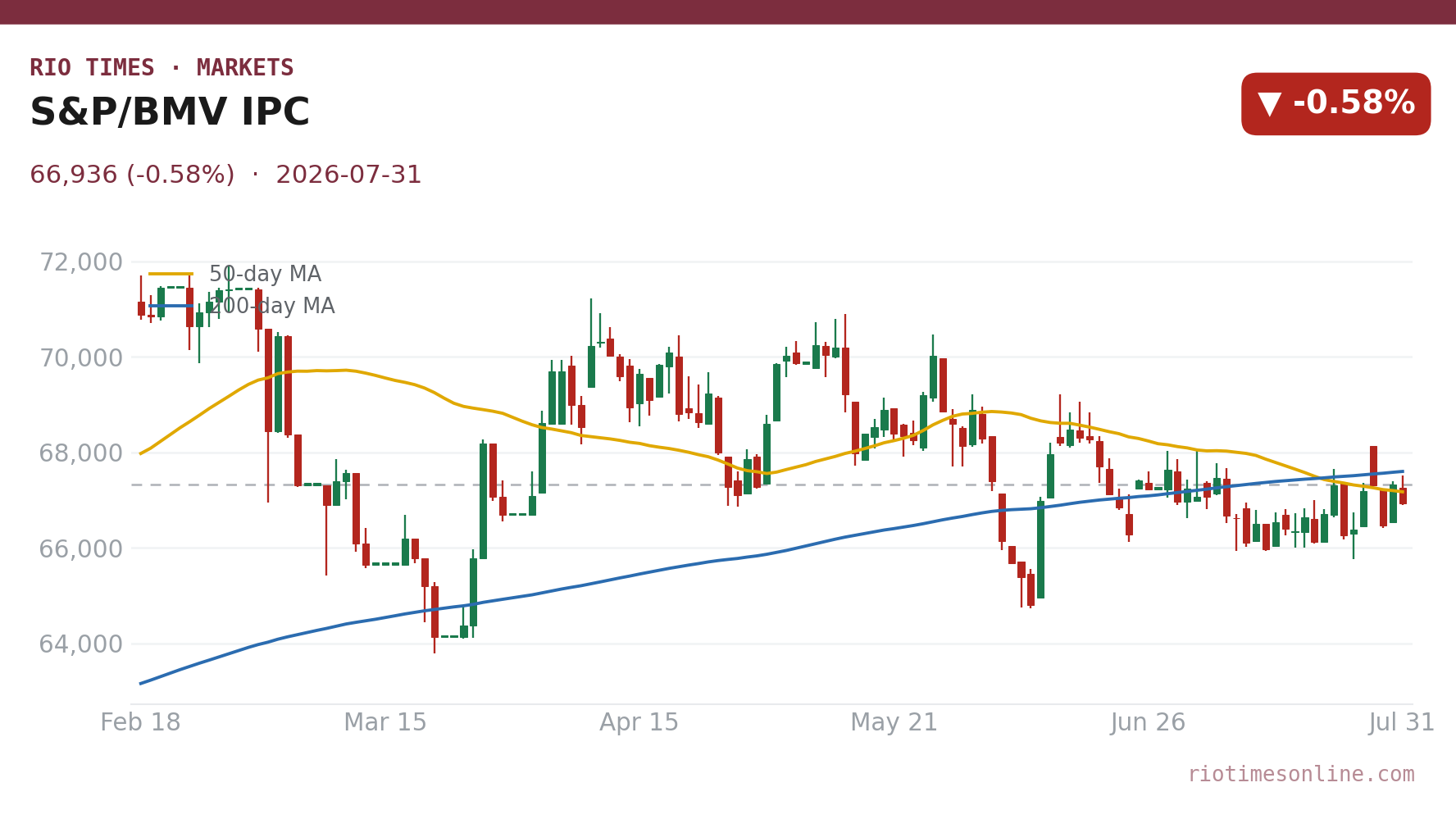
Mexico’s equity market finished the week on a soft note, with the benchmark S&P/BMV IPC — the barometer for the country’s largest shares — shedding 0.58% to settle at 66,936 points, unwinding most of Thursday’s 1.28% climb to 67,327. The decline stood in contrast to the upbeat mood on Wall Street, where the S&P 500 advanced 0.70%, suggesting the move was overwhelmingly a local affair.
The pain was concentrated among miners and infrastructure operators. Grupo México, the copper-and-rail heavyweight, fell 2.1% and accounted for a sizeable chunk of the index’s loss. Gold and silver miner Peñoles tumbled 2.3%, while airport group GAP dropped 1.5%, showing that the selling cut across both raw materials and transport-linked names.
There were pockets of strength. Retailer and bottler Femsa added 0.8%, breadmaker Bimbo rose 1.9%, and telecom giant América Móvil, controlled by Carlos Slim, managed a 0.4% gain on solid turnover of 36 million pesos (about US$2.1 million) — defensive, domestic-demand names that often attract buyers when global cyclical trades wobble.
The currency market told its own, calmer story. The Mexican peso firmed by 0.09% to 17.328 per US dollar, edging deeper into territory that has the currency trading near its strongest levels of the past twelve months. For foreign investors holding Mexican equities, the tiny move in the peso was a negligible effect on the day’s total return.
The evidence points to a sector-specific unwind rather than a shift in sentiment towards Mexico as a whole. The peso actually strengthened, and consumer staples like Bimbo and Femsa posted gains, which is not the behaviour one would expect in a genuine risk-off session for the country. The absence of heavy selling in heavily traded banks such as Banorte, which slipped only 0.2%, further suggests the move was driven by commodity traders trimming positions rather than a macro call. The variable to watch is whether the peso can sustain levels below 17.4 per US dollar into the central bank’s August meeting; a sustained break below that threshold would signal a genuine improvement in the Mexican carry-trade story.
02 The day’s numbers
| Measure | Level | Change | Read |
|---|---|---|---|
| S&P/BMV IPC | 66,936 | −0.58% | A soft end to the week for Mexico’s main stock gauge |
| USD/MXN | 17.328 | −0.09% | The peso ticked firmer, staying near its strongest 52-week levels |
| 52-week high (IPC) | 71,601 | — | The index sits 6.5% below its yearly peak |
| 52-week low (IPC) | 60,774 | — | Trading well above the trough, keeping the medium-term trend intact |
The index’s 0.58% decline kept it inside a range that has held for weeks, roughly between 66,500 and 68,000 points. The 52-week picture remains one of consolidation: the IPC is 6.5% below its high of 71,601 but a comfortable 10% above its low of 60,774, giving chart-watchers little reason to call the longer-term trend into question.
On the currency side, the peso’s −0.09% move means the dollar became marginally cheaper for Mexican importers. A rising peso — or a falling USD/MXN rate — is often interpreted by local investors as a vote of confidence in Mexico’s relative stability and attractive interest rates. Rio Times · Live Market Intelligence
Live Market IntelligenceMexico — Live Market Board
Mexico — Live Market Board
Instrument Last Change YoY Prev. High Low Volume
IPC MEX
63,507.11
-1.11%
+12.17%
64,216.98
66,121
65,405
108,886,187
USD/MXN
17.06
-0.24%
-8.58%
17.10
17.08
17.01
—
WALMEX
48.07
-0.62%
-14.38%
48.37
48.65
48.02
10,781,446
GMEXICO
223.28
+0.35%
+73.59%
222.50
226.18
222.17
1,325,556
FEMSA
201.19
-0.24%
+25.67%
201.67
206.71
199.56
750,706
CEMEX
19.32
+0.89%
+19.10%
19.15
19.35
19.04
14,327,054
GFNORTE
193.98
+1.18%
+14.36%
191.71
195.79
191.83
1,579,115
BIMBO
60.98
-0.96%
+11.89%
61.57
61.46
60.29
1,048,115
TELEVISA
9.71
+0.21%
+12.78%
9.69
9.75
9.60
577,851
AMX
19.80
-0.95%
+12.53%
19.99
20.05
19.70
58,058,525
GAP
366.23
+0.43%
-21.21%
364.68
370.85
362.82
226,946
ASUR
275.04
+1.25%
-15.28%
271.64
275.08
271.31
15,451
OMA
233.50
+0.62%
-6.48%
232.06
235.00
230.62
555,693
KOF
188.04
+0.86%
+18.94%
186.44
188.56
185.52
425,273
GRUMA
252.90
+0.11%
-21.85%
252.61
254.74
250.36
90,048
KIMBER
39.74
+0.43%
+8.85%
39.57
40.09
39.33
490,551
AMX ADR
23.38
-0.23%
+22.25%
23.43
23.49
23.06
1,347,445
Live Company IntelligenceGrupo México S.A.B. de C.V — the full investor dossier
Valuation & profitability
Price & risk
$123.9552-wk high
$238.91
Revenue trend · 6y
Ownership
Dividend
03 Why it moved — a mining-led drag on a thin Friday
The culprit list was short and pointed squarely at the materials sector. Grupo México’s 2.1% drop was the single largest weight on the benchmark index. The company, one of the world’s biggest copper producers, tends to trade as a proxy for global growth expectations, and any chill in the outlook for industrial metals feeds directly into its share price. Supply-side pressure is building too, with Chile posting its weakest second-quarter copper output since 2007.
Precious metals offered no cushion. Peñoles fell 2.3% despite gold’s reasonably firm footing in international markets, suggesting that traders were paring local exposure for reasons beyond the commodity price itself. With the broader metals complex lacking a clear direction into month-end, some investors appeared to be trimming risk into the weekend.
The homegrown consumer side, however, hummed along quietly. Bimbo’s 1.9% rise extended a run of relative strength for a stock that benefits from stable domestic consumption. Femsa’s 0.8% gain added weight to the idea that Friday’s move was a rotation away from commodity-cyclical names and into defensive shares that generate much of their revenue in Mexican pesos.
04 The day’s movers
| Driver | Level / Move | Change | Note |
|---|---|---|---|
| CEMEXCPO (Cemex) | Most-traded of the day | +1.6% | Heavy turnover of 1,868m pesos (US$108m); bucked the wider market’s weak tone |
| GMEXICOB (Grupo México) | Single largest drag on the IPC | −2.1% | Turnover 73m pesos (US$4.2m); copper-exposed miner weighed heavily |
| PE&OLES | Biggest laggard among large-caps | −2.3% | Gold and silver miner fell despite firm precious-metal prices |
| GAPB (Pacific airports) | Heaviest airport loss | −1.5% | Airport operators fell in sympathy with infrastructure wobbles |
| BIMBOA | Top domestic gainer of the day | +1.9% | The bread and snacks giant bounced on defensive rotation |
| FEMSAUBD (Femsa) | Consumer heavyweight posts gains | +0.8% | OXXO owner outperformed as investors rotated away from cyclicals |
The turnover leaderboard was instructive. Cemex, the cement maker that draws heavy international interest, was the most-traded name on the local board, where it is quoted as CEMEXCPO, with nearly 1.9 billion pesos (about US$108 million) changing hands, and its shares rose 1.6% — a rare bright spot in the industrial space. The gain suggested that some global investors were still willing to back Mexican construction-linked names.
But the broad sweep of the active list was negative. Of the eight most-traded stocks tracked in the scan, five posted declines. Quálitas, the insurance firm trading as ‘Q’, dropped 1.7% while Walmex edged down 0.2% — small moves, but enough to show that the session lacked conviction across the board.
05 The regional scoreboard
| Index | Country | Change |
|---|---|---|
| S&P/BMV IPC | Mexico | −0.58% |
| Ibovespa | Brazil | +0.47% |
| IPSA | Chile | −0.13% |
| Merval | Argentina | −0.41% |
| COLCAP | Colombia | +2.12% |
Mexico was not alone in finishing lower, but its decline was the most pronounced in the larger regional markets. Brazil’s Ibovespa, the main gauge for Latin America’s biggest economy, added 0.47%, while Colombia’s COLCAP surged 2.12%, making Mexico the outlier among the heavyweight markets. Argentina’s Merval slipped 0.41% and Chile’s IPSA fell a very modest 0.13%, both in the same gently negative territory but without the concentrated mining drag that characterised the Mexican session.
The regional picture was mixed enough that no single Latin American narrative seemed to be at play. Instead, country-specific currents dominated: Colombia continued to ride a wave of positive sentiment, Brazil traded on its own rate-cut dynamics, and Mexico was held back by a handful of large-cap commodity names.
06 The technical picture
At 66,936, the S&P/BMV IPC is trading in the middle of a well-established range, a full 6.5% below its 52-week high of 71,601 but comfortably above the 60,774 trough. The level does not, in itself, set off alarms — the index has spent weeks inside this band, and a 0.58% daily move barely registers on the volatility scale.
What chart-minded traders will be watching is whether support around 66,500 holds in the coming sessions. A breach of that floor could signal a retest of the psychologically important 65,000 mark. On the upside, the index needs to clear 68,000 with conviction to bring the 52-week high back into view. For now, the weight of the evidence says the market is in a holding pattern, waiting for a catalyst — perhaps from the central bank’s August meeting — to decide its next meaningful direction.
07 What to watch
- Banxico’s August meeting: The central bank’s next policy decision and its statement could shift interest-rate expectations and, with them, the peso and rate-sensitive bank stocks.
- Commodity prices: Copper and gold moves will remain the key driver for heavyweights Grupo México and Peñoles, which anchored Friday’s losses.
- US trade sentiment: Any shift in the mood around US-Mexico trade relations, especially as the US political season heats up, could quickly ripple through the IPC.
- Defensive rotation persistence: Whether buying in Bimbo, Femsa and América Móvil continues will tell us if traders are positioning for a deeper cyclical slowdown or merely taking profits.
Background: Vesta Rides Nearshoring to a Stronger Second Quarter.
Background: Televisa Second Quarter: US$28M Loss as Sky Bleeds, ViX Grows.
More: Mexico news in English, every day from The Rio Times.
Frequently Asked Questions
Why did Mexico’s IPC index fall on July 31, 2026?
The IPC slipped 0.58% to 66,936 points, with the damage concentrated in mining and infrastructure. Grupo México fell 2.1% and Peñoles lost 2.3%, together outweighing gains in defensive names such as Bimbo and Femsa. Because the peso firmed and consumer stocks rose, the session read as a rotation out of commodity cyclicals rather than a broad retreat from Mexican risk.
What is the IPC index and why is it so concentrated?
The IPC is Mexico’s benchmark equity index, tracking roughly 35 of the most liquid shares on the Bolsa Mexicana de Valores in Mexico City. It is weighted towards a handful of very large companies, which is why single names such as Grupo México or América Móvil can move the entire index on an otherwise quiet trading day.
Is the Mexican peso at 17.328 strong or weak?
At 17.328 per US dollar the peso is trading near its firmest levels of the past twelve months, and it added 0.09% on the session. A lower USD/MXN number means each peso buys more US dollars. Steady demand reflects Mexico’s relatively high interest rates, which make the peso a favoured carry-trade currency.
Which Mexican stock was the most traded on July 31, 2026?
Cemex, quoted locally on the Bolsa Mexicana de Valores as CEMEXCPO, led turnover with about 1,868 million pesos (US$108 million) changing hands, and its shares rose 1.6%. That made the cement maker a rare bright spot in an otherwise weak industrial complex, and it suggested foreign buyers were still willing to back Mexican construction names.
Sources: Bolsa Mexicana de Valores, Banco de Mexico
This article was produced by The Rio Times’ automated newsroom system. How we use AI · Report an error
In depth
LatAm Markets: Live Signals → — real-time movers, turnover leaders and FX across Latin America.
Read More from The Rio Times