Brazil’s Gripen F Makes Its First Flight With an Air Force Pilot Aboard
Brazil · DEFENCE
Key Facts
- —First flight The Gripen F first flight ran 40 minutes from Linköping on 28 August 2026.
- —Crew Saab’s Jakob Högberg flew with Brazilian Air Force test pilot Abdon de Rezende Vasconcelos.
- —Order Brazil contracted 36 jets in 2014, 28 single-seat F-39E and eight two-seat F-39F.
- —Budget The 2026 federal line for the programme is about R$2.1 billion (US$403.8 million).
- —Schedule The last of the 36 aircraft is now due for delivery in 2032.
The Gripen F first flight opens a test campaign that must finish before the jet reaches Brazil.
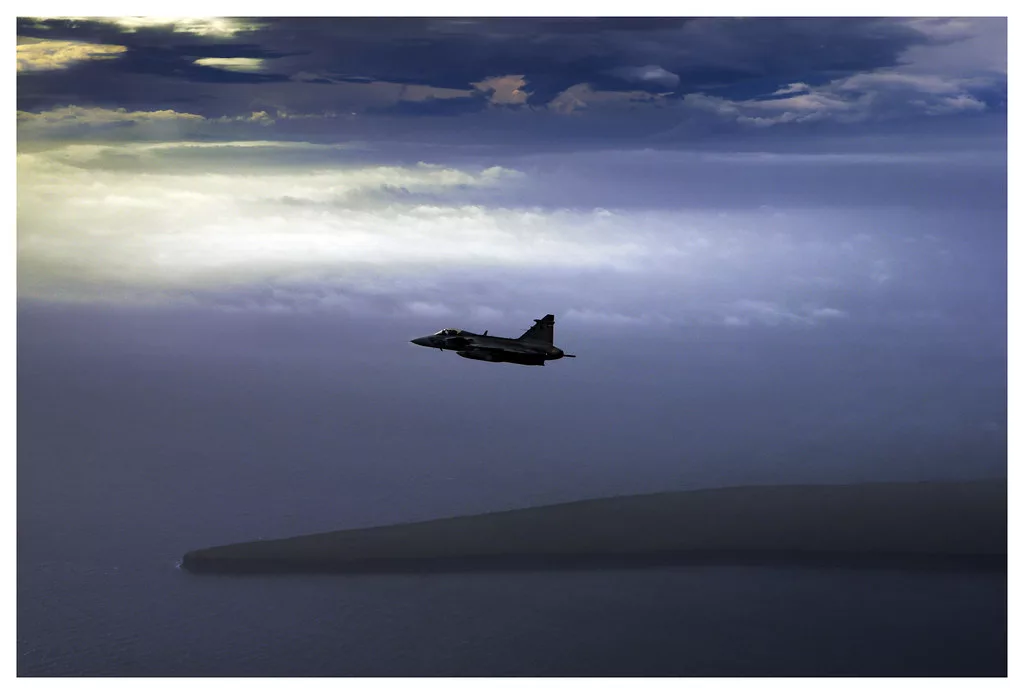
Saab flew the two-seat Gripen F for the first time on Friday, with a Brazilian Air Force test pilot aboard. The sortie lasted 40 minutes from the company airfield at Linköping in Sweden.
What Saab confirmed about the Gripen F first flight
The aircraft took off at 09:40 local time and stayed airborne for 40 minutes, Saab said. The sortie checked the fighter’s core systems and its initial flight performance.
Saab chief test pilot Jakob Högberg flew the aircraft with Brazilian Air Force test pilot Lieutenant Colonel Abdon de Rezende Vasconcelos. The company did not publish the airframe’s registration, nor the altitudes and speeds flown.
No matching notice appeared on the Brazilian Ministry of Defence news pages on the day of the flight. Brazilian aviation titles carried the same departure time and the same two pilot names.
Cavok, a Brazilian aviation outlet, reported the same 09:40 departure and roughly 40 minutes aloft. It described the Gripen F first flight as the opening of a wider test campaign.
Saab’s release carries the reference CU 26-034 and links to video of the departure. It gives no serial number for the airframe, a detail Brazilian outlets also left out.
Why the two-seat version matters to Brazil
The Gripen F is the two-seat version of the single-seat Gripen E, built to Brazilian requirements. It shares sensors, avionics, mission systems, weapons and logistics with the aircraft already in service.
Saab says the second cockpit lets a crew divide the workload during complex missions. The rear seat can manage sensors, mission systems and weapons rather than simply carrying an instructor.
For the Air Force the aircraft shortens the path from a training aeroplane to a front-line fighter. Pilots convert on the same platform they will fly in combat, cutting the need for an interim jet.
Brazilian reporting says the two-seater drops the 27 millimetre Mauser cannon carried by the single-seat version. The space it occupies is needed for the systems that sit behind the second cockpit.
Where the F-39 programme stands today
Brazil signed with Saab in 2014 for 36 aircraft, 28 single-seat F-39E and eight two-seat F-39F. Saab announced the deal at 39.3 billion Swedish kronor (about US$4.05 billion at 2014 values).
Ten aircraft were in service by late 2025, with one more kept for test work in Brazil. The first jet assembled in the country, registered FAB 4109, was rolled out in March 2026 as the twelfth.
The single-seaters fly with the 1st Air Defence Group at Ala 2, the Anápolis wing in Goiás. That unit, known as the Jaguar Squadron, shares the base with Embraer KC-390 transport aircraft.
Sweden builds 13 single-seaters and all eight of the two-seaters, according to Brazilian trade reporting. The other 15 single-seat jets are assembled at Embraer’s plant in Gavião Peixoto, São Paulo.
The Air Force has already flown the type abroad, sending six F-39E jets across the Andes to Chile this year. That deployment, for the Salitre 2026 exercise, was the fighter’s first large multinational outing.
The Embraer assembly line at Gavião Peixoto
Gavião Peixoto holds the only Gripen production line outside Sweden, according to Saab’s own account. The site also hosts the Gripen design and development centre that opened there in 2016.
President Luiz Inácio Lula da Silva attended the March rollout of the first Brazilian-built fighter. Defence Minister José Múcio Monteiro and the Air Force commander were also at the ceremony.
Saab counts more than 350 Brazilian engineers, technicians and pilots trained under the programme. Embraer, Akaer and AEL Sistemas work on structures, systems integration and onboard electronics.
The two-seat variant itself is built only in Sweden, so the Gripen F first flight was always going to happen there. Brazilian engineers nonetheless worked on its structure and on its systems.
Money, amendments and a schedule that slipped to 2032
The contract has been amended twelve times, the Air Force told senators in September 2025. The original plan closed deliveries in 2024, yet the last aircraft is now due only in 2032.
Air Force chief of staff Walcyr Josué de Castilho Araújo told the committee that budgets fell short of the contract. He set out one delivery in 2026, four in 2027 and five in 2028.
The 2026 federal budget carries about R$2.1 billion (US$403.8 million) for the fighter programme. Roughly R$800 million (US$153.8 million) of that sum was blocked under this year’s fiscal squeeze.
Both conversions use the Banco Central do Brasil PTAX selling rate of R$5.2005 to the dollar on 28 August 2026. PTAX is the central bank’s official daily reference rate for the real.
The Air Force extended the life of its Northrop F-5 fleet to cover the gap left by the delays. Those older jets reached 50 years of Brazilian service during 2025.
When Brazil expects to fly the aircraft at home
Saab says the aircraft now enters production acceptance flights, then a step-by-step expansion of its flight envelope. Speed, altitude, G-load and angle of attack limits will be cleared in stages.
Rear cockpit functions and the tactical capabilities specific to the two-seater will be assessed in parallel. The campaign runs from the company’s flight test centre in Sweden.
An Air Force briefing in April 2026 put the arrival of the first two-seater in Brazil in 2028. The Gripen F first flight therefore opens a test phase lasting roughly two years.
Once it arrives, the Air Force plans to move pilots straight from the A-29 Super Tucano to the Gripen. That would remove the need for an intermediate lead-in fighter trainer aeroplane.
A possible second batch of twenty aircraft
Embraer and Saab signed a head of agreement in July 2026 to study building 20 more Gripen fighters. The work would go to Gavião Peixoto, complementing the existing line at Linköping.
The companies stressed that nothing is ordered until the Air Force signs a further contract amendment. Such a deal would take the Brazilian fleet to 56 aircraft.
The Air Force has told Congress that 36 fighters are not enough for a country of continental size. It puts the operational requirement at 66 aircraft.
For now the Gripen F first flight is the programme’s clearest step forward in a difficult budget year. Delivery to Brazil, and any second batch, both remain some way off.
Frequently Asked Questions
When and where did the Gripen F first flight take place?
It took place on 28 August 2026 at Saab’s airfield in Linköping, Sweden. The aircraft took off at 09:40 local time and flew for 40 minutes.
Who was in the cockpit for the flight?
Saab chief test pilot Jakob Högberg flew with Brazilian Air Force test pilot Lieutenant Colonel Abdon de Rezende Vasconcelos. Saab did not publish the aircraft’s registration.
How many Gripen fighters has Brazil ordered and received?
Brazil contracted 36 aircraft in 2014, 28 single-seat and eight two-seat. Ten were in service by late 2025, plus one more kept for testing.
Connected Coverage
Brazil’s 2027 Budget Promises a Primary Surplus of 0.1% of GDP
Sources
- www.saab.com
- www.cavok.com.br
- aeroin.net
- aeroin.net
- aeroin.net
- www.cavok.com.br
- www.cavok.com.br
- www.cavok.com.br
- www.cavok.com.br
- olinda.bcb.gov.br
This article was produced by The Rio Times’ automated newsroom system. How we use AI · Report an error · Editorial responsibility: Matthias Camenzind, Editor-in-Chief