Brazil Supreme Court Justice Clears Abortion Ad Against Moro Before Paraná Vote

POLITICS · BRAZIL
Key Facts
- —The country Brazil votes on Sunday 4 October for president, Congress and state governors. In Paraná, a southern farm and industry state, former judge Sergio Moro leads the governor’s race.
- —What happened On Saturday 3 October, Supreme Court (STF) Justice Gilmar Mendes overturned two orders from the head of Paraná’s electoral court that gave Moro a right of response and pulled a rival’s ad.
- —Who is involved Moro (PL) faces Sandro Alex (PSD), backed by Governor Ratinho Junior. Alex’s ads quote Moro’s 2002 doctoral thesis, which called the compromise in the US Roe v. Wade ruling “reasonable”.
- —What it means for you Alex’s TV spot and Instagram posts may run again on the last day of campaigning. Moro no longer gets reply time, and he denies favouring legal abortion.
- —Still open Whether Moro challenges the decision before polls open, and whether the full Supreme Court ever reviews a ruling taken by one justice alone.
A Brazil Supreme Court justice has cleared an abortion ad against Sergio Moro, one day before Paraná elects its governor. Justice Gilmar Mendes on Saturday 3 October cancelled Moro’s right of response and let his rival’s spots return.
Moro, a right-wing PL senator and former anti-corruption judge, leads the polls but faces pressure from Sandro Alex of the PSD. Alex’s campaign used a line from Moro’s 2002 doctoral thesis to suggest he favours legal abortion, which Moro denies.
How the abortion ad reached the Supreme Court
Alex’s TV spot and Instagram posts carried the slogan “Abortion = reasonable solution”, G1 and O Globo reported. They quote Moro’s thesis, written at the Federal University of Paraná, on the US Supreme Court’s 1973 Roe v. Wade ruling.
There, Moro called the decision an “intermediate solution to the abortion question” and said the attempt to reconcile views “is not unreasonable”. The US Supreme Court overturned Roe v. Wade in 2022.
Moro’s coalition asked the Paraná Regional Electoral Court (TRE-PR), which runs the state’s vote, for a right of response. Its full bench refused, treating the posts as political criticism, according to G1 and the legal news site ConJur.
On Friday 2 October, court president Luciano Carrasco Falavinha Souza granted the requests in single-judge orders. He required a reply video pinned for at least 14 hours, under a R$15,000 (about US$2,870) fine, O Globo reported.
A second order suspended Alex’s TV spot under a R$50,000 (about US$9,580) penalty. Conversions use R$5.22 per US dollar, the close of 2 October.
A tight race on the eve of the vote
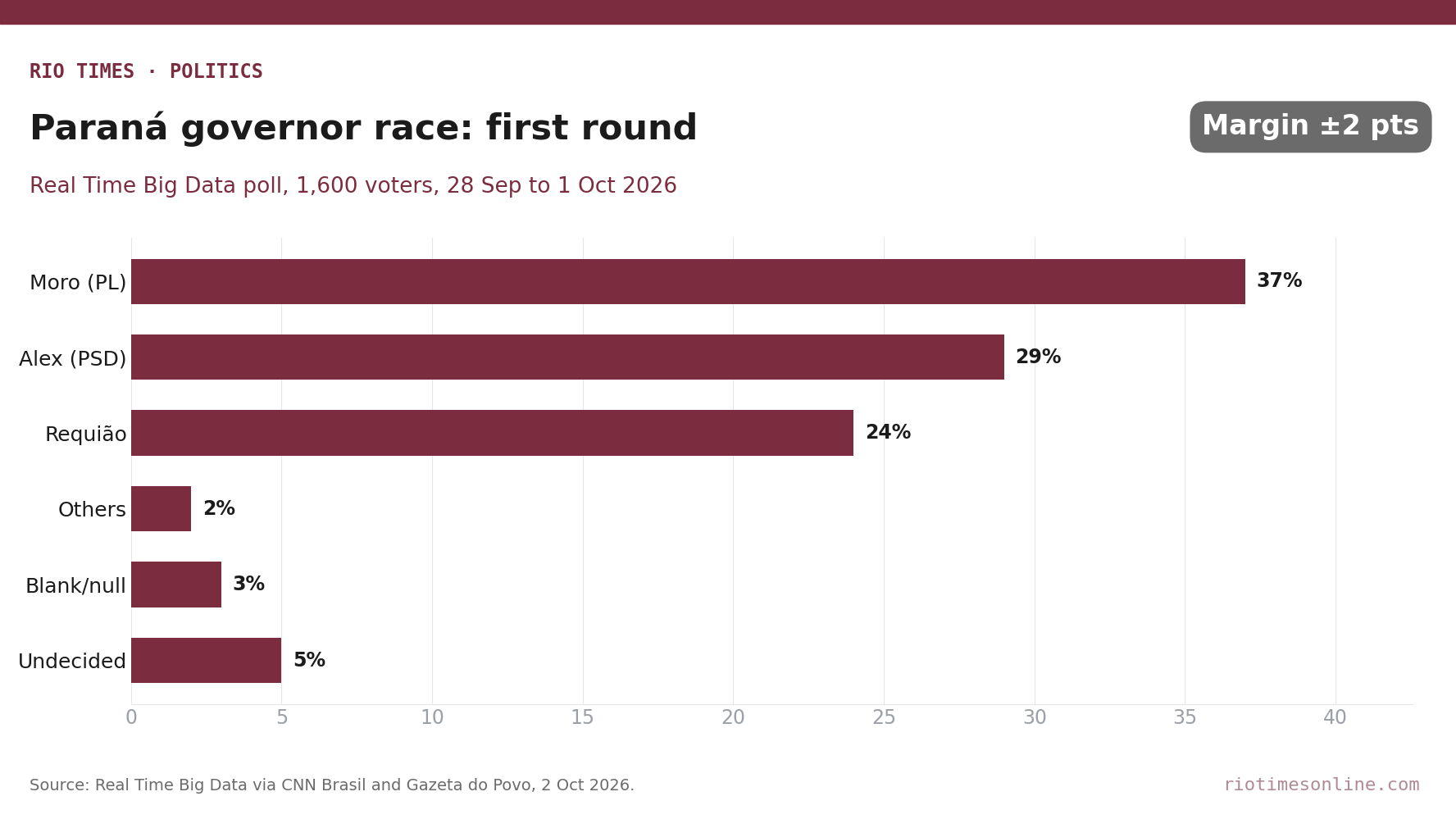
A Real Time Big Data poll of 1,600 voters, taken from 28 September to 1 October, put Moro on 37 percent. Alex had 29 percent, and Requião Filho of the centre-left PDT was on 24 percent, CNN Brasil and Gazeta do Povo reported.
In a simulated runoff, Moro and Alex tied on 42 percent each, with a two-point margin of error. A Quaest poll published on 24 September had Moro on 36 percent and both rivals on 20.
Alex has gained ground since mid-September polling showed Moro well ahead. In Quaest’s runoff simulation, his gap to Moro shrank from 29 points in August to 14 in September, Valor reported.
What the justice decided, and how
Mendes, the court’s longest-serving member, annulled the TRE-PR president’s orders at Alex’s request. Criticism based on a candidate’s public and academic record belongs to democratic debate, he wrote, according to ConJur.
He found “no kind of disinformation” in the pieces, Estadão reported. The ruling does not say Moro supports abortion, the paper noted, only that the questions are fair campaign material.
Mendes also warned that courts must not turn the right of response into prior censorship. Those who disagree should answer the argument in public, he wrote.
Estadão reported that he ruled inside a case he has handled since May, first filed by PT deputy Zeca Dirceu. He used the same route to order Renan Santos into the Globo presidential debate that was later cancelled.
On Friday, Chief Justice Edson Fachin issued a resolution reinforcing random allocation of new requests among justices, the paper added. Paraná’s electoral court had already been drawn into this race over the utility Copel.
What Is Not Yet Known
Moro’s campaign had not responded to the ruling in the reports available by Saturday afternoon. It is unclear whether he will appeal, or whether the full Supreme Court will examine the decision.
Paraná’s voters decide on Sunday whether Moro wins outright or faces a runoff. Whether the late dispute over the abortion ad moves any votes will only show in the count.
Sources: O Globo, 3 Oct 2026; G1, 3 Oct 2026; ConJur, 3 Oct 2026; Estadão, 3 Oct 2026; CNN Brasil and Gazeta do Povo (Real Time Big Data poll), 2 Oct 2026; Valor (Quaest poll), 24 Sep 2026.
This article was drafted with automated assistance and reviewed before publication. How we use AI · Report an error · Editorial responsibility: Matthias Camenzind, Editor-in-Chief