Bolivia will raise the maritime issue again with the new Chilean government
RIO DE JANEIRO, BRAZIL – José Antonio Kast and Gabriel Boric competed for the presidency in a runoff election, the closest in Chile in the last 30 years. The extreme leftist emerged victorious with 55%, and now the Bolivian government announced Sunday that the Bolivian government announced Sunday it would raise the maritime issue again. Comrade to comrade, so to speak.
In an interview with the news portal Urgente.bo, the Plurinational State’s deputy foreign minister, Freddy Mamani, assured that they hope to build a common agenda based on trust and mutual respect between the two peoples, without disregarding Bolivia’s aspiration to access the Pacific Ocean.
“We want to build a common agenda of mutual trust and put all issues on our bilateral agenda with Chile; that is the premise. This includes the maritime issue, transboundary water resources, and free transit. That is our position as a country, enshrined in the political constitution of the state,” the vice-chancellor told this digital media.

“That is our position as a country, and the ruling of the Court in The Hague does not preclude a dialogue on the issues at hand based on the central dialogue,” Mamani added.
Bolivia and Chile opened a roadmap to resolve various bilateral issues, except the maritime case. On April 30 this year, Chilean Undersecretary of Foreign Affairs, Carolina Valdivia Torres, arrived in La Paz and met with Deputy Foreign Minister Freddy Mamani.
Valdivia and Mamani also signed a Memorandum of Understanding on Consular and Migration Cooperation and the Minutes of the XXII Meeting of the Administrative Commission of the ACE-22 Economic Complementary Agreement.
“We hope that with the new government that Chileans elect today, (…) the agenda related to the framework of bilateral relations can be worked on,” argued the Vice-Chancellor.
On March 23, 2021, as part of the celebration of the Day of the Sea, President Luis Arce announced Tuesday the resumption of dialogue with the Republic of Chile to plan the integration of Bolivia in the Pacific Basin.
On March 28, Foreign Minister Rogelio Mayta reported that Bolivia and Chile are restoring mutual trust to strengthen bilateral relations. He said that he had spoken with his Chilean counterpart, Andrés Allamand.
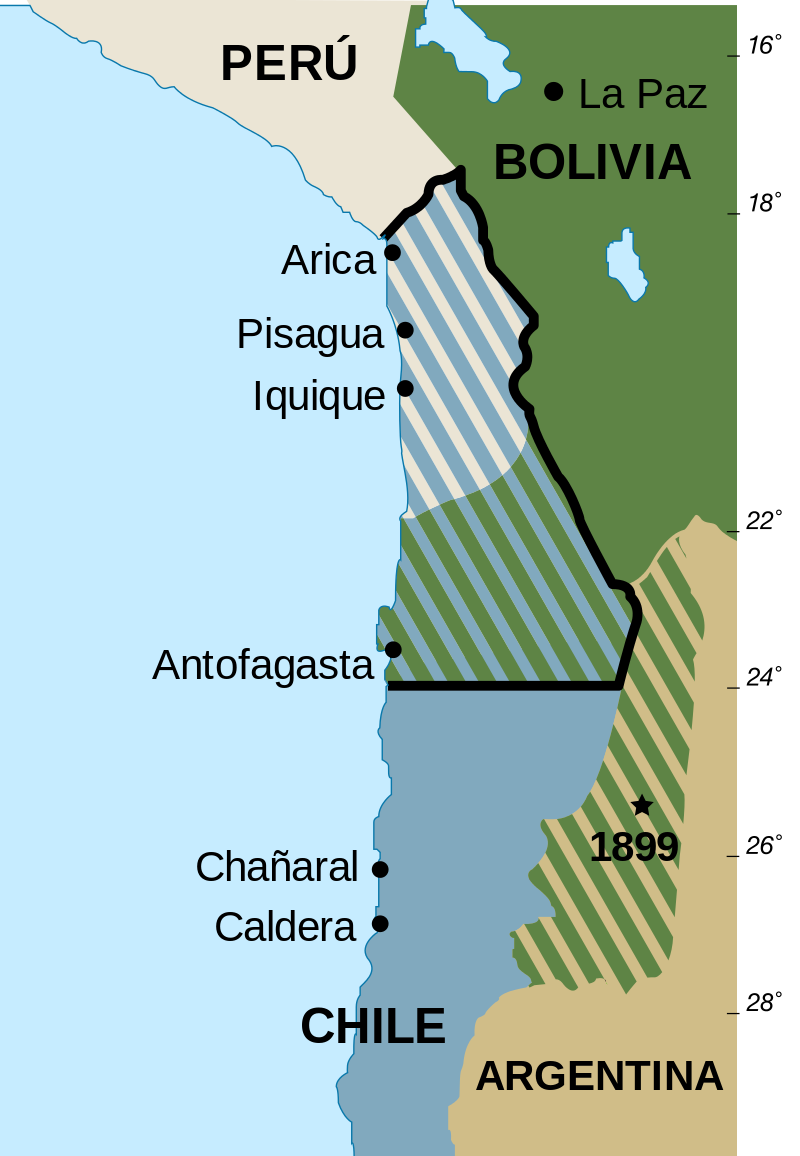
ORIGIN OF BORDER DISPUTE
In 1879, Bolivian dictator General Hilarión Daza increased the taxes on the exportation of saltpeter in violation of the 1866 treaty. When Chilean-owned saltpeter companies refused to pay, Daza expropriated the companies and sold them in a public auction.
Daza then put an end to all commerce with Chile and exiled all Chilean residents in Bolivia (the Bolivian port of Antofagasta had more Chileans than Bolivians).
In response, Chile declared the border treaties null and reactivated its old claim that Chile had inherited a land border with Peru using the uti possidetis principle. Chile disembarked troops at Antofagasta the day of the auction.
Later, Chile declared war on Bolivia and occupied Bolivia’s coast. Peru had, in 1873, signed a secret pact with Bolivia in which the two countries agreed to fight together against any nation that threatened either of them.
When Peru refused to be neutral in the conflict between Chile and Bolivia, Chile declared war on Peru. Chile defeated both countries and annexed the coast claimed by Bolivia.
This was ratified by Peru in the Treaty of Ancón (1883) and by Bolivia in a Treaty of Peace and Friendship signed in 1904.
More: Bolivia news in English, every day from The Rio Times.
This article was produced by The Rio Times’ automated newsroom system. How we use AI · Report an error · Editorial responsibility: Matthias Camenzind, Editor-in-Chief