
ECONOMY · BOLIVIA
Key Facts
- —The country Bolivia is a landlocked Andean country where a shortage of US dollars has squeezed importers, savers and fuel supplies since 2023.
- —Why it matters Gold is Bolivia’s main mining export, so where the sale proceeds end up shapes how many dollars reach the economy.
- —Why now President Rodrigo Paz signed Supreme Decree 5747 on Tuesday 13 October, and it appeared in the official gazette the same day.
- —What happened Gold exporters must prove that 80% of the value of earlier exports reached a regulated Bolivian bank before getting a new export form.
- —The numbers An 80% deposit share, 15 working days to write the detailed rules, and a quarterly review of the effects by the economy ministry.
- —What it means for you Foreign buyers of Bolivian gold face no export ban, but sellers must route more of their dollars home before each new shipment.
- —Still open The central bank and the minerals registry still have to issue the detailed rules, and the 80% share can be changed by ministerial resolution.
- —Power Index Bolivia ranks 12th of 14 in The Rio Times Latin America Power Index, with 28.4 points (October 2026 edition).
Bolivia gold exporters must bring 80% of the dollars from earlier sales back into the country’s banks before they can ship again. Supreme Decree 5747, signed by President Rodrigo Paz on Tuesday 13 October, makes this a condition for the official export form.
For US readers, the rule touches a metal priced in dollars on world markets and Bolivia’s main mining export. It also shows how a government short of hard currency is trying to keep more export earnings at home.
The official gazette published the decree on 13 October, and the radio network Erbol and news site Brújula Digital reported it Wednesday. It scraps a 2023 system under which exporters needed a gold export certificate from the Central Bank of Bolivia (BCB).
How the Rule Works for Bolivia Gold Exporters
Exporters must show that foreign currency worth 80% of the computable value of earlier gold exports reached their account. The account must be held at a lender supervised by ASFI, the regulator of Bolivia’s financial system.
Proof of that deposit becomes a condition for Form M-03, the single export form for minerals. It is issued by Senarecom, a state agency under the mining ministry that registers and controls mineral sales.
Exporters without a central bank certificate can make their first shipment without prior proof. They must then show that the dollars from that sale arrived before a later shipment is cleared.
Exporters who already hold a valid BCB gold export certificate can keep using it until it expires. After that, they must follow the new rule like everyone else.
The decree says the measure does not restrict the freedom to export, a right set out in a 1993 law. It presents the deposit instead as a way to trace the dollars that gold sales generate.
Why Bolivia Wants Its Gold Dollars Back
The decree says gold’s high value for its weight creates a specific risk of diverted value and opaque financial flows. Because gold is the country’s main mining export, the text argues, tracing its proceeds is justified.
The measure comes as the government lets the boliviano float, Erbol noted, after years of a fixed exchange rate. The BCB’s official rate was 11.70 bolivianos to the US dollar on Wednesday 14 October.
The decree also ends the central bank’s obligation to buy gold under the old certificates. It removes, too, any duty on exporters to sell gold to the BCB that arose from those documents.
Separately, the BCB said on Wednesday it had completed three gold forward sales agreed in 2025, worth US$872.5 million, Brújula Digital reported. The last delivery, 1.2 tonnes worth US$155.4 million, was made on Friday 9 October.
Gold, Reserves and the Dollar Squeeze
A gold law passed in May 2023 let the BCB buy domestic gold and use its gold reserves in international operations. Between May 2023 and April 2026 the bank bought 38.2 tonnes, according to Fundación Jubileo, a Bolivian research foundation.
Even so, gold in the reserves fell from 43.05 tonnes in April 2023 to 23.5 tonnes in April 2026, Jubileo found in its analysis of central bank data. El Deber, a daily from Santa Cruz, reported the study on Monday 12 October and noted that the BCB later put its gold at 24.3 tonnes at the end of August.
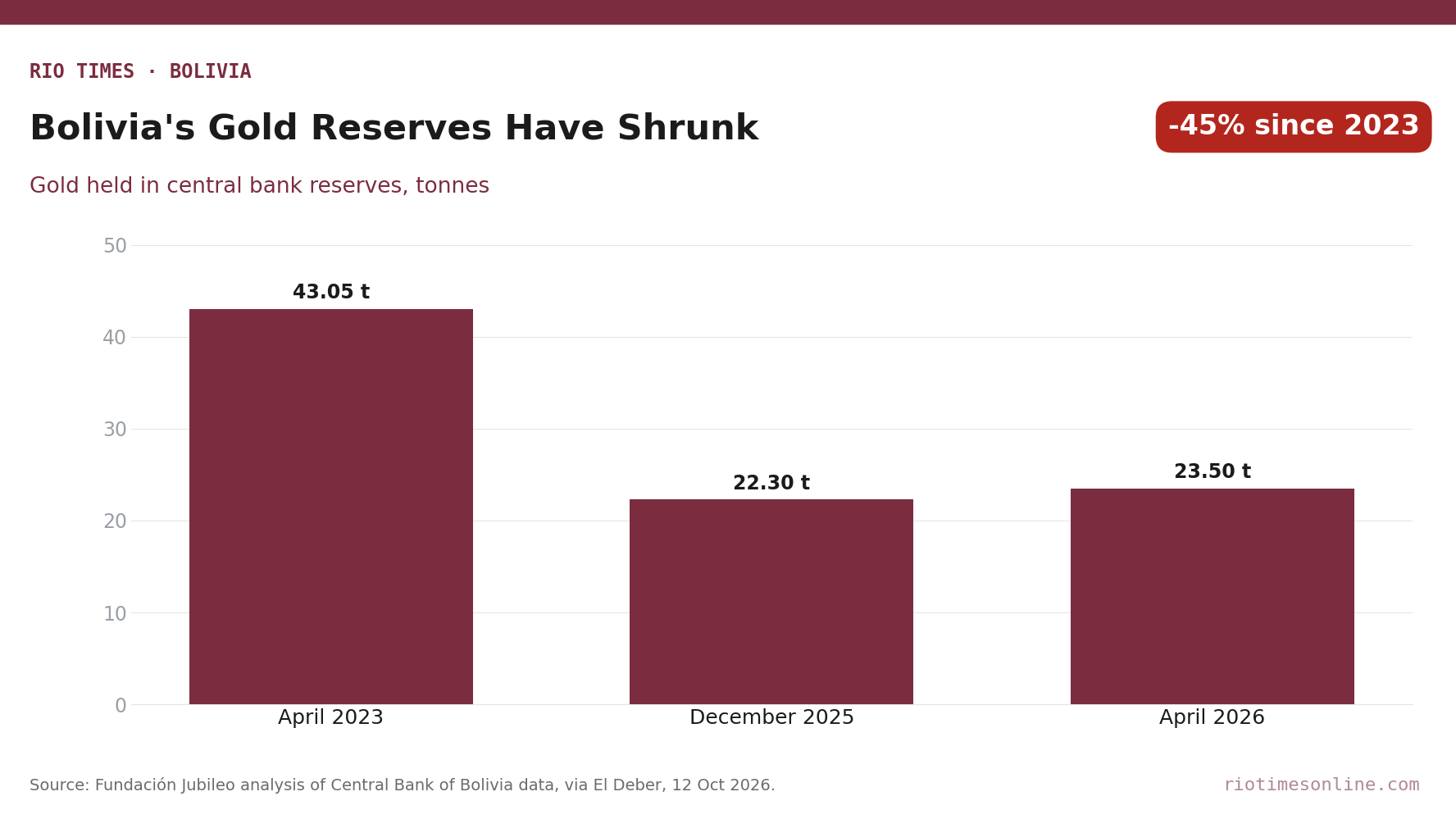
Jubileo concluded that the gold sales eased the dollar shortage but did not fix the imbalances that caused it. Part of the dollars raised went to pay for fuel imports, according to its report.
Our earlier report, Bolivia Reserves Rise 8.7% to US$3.93 Billion on Gold, followed the central bank side of this story. The new decree targets a different flow, the private dollars that exporters earn abroad.
What It Means for You
For US investors and traders, the decree neither bans gold exports nor sets a price. It adds a paperwork step that ties each new shipment to proof that earlier dollars reached Bolivian banks.
Refiners and buyers abroad may find Bolivia gold exporters timing shipments around those deposits. More dollars in local banks would also matter to companies that import goods or pay suppliers in Bolivia.
For the bigger picture, read Bolivia in 2026 Explained, From Fuel Crisis to IMF Deal. Our profile of President Rodrigo Paz covers the leader who signed the decree.
Visitors and residents will find practical guidance on our La Paz city page. La Paz is the seat of government, where the decree was signed at the Government Palace.
What Is Not Known
The detailed rules are still missing, since the BCB and Senarecom have up to 15 working days to issue them. It is not yet clear how the computable value of each export will be measured and checked.
The government has not published an estimate of how many dollars the rule could bring home. The economy ministry can change the 80% share by ministerial resolution and will review the effects every quarter.
It is also unclear whether the rule will reduce registered gold exports, which that quarterly review is meant to measure. Reactions from Bolivia gold exporters and mining cooperatives had not been published by Wednesday afternoon.
Frequently Asked Questions
What does Bolivia’s Supreme Decree 5747 require?
Gold exporters must prove that 80% of the value of earlier exports was credited to an account at a regulated Bolivian lender. That proof is needed to obtain Form M-03 for the next shipment.
Does the decree ban gold exports?
No, the decree says it does not restrict the freedom to export. It adds proof of the dollar deposit as a condition for the export form.
When was the decree issued?
President Rodrigo Paz signed it on Tuesday 13 October 2026, and it was published in the official gazette that day. The central bank and Senarecom have up to 15 working days to issue the detailed rules.
Can the 80% share change?
Yes, the Ministry of Economy and Public Finance can adjust it by ministerial resolution. The ministry will also review the effects of the measure every quarter.
What happens to the old gold export certificates?
Valid central bank certificates can be used until they expire, after which holders must follow the new rule. The 2023 decree that created them has been repealed.
Sources: Gaceta Oficial de Bolivia, Supreme Decree 5747 (13 Oct 2026) · Central Bank of Bolivia, official exchange rate · Erbol · Brújula Digital, gold decree · Brújula Digital, BCB gold forwards · El Deber, Jubileo gold analysis · Economy
This article was produced by The Rio Times’ automated newsroom system. How we use AI · Report an error · Editorial responsibility: Matthias Camenzind, Editor-in-Chief
In depth