Bitcoin Falls to US$62,814 as Risk-off Hits Crypto
Key Facts
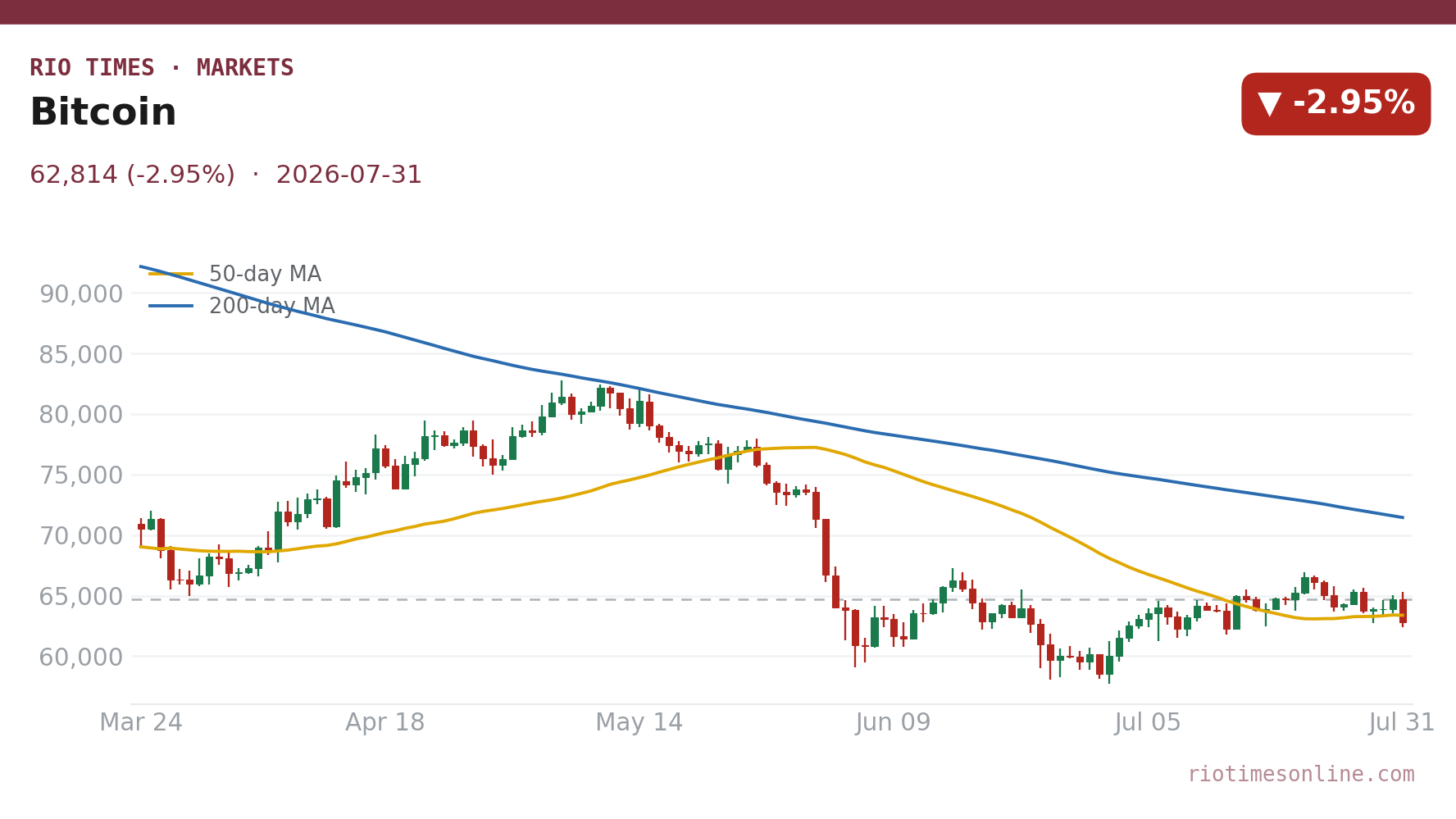
- Bitcoin fell 2.95% to US$62,814 in Friday’s settled session, leading a broad retreat across the crypto board as traders reacted to rising global rate expectations.
- Ethereum dropped 2.97% to US$1,860, extending a slide from earlier 2026 levels above US$2,300 that has erased gains for late-year buyers.
- Solana lost 2.25% to US$72.79 and XRP shed 2.15% to US$1.0605, showing altcoins moving in near lockstep with Bitcoin as risk appetites soured.
- Futures and options positions dominated the sell-off, as leveraged traders cut exposure to Bitcoin derivatives that had built up during a brief rally earlier in July.
- Dollar-pegged stablecoins such as USD Coin saw increased buying from Argentine savers, who use the 1:1 redeemable tokens to bypass national currency controls and inflation.
- El Salvador still holds and expands its Bitcoin reserves, though bitcoin ceased to be legal tender there in 2025 and the economy runs on the US dollar, with remittance providers using the Lightning network to undercut traditional operators charging more than 5% per transfer.
Today’s Focus
Bitcoin’s 2.95% drop to US$62,814 on Friday capped a week where every major tracked token fell between 2.15% and 2.97%. The move was driven by futures traders unwinding leveraged bets after a short-lived rally in early July reversed, with crypto acting as a high-beta proxy for United States interest-rate sensitivity. Ethereum tracked the same pattern, its price hitting US$1,860 as gas-fee heavy DeFi platforms saw reduced activity.
For Latin America, the session’s price action is secondary to what it signals about stablecoin dependence. In Argentina, where citizens face strict limits on dollar purchases, USD Coin volumes on Buenos Aires exchanges rose as locals parked pesos in the dollar-pegged asset. Brazilian fintechs embedded in apps such as Nubank continued offering direct Bitcoin exposure to millions, while the central bank’s Drex digital-real pilot advanced in São Paulo, testing blockchain settlement without relying on volatile public tokens.
El Salvador’s bitcoin experiment remains a live one, watched closely from abroad, even after bitcoin lost its legal-tender status in 2025. Most daily commerce still runs on the US dollar, but Lightning Network remittance corridors from the United States are shaving costs for families who previously paid traditional operators over 5% in fees. XRP’s role in the same corridors is growing as Ripple’s software attracts banks in the Americas that want seconds-long settlement times.
Foreign investors eyeing the region should see Friday’s 2-3% drops less as a crypto story and more as a reminder that these tokens now trade like leveraged tech stocks. The deeper narrative is Latin America’s accelerated adoption of stablecoins as dollar substitutes, a structural trend that continues through every Bitcoin price swing.
What matters today. Bitcoin fell in step with rate-sensitive equities, but the underlying Latin American story is a steady migration toward dollar-pegged stablecoins for savings, payments and remittances.
01 The session in one read
Every major tracked crypto token fell between 2.15% and 2.97% on Friday, a synchronised pullback that erased the small early-July bounce and pulled Bitcoin to US$62,814. The sell-off mirrored losses in growth stocks and came from derivatives desks unwinding positions rather than spot holders dumping coins.
Traders who had piled into Bitcoin futures after a 2% single-day rise in early July reversed those bets when United States rate expectations firmed, dragging Ethereum to US$1,860, Solana to US$72.79 and XRP to US$1.0605. Stablecoin volumes picked up as capital rotated into dollar-pegged tokens to wait out the turbulence.
Friday’s 2.95% Bitcoin decline changes nothing structurally for Latin America’s crypto users, who increasingly treat stablecoins such as USD Coin as digital dollar accounts rather than speculative bets. Brazilian banks, Argentine households and Salvadoran remittance corridors are all expanding stablecoin rails even as volatile tokens slide. Watch United States 10-year yields; another spike would pressure the entire crypto board further, but the steady migration from local currencies into dollar-pegged digital cash is the variable that matters for the region’s adoption story.
02 The board
Bitcoin settled at US$62,814, a 2.95% drop from Thursday’s US$64,725 close that set the tone for a session where no major token escaped red. Ethereum slid 2.97% to US$1,860, bringing its discount to the March 2026 closing level of US$2,351.60 into sharper relief for holders who bought the year’s earlier strength.
Solana fell 2.25% to US$72.79, with underlying spot volumes still running above US$1.6 billion daily, while XRP lost 2.15% to US$1.0605. The two-to-three per cent range across all four names is the fingerprint of macro-driven, leveraged selling rather than a crypto-specific shock.
| Asset | Level | Change |
|---|---|---|
| Bitcoin | US$62,814 | -2.95% |
| Ethereum | US$1,860 | -2.97% |
| Solana | US$72.79 | -2.25% |
| XRP | US$1.0605 | -2.15% |
Source: RT close, 2026-07-31. Levels shown are spot closing prices for each token.
Live Market IntelligenceThe live market board
Rio Times · Live Market Intelligence
Latin America — Cross-Market Board
| Instrument | Last | Change | YoY | Prev. | High | Low | Volume |
|---|---|---|---|---|---|---|---|
| IBOV | 183,476.86 | -0.27% | +21.85% | 183,965.91 | 168,310 | 167,142 | — |
| IPSA | 11,255.90 | -0.39% | — | 11,299.82 | 11,210 | 10,984 | 1,513,213,483 |
| IPC MEX | 64,651.92 | +0.60% | +12.17% | 64,264.16 | 66,121 | 65,405 | 108,886,187 |
| MERVAL | 2,893,751 | -1.57% | +30.51% | 3,022,485 | 3,042,365 | 2,991,150 | — |
| COLCAP | 2,584.72 | -0.95% | — | 9.04 | 9.05 | 9.02 | 4,133 |
| BVL PERÚ | 59,934.37 | +1.27% | — | — | — | — | — |
| USD/BRL | 5.16 | +0.01% | -5.13% | 5.16 | 5.18 | 5.14 | — |
| EUR/BRL | 5.95 | +1.01% | -5.83% | 5.89 | 5.98 | 5.94 | — |
| USD/MXN | 17.06 | -0.24% | -8.58% | 17.10 | 17.08 | 17.01 | — |
| USD/CLP | 913.98 | +0.04% | -5.67% | 913.65 | 915.11 | 906.68 | — |
| USD/COP | 3,140 | +0.03% | -22.04% | 3,139 | 3,141 | 3,105 | — |
| USD/PEN | 3.36 | -0.66% | -4.82% | 3.38 | 3.38 | 3.35 | — |
| USD/ARS | 1,493 | +0.10% | +12.96% | 1,491 | 1,494 | 1,480 | — |
| USD/UYU | 40.27 | +1.24% | +1.80% | 39.77 | 40.27 | 40.23 | — |
| USD/PYG | 5,939 | +1.68% | -19.54% | 5,841 | 5,939 | 5,925 | — |
| USD/BOB | 11.64 | -0.76% | +72.04% | 11.73 | 11.72 | 11.64 | — |
| USD/DOP | 58.34 | +1.25% | -3.44% | 57.62 | 58.34 | 58.04 | — |
| USD/CRC | 445.92 | +0.89% | -9.71% | 441.97 | 448.50 | 445.92 | — |
03 What moved it
Rising conviction that the United States Federal Reserve will keep rates tighter for longer pulled down Bitcoin, which now trades as a risk asset that falls when traders price in higher yields. Large derivatives positions dominated the move, with futures and options desks reducing exposure after a brief rally earlier in July drew speculative inflows.
Ethereum’s additional weight came from reduced activity on decentralised finance platforms that require Ether for gas fees, a drag that amplified the macro sell signal. Solana and XRP both moved in near lockstep with Bitcoin, confirming that altcoins are not decoupling and that the session was about broad risk appetite, not individual network news.
04 The Latin American read
In Argentina, where inflation has shredded peso savings and banks cap dollar purchases, Friday’s dip was background noise. The official peso closed the same session at 1,485 per US dollar, and the central bank has separately opened the door to dollar payroll accounts. Buenos Aires exchanges reported steady demand for USD Coin, the dollar-pegged stablecoin that is redeemable 1:1 and that Argentines use as a de facto dollar current account.
Brazil’s crypto integration kept expanding through mainstream fintechs in São Paulo, in a week when the Ibovespa closed at 177,999, that let customers buy Bitcoin and Ethereum inside banking apps, while the central bank’s Drex digital-real pilot progressed with tests of blockchain-based settlement. Neither the Drex project nor consumer buying habits changed on a single 2.95% Bitcoin drop.
El Salvador’s adoption story remains bifurcated. Most everyday commerce still runs on the US dollar, but Lightning Network remittance corridors from the United States are trimming costs for families who previously paid traditional operators more than 5% per transfer. Bitcoin serves more as a tourism-facing novelty and a long-term speculative hold than a medium of exchange.
05 The names to watch
Ripple Labs, the United States-based company behind XRP, continues to sign bank partners in the Americas for its cross-border settlement software, which targets the same remittance corridors where stablecoins such as USD Coin are gaining ground. The 2.15% XRP decline to US$1.0605 does not alter that pipeline.
Brazilian digital banks, including Nubank, are the most visible on-ramps for retail crypto buying in the region, while Argentina’s peer-to-peer exchanges handle the bulk of stablecoin demand. In El Salvador, the state-backed Chivo wallet is being wound down, with public-sector participation ended in July 2025 under the IMF programme, leaving Lightning-enabled remittance firms and private wallets as the vehicles to watch for whether Bitcoin-based payments gain share against dollar rails.
06 The outlook
Crypto prices will stay tethered to United States rate-sensitive equities until the derivatives overhang clears; another jump in Treasury yields could push Bitcoin below the US$57,000 floor of its recent band. But for Latin America’s adoption story, the variable that matters is not Bitcoin’s weekly swing but the volume of stablecoin inflows into Argentina, Brazil and the remittance corridors connecting the region to the United States.
07 What to watch
- United States 10-year Treasury yield: A sustained rise would drag Bitcoin and the broader crypto board lower, repeating Friday’s rate-to-risk-asset transmission.
- USD Coin minting volumes on Argentine exchanges: Rising USDC issuance signals more peso-to-dollar conversion outside banks and is a real-time gauge of capital flight through stablecoin rails.
- Lightning Network remittance flows to El Salvador: Growing transaction counts would prove Bitcoin-based payment corridors can beat the 5% fees of traditional operators.
- Brazil’s Drex digital-real pilot milestones: Any move from testing to live deployment would give Brazil a state-backed token that competes with private stablecoins for domestic payment volumes.
Frequently Asked Questions
Why did Bitcoin fall to US$62,814 on July 31, 2026?
Bitcoin dropped 2.95% from the previous close of US$64,725 as traders priced in a longer stretch of higher United States interest rates. The selling came mainly from futures and options desks unwinding leveraged positions built during an early-July rally, rather than long-term spot holders selling coins. Ethereum, Solana and XRP all fell between 2.15% and 2.97% alongside it.
Why do Argentines buy dollar-pegged stablecoins?
Argentine savers face strict limits on buying US dollars through banks, and years of high inflation have eroded peso savings. Stablecoins such as USD Coin are redeemable one-for-one against the dollar, so Buenos Aires exchanges see steady demand for them as a de facto dollar account. That flow continues whether Bitcoin rises or falls on any given day.
Is Bitcoin still legal tender in El Salvador?
No. Bitcoin ceased to be legal tender in El Salvador in 2025. Congress removed its legal-tender status in January 2025 as a condition of a US$1.4 billion IMF programme, so bitcoin is no longer classified as currency, businesses are not obliged to accept it, and it cannot be used to pay taxes or other government charges. It remains legal to hold and trade, and the state still adds to its Bitcoin reserves, but everyday commerce runs on the US dollar.
What is Brazil’s Drex and how does it differ from a stablecoin?
Drex is the Brazilian central bank’s digital version of the real, being tested on blockchain settlement infrastructure in Sao Paulo. Unlike USD Coin and other private stablecoins, it is state-issued and denominated in reais rather than US dollars. If it moves from pilot to live deployment it would compete with private tokens for domestic payment volumes.
Sources: RT market data, Banco Central do Brasil (Drex)
This article was produced by The Rio Times’ automated newsroom system. How we use AI · Report an error
LatAm Markets: Live Signals → — real-time movers, turnover leaders and FX across Latin America.
Read More from The Rio Times