
ECONOMY · BENIN
Key Facts
- —The country Benin is a coastal West African state between Nigeria and Togo that uses the CFA franc, which is pegged to the euro.
- —Why it matters The draft is the government’s spending plan for next year and sets the deficit that foreign lenders and bondholders watch.
- —Why now The Council of Ministers sent the bill to the National Assembly on Wednesday 7 October; deputies are convened on 19 October, Bénin Web TV reports.
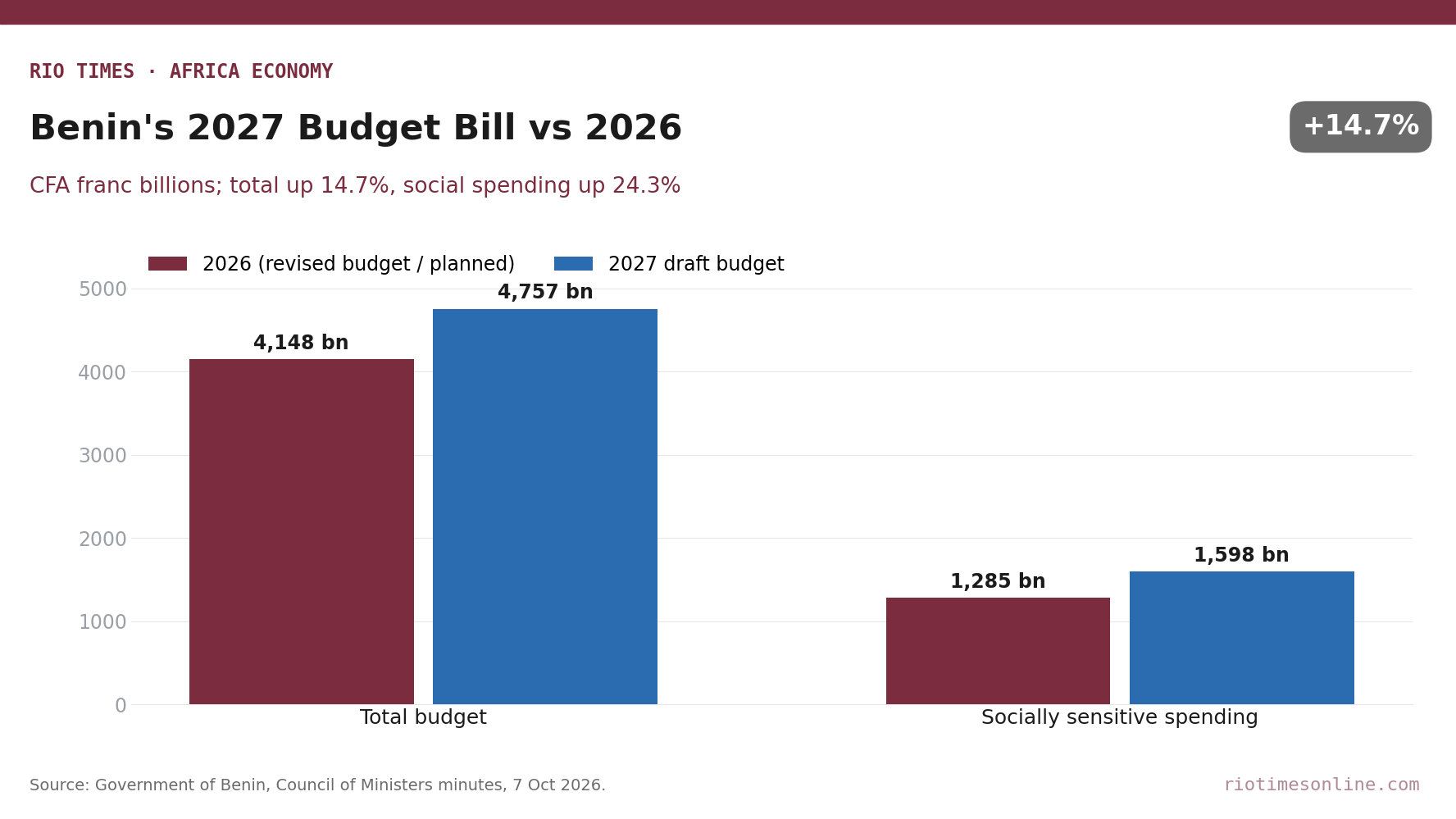
- —What happened The 2027 finance bill totals CFA 4,757 billion (about US$8.1 billion), up 14.7% on the revised 2026 budget.
- —The numbers Deficit target 2.8% of GDP, inflation 2.0%, growth of at least 8%, social spending CFA 1,598 billion (about US$2.7 billion).
- —What it means for US readers A small deficit target supports Benin’s standing with foreign creditors; dollar values move with the euro because of the peg.
- —Still open How the bill will be financed, how much goes to debt service and security, and when deputies will vote.
The Benin 2027 budget sent to parliament this week totals CFA 4,757.029 billion (about US$8.1 billion), a rise of 14.7%. The government of President Romuald Wadagni approved the finance bill on Wednesday 7 October and sent it to the National Assembly in Porto-Novo. For foreign investors, the headline is restraint: a deficit target of 2.8% of GDP despite the bigger envelope.
The figures come from the official minutes of the Council of Ministers, published by the Secretariat General of the Government. They were also reported by the Cotonou news site Bénin Web TV. The comparison base is the revised 2026 budget of CFA 4,148.357 billion (about US$7.1 billion).
Dollar values here use the fixed BCEAO peg of CFA 655.957 per euro and the European Central Bank reference rate of US$1.1206 per euro on Friday 9 October. That works out at roughly CFA 585 per US dollar.
What the Government Is Promising
The minutes say the bill aims to consolidate strong, inclusive and lasting growth while eradicating extreme poverty. It assumes economic growth of at least 8%. It also targets inflation of 2.0%, below the 3.0% ceiling of the West African Economic and Monetary Union (WAEMU).
WAEMU is the eight-nation bloc that shares the CFA franc, issued by the regional central bank, the BCEAO. Its members agree common limits on deficits and inflation. The government says its 2.8% deficit target meets the bloc’s convergence criterion.
Spending is to be organised around five priorities: modern agriculture, industrial promotion, tourism and culture, technology and human capital. Education, health, social protection, energy, water and digital services are to receive a sustained funding effort.
The same meeting created six territorial development poles to steer public investment by region. A Communal Investment Fund is meant to give local councils more resources and access to financing beyond state transfers.
Where the Social Money Goes
Spending the government classes as socially sensitive rises to CFA 1,597.533 billion (about US$2.7 billion). That compares with CFA 1,285.37 billion (about US$2.2 billion) planned for 2026, an increase of about 24%. It is roughly a third of the whole bill.
The flagship is ARCH, the Insurance for Strengthening Human Capital programme, which the government wants to extend. GBESSOKE, a scheme of cash transfers to extremely poor households for small income-generating activities, is to be scaled up.
The bill also extends free tuition for girls in general and technical secondary schools. It continues the drive to give every pupil a school meal and plans a national platform for social benefits.
In health, the minutes list five new zone hospitals, the refurbishment of departmental and university hospitals and wider child vaccination. They also promise systematic care for life-threatening emergencies and more work against malaria.
For public servants, the bill plans gradual recruitment of trainee teachers and the start of a reform giving state employees automatic career advancement. Such measures can raise the wage bill over time, a risk to the deficit goal.
What It Means for US Readers
Benin is small, but it borrows abroad, and foreign lenders watch its deficit closely. Its latest deal is covered in Benin Financing Deal Raises US$563 Million From Banks. A 2.8% deficit target signals that new borrowing needs should stay contained.
For US companies, the spending list points to contracts in hospitals, schools, roads, farming and digital services.
Currency is the other point for anyone pricing the Benin 2027 budget in dollars. The CFA franc is fixed to the euro, not the dollar. If the euro weakens, the dollar value of Benin’s budget falls even if nothing changes in Cotonou.
For background on the new administration and its priorities, see Benin Explained: Wadagni’s New Era, the Cotonou Port Boom and the Jihadist North.
What Is Not Known
The published minutes give the total, the social envelope and the macroeconomic targets. They do not give the split between tax revenue, grants and borrowing, nor the amounts for debt service, defence or security in the north.
There is also a gap on growth. Bénin Web TV reported a growth assumption of 7.5%, while the official minutes say at least 8%. This article uses the official figure.
Deputies are convened on 19 October for the budget session, Bénin Web TV reported. The date of the final vote on the Benin 2027 budget, and any changes deputies make, are not yet known.
Frequently Asked Questions
How big is the Benin 2027 budget?
The finance bill totals CFA 4,757.029 billion, about US$8.1 billion at the 9 October euro rate, up 14.7% from the revised 2026 budget of CFA 4,148.357 billion.
When was the bill approved and sent to parliament?
The Council of Ministers, chaired by President Romuald Wadagni, sent it to the National Assembly on Wednesday 7 October 2026. Deputies are convened on 19 October, Bénin Web TV reported.
What deficit and growth does it assume?
A deficit of 2.8% of GDP, inflation of 2.0% and economic growth of at least 8%, according to the official minutes.
How much goes to social spending?
Socially sensitive spending is set at CFA 1,597.533 billion, about US$2.7 billion, up from CFA 1,285.37 billion planned for 2026.
Why does the euro matter for Benin’s budget?
Benin uses the CFA franc, which is fixed at 655.957 per euro, so its dollar value rises and falls with the euro.
Sources: Secretariat General of the Government of Benin, Compte rendu du Conseil des ministres du 7 octobre 2026; Bénin Web TV, Au Bénin, le projet de budget 2027 bondit de 14,7 % à 4 757 milliards FCFA, 10 October 2026; Bénin Web TV, Conseil des ministres du 7 octobre; European Central Bank, euro reference rates, 9 October 2026.
This article was produced by The Rio Times’ automated newsroom system. How we use AI · Report an error · Editorial responsibility: Matthias Camenzind, Editor-in-Chief
Part of our ongoing coverage
Africa: The New Scramble — the great-power contest over the continent.