
CENTRAL BANKS · UGANDA
Key Facts
- —The country Uganda is a landlocked East African country of about 46 million people that imports its fuel and whose biggest exports are gold and coffee.
- —Why it matters A weaker shilling and dearer fuel threaten to push inflation above target. Higher rates raise borrowing costs for firms and households across the economy.
- —Why now The Monetary Policy Committee met in a special session on Wednesday, 14 October, outside its regular schedule, after the shilling slid to multi-year lows.
- —What happened Uganda’s central bank raised its Central Bank Rate by 225 basis points, from 9.75% to 12%, on Wednesday, 14 October.
- —The numbers Headline inflation rose to 4.6% in September and is now forecast at 7% to 7.5% over the next 12 months. The growth forecast for 2026/27 fell to 6% to 6.5%.
- —What it means for you Ugandan bonds now pay more, which may draw back foreign investors. Imported goods and loans in Uganda are likely to cost more in the months ahead.
- —Still open When commercial banks pass on the hike, and whether the shilling’s rebound on Wednesday holds, is not yet clear.
The Bank of Uganda raised its Central Bank Rate to 12% on Wednesday, 14 October, lifting it from 9.75% at a special meeting. The 225-basis-point increase aims to stop a sliding shilling and dearer fuel from pushing up prices across the economy.
For US investors, the move makes Ugandan government bonds pay more just as capital inflows had weakened. It also signals that the central bank will defend the currency even at some cost to growth.
The Monetary Policy Committee, the bank’s rate-setting panel, normally meets in February, May, August and November. The bank says special meetings may be called when economic developments warrant them, as happened this week.
Why the Bank of Uganda Raised Rates Now
In its October monetary policy statement, the bank blamed the escalating conflict in the Middle East for a sharp deterioration since August. The fighting has disrupted shipping routes and energy infrastructure, raising oil prices, freight charges and insurance costs.
“These developments have adversely affected the current account deficit and increased exchange rate volatility,” the bank said, as quoted by ChimpReports. It added that the resulting depreciation pressures could amplify inflation and required a tight monetary policy stance.
Uganda’s current account deficit widened by US$1.4 billion to US$4.6 billion, according to the statement. Lower coffee and cocoa prices, weaker tourism receipts and higher oil import costs drove the gap.
The goods deficit rose to US$2.8 billion in the 12 months to August, from US$2.4 billion a year earlier. The services deficit grew to US$3.3 billion from US$2.2 billion, largely because of higher freight charges.
Higher remittances from Ugandans abroad offered some relief, lifting the secondary income surplus to US$3.1 billion from US$2.7 billion. That cushion was not enough to offset weaker capital inflows as higher rates abroad drew money away.
“The resulting depreciation, together with elevated international oil prices, has raised domestic fuel pump prices,” the bank said. Uganda has no oil refinery and imports its fuel, so fuel costs feed quickly into transport and food prices.
Inflation Is Still Low but Rising
Headline inflation rose to 4.6% in September from 4.1% in August, driven by food crop prices and fuel costs. Core inflation, which strips out volatile items, climbed to 3.7% from 3.5% in August and 3.0% in May.
“This steady rise indicates that cost pressures are beginning to spread more broadly,” the bank said. Over the 12 months to September, headline inflation still averaged a moderate 3.4% and core inflation 3.3%.
The outlook is much worse, however, because the bank now expects headline inflation of 7% to 7.5% over the next 12 months. Core inflation is projected at 5.5% to 6%, above the bank’s medium-term target of 5%.
“The fuel shock seems persistent,” the bank warned, adding that it could combine with depreciation and El Niño weather to entrench inflation. Raising rates early is meant to stop those pressures from becoming permanent.
The hike follows an earlier tightening step on the banking system. The bank had already raised the cash reserve requirement for commercial banks to 13.5% from 11%, effective Thursday, 24 September.
After Wednesday’s decision, the band around the policy rate stays at plus or minus two percentage points, or 10% to 14%. Nile Post, a Ugandan news site, reports that the rediscount rate now stands at 15% and the bank rate at 16%.
Growth Forecast Cut as Shilling Rebounds
The bank lowered its growth forecast for the 2026/27 financial year to between 6% and 6.5%, from 7% to 7.5% previously. It estimates growth slowed to 6.4% in the quarter to September, from 6.8% in the quarter to June.
That trade-off is the price of the hike, since dearer credit can slow private investment in the short term. The bank still expects growth to average about 8% over the medium term as oil production approaches and exports strengthen.
Markets reacted quickly on Wednesday. The central bank’s own indicative mid rate moved from about 4,130 shillings per US dollar at the opening to about 3,951 at the close.
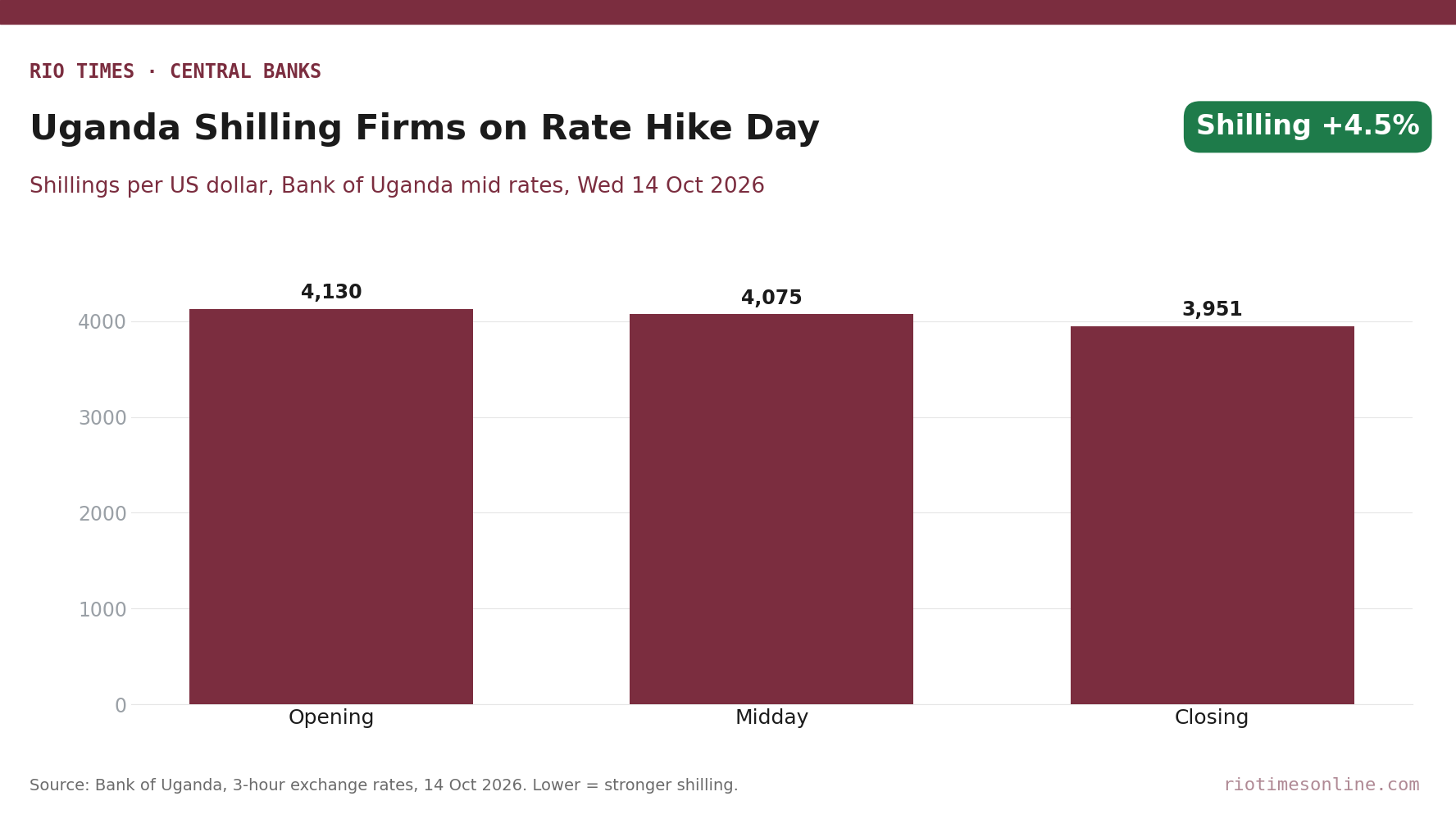
That is a gain of about 4.5% for the shilling in a single session. The Daily Monitor, a Kampala newspaper, had reported on 5 October that the currency had sunk to its weakest level on record.
What It Means for US Readers
For US funds that hold East African debt, a 12% policy rate makes Ugandan Treasury bills and bonds more attractive. A steadier shilling would also protect the dollar value of those holdings after recent losses.
For US companies operating in Uganda, local borrowing will become more expensive once commercial banks adjust their lending rates. Importers of US goods face a currency that is stronger after the hike but still volatile.
US coffee buyers have a stake too, because coffee is Uganda’s largest agricultural export and its prices have fallen. Weaker coffee earnings are one reason the bank cited for the wider current account deficit.
Travellers and expatriates paid in dollars have recently seen their money stretch further in Uganda. If the shilling keeps recovering, that advantage will shrink, while local prices may rise as fuel costs filter through.
For background on the country, read Uganda Explained: Museveni’s Uganda, the Long Wait for Oil, the Economy and What to Watch. For the trade picture, see Uganda Trade Deficit Hits Record US$1.14 Billion.
What Is Not Known
We could not find the full October monetary policy statement on the central bank’s website by Wednesday evening. The quotations here come from the statement as published by Ugandan outlets.
It is not yet known how quickly commercial banks will raise their own lending rates, or by how much. It is also unclear whether one day’s rebound in the shilling will last once the immediate shock fades.
The committee said it remains ready to take further action to preserve price and financial stability. Its next scheduled meeting would normally fall in November, but no date has been confirmed in what we reviewed.
Frequently Asked Questions
What did the Bank of Uganda decide on 14 October?
It raised the Central Bank Rate by 225 basis points, from 9.75% to 12%, at a special meeting. The aim is to contain inflation driven by a weaker shilling and higher fuel prices.
Why did Uganda’s central bank hold a special meeting?
The bank said the Middle East conflict had sharply worsened external conditions since August. The shilling had fallen to multi-year lows, raising the risk of faster inflation.
How high is inflation in Uganda?
Headline inflation was 4.6% in September and core inflation 3.7%. The bank expects headline inflation of 7% to 7.5% over the next 12 months.
How did the shilling react to the rate hike?
The central bank’s mid rate moved from about 4,130 to about 3,951 shillings per US dollar during Wednesday. That was a gain of about 4.5% for the shilling.
What does the rate hike mean for US investors?
Ugandan government bonds now offer higher yields, which may attract foreign investors back. Borrowing in Uganda will become dearer, and growth is forecast to slow to 6% to 6.5%.
Sources: Nile Post; ChimpReports; Bank of Uganda exchange rates, 14 October 2026; Bank of Uganda money market rates; Bank of Uganda monetary policy; Daily Monitor.
This article was produced by The Rio Times’ automated newsroom system. How we use AI · Report an error · Editorial responsibility: Matthias Camenzind, Editor-in-Chief
Part of our ongoing coverage
Africa: The New Scramble — the great-power contest over the continent.