Argentina Country Risk Climbs to 635 Points as the IMF Backs Milei’s Programme
ECONOMY · ARGENTINA
Key Facts
- —The country Argentina is South America’s second-largest economy, run since December 2023 by President Javier Milei, whose programme rests on a fiscal surplus and an IMF loan.
- —What happened Argentina’s country risk rose 29 points to 635 basis points by 12:10 Buenos Aires time on Thursday 1 October 2026, Infobae and Ámbito reported.
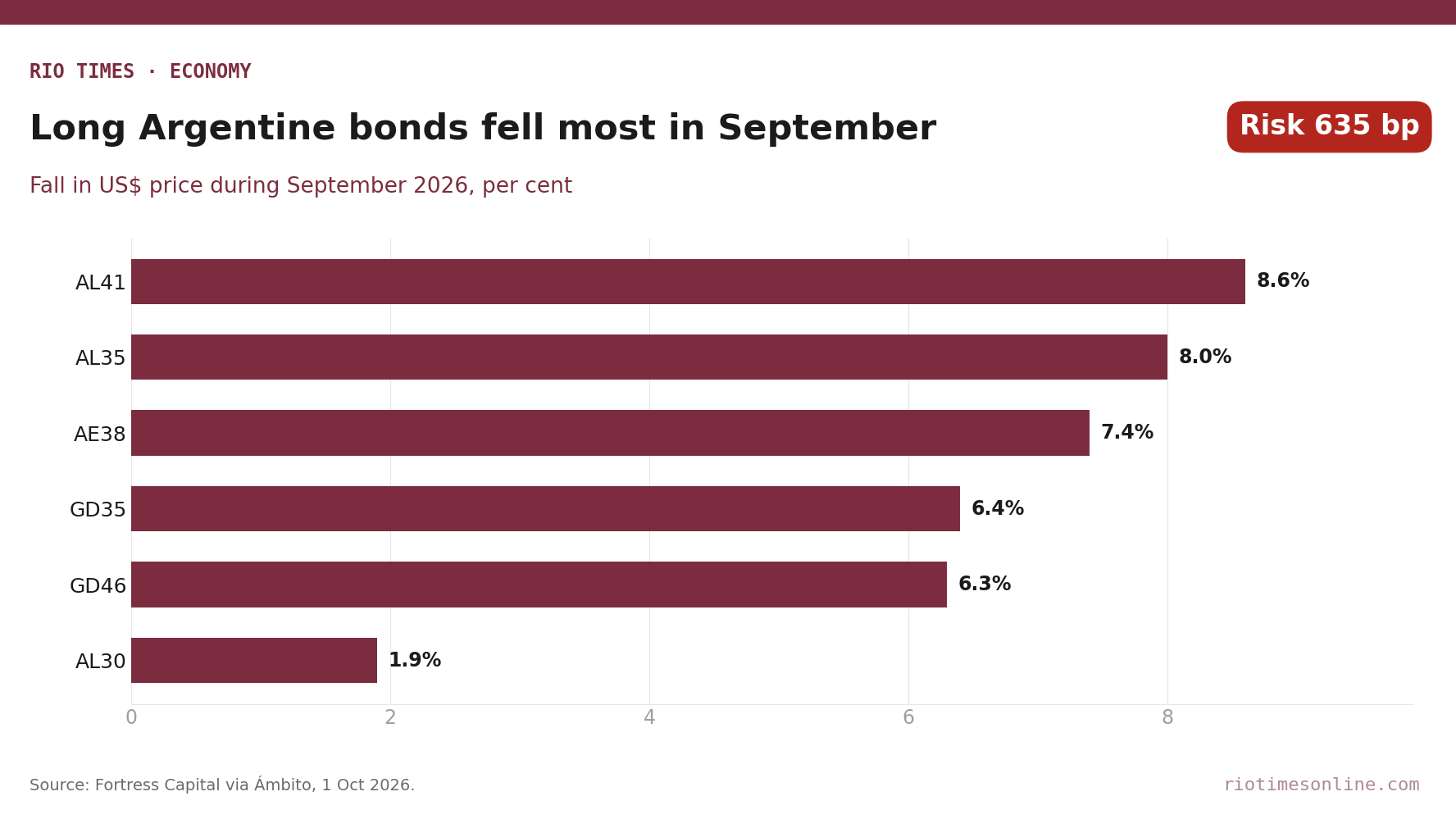
- —The numbers The index jumped almost 100 points in September, Ámbito reported. Long dollar bonds lost up to 8.6% that month; the Merval share index fell 2.4% on 1 October.
- —What it means for you A spread above 600 points keeps Argentina shut out of global debt markets, Ámbito noted. Holders of long bonds carry most of the swing; short bonds held up better.
- —Still open A staff-level deal on the IMF’s third programme review is pending as of 1 October. Whether Argentina needs a waiver for the fiscal target is unconfirmed.
Argentina country risk climbed to 635 basis points on Thursday 1 October, up 29 points by midday. The index, compiled by JP Morgan, measures the extra yield Argentine dollar bonds pay over US Treasuries.
The jump came as the IMF (International Monetary Fund) restated its support for President Javier Milei’s programme. Economy Minister Luis Caputo, speaking in Paris, told investors the real risk was missing the chance to invest.

Where the country risk stands
Infobae put the reading at 635 points at 12:10 local time, citing the JP Morgan index. Ámbito reported the same level, later headlining that the spread was nearing 640 points.
Argentina country risk had dipped on Tuesday after 11 straight daily rises, Ámbito reported. It still ended September almost 100 points higher, after an earlier reading above 600 points pushed the Merval lower for a fifth session.
The Merval, the Buenos Aires stock index, fell 2.4% on Thursday. Dollar bonds lost about 0.6% on average, according to Infobae.
Why bonds are falling
Part of the pressure is global. The ten-year US Treasury yield reached 5.30% on Thursday, its highest in two decades, Infobae reported.
Analysts at Fortress Capital, quoted by Ámbito, also cite worry about the 2027 presidential election. Bonds maturing after the vote fell hardest in September, while short bonds lost about 1%.
The stabilisers are real, though. The central bank (BCRA) has bought about US$14.55 billion in 2026, above the US$10 billion pledged to the IMF, Infobae reported.
Live Market IntelligenceArgentina — Live Market Board
Rio Times · Live Market Intelligence
Argentina — Live Market Board
-1.33%
185,121.99
-0.65%
64,214.36
-1.38%
10,880.60
-0.81%
2,781,799
-1.33%
2,537.48
-0.46%
59,831.84
-0.49%
| Instrument | Last | Change | YoY | Prev. | High | Low | Volume |
|---|---|---|---|---|---|---|---|
| MERVAL | 2,781,799 | -1.33% | +30.51% | 3,022,485 | 3,042,365 | 2,991,150 | — |
| USD/ARS | 1,493 | +0.10% | +12.96% | 1,491 | 1,494 | 1,480 | — |
| YPF | 7,810 | +0.26% | +72.84% | 7,790 | 7,850 | 7,600 | 1,763,858 |
| GGAL | 6,980 | -0.78% | +1.82% | 7,035 | 7,115 | 6,920 | 1,564,062 |
| PAMPA | 5,115 | +0.69% | +26.70% | 5,080 | 5,140 | 5,000 | 721,190 |
| TXAR | 747.50 | -2.35% | +18.67% | 765.50 | 770.00 | 742.50 | 771,892 |
| ALUAR | 938.00 | -1.21% | +29.83% | 949.50 | 951.00 | 932.50 | 135,426 |
| TGS | 8,870 | -0.17% | +15.05% | 8,885 | 9,075 | 8,720 | 143,546 |
| CEPU | 2,156 | +1.84% | +28.36% | 2,117 | 2,165 | 2,086 | 404,146 |
| MIRGOR | 1,650 | -1.20% | -92.90% | 1,670 | 1,670 | 1,635 | 20,877 |
| COME | 40.93 | -0.73% | -30.47% | 41.23 | 41.60 | 40.50 | 4,258,884 |
| LOMA NEGRA | 3,130 | +0.08% | +5.80% | 3,128 | 3,205 | 3,090 | 182,992 |
| BYMA | 275.00 | -1.70% | +35.14% | 279.75 | 282.50 | 272.00 | 1,409,575 |
| TELECOM ARG | 4,233 | -0.70% | +55.19% | 4,263 | 4,335 | 4,160 | 31,896 |
| GLOBANT | 38.10 | -2.26% | -49.65% | 38.98 | 38.70 | 36.77 | 793,552 |
| MERCADOLIBRE | 1,870 | -3.59% | -20.71% | 1,940 | 1,927 | 1,870 | 329,640 |
What the IMF said
IMF spokesperson Julie Kozack told reporters in Washington on Thursday that Argentina had made significant progress in restoring stability. She cited falling inflation, rebuilt reserves and a move from deficit to fiscal surplus.
She also said growth, so far concentrated in energy, mining and farming, should spread to other sectors and workers. Talks will continue towards a staff-level agreement on the third review, Ámbito and Infobae reported.
The review is part of the US$20 billion programme agreed in 2025. Kozack said falling tax revenue would be discussed between staff and the authorities.
The missed fiscal target
The central government ran a first-half primary surplus of ARS 6.29 trillion (about US$4.13 billion), Ámbito reported. That fell short of the ARS 6.86 trillion (about US$4.50 billion) target, at ARS 1,524 per US$ on 30 September.
Official sources blamed postponed income-tax deadlines, according to Ámbito. The central bank overshot its reserve target, helped by a revaluation of gold and a target eased in May.
In Paris, Caputo did not dwell on the shortfall. “We prepare as if we were wrong,” he said, adding the government had to “prepare for the worst”, Infobae reported.
“The risk is not in the elections in Argentina. The risk is not in the exchange rate,” he told about 700 people. “The risk is in missing the opportunity to invest in Argentina.”
What Is Not Yet Known
It is not confirmed whether Argentina will request a formal waiver for the fiscal miss. Ámbito reported one might be sought to release about US$800 million, a figure other outlets put higher.
No date has been set for the staff-level agreement. Infobae reported the deal could reach the IMF board before the end of November.
Sources: Infobae, markets report, IMF briefing and Caputo in Paris (1 Oct 2026); Ámbito, markets report and IMF briefing (1 Oct 2026).
In depth
Read More from The Rio Times